

Maddy summaryThis bill reauthorizes the Project Safe Neighborhoods program, which helps local law enforcement reduce violent crime, through fiscal years 2024-2028. It allows funding to be used for hiring crime analysts, covering overtime for officers and prosecutors, and purchasing crime-fighting technology. The bill also requires the Attorney General to annually report to Congress on how funds are spent, prosecution outcomes, community outreach, and specific violent crime statistics (like murder and assault) in each participating area. This directly affects all 94 federal judicial districts across the U.S. and their law enforcement partners.
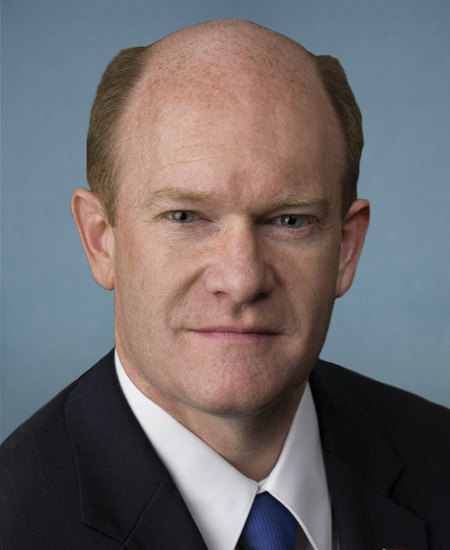
Sen. Christopher A. Coons
Sponsored bills
Maddy summaryThe Strong Communities Act of 2023 creates a new grant program (COPS Strong Communities Program) under the Omnibus Crime Control Act. It provides competitive federal grants to local law enforcement agencies to cover training costs for officers and recruits at eligible entities like colleges or police departments, with the requirement that participants serve full-time in their local communities for at least four years within specified distances from their long-term residence. If participants don't complete this service, they must repay the training benefits, though regulations will allow for exceptions due to extenuating circumstances. This directly affects local law enforcement agencies, officers, and recruits who participate in the training program.
Maddy summaryThe Promotion and Expansion of Private Employee Ownership Act of 2023 aims to increase employee ownership in S corporations by making it easier for companies to adopt Employee Stock Ownership Plans (ESOPs). Key provisions include extending tax deferral for sales of company stock to ESOPs, creating a Treasury Department office to provide technical assistance for ESOPs, and amending small business laws to ensure ESOP-owned businesses remain eligible for small business programs. The bill also establishes a dedicated Advocate for Employee Ownership within the Department of Labor to promote ESOP adoption, provide education, and help resolve disputes related to ESOPs. This legislation directly affects S corporations considering employee ownership transitions, their employees who would become partial owners, and small businesses that want to maintain eligibility for small business programs after an ESOP transition. The bill seeks to expand a model that studies show provides employees with retirement savings and greater job stability compared to traditional companies.
Maddy summarySCONRES 2 is a symbolic congressional resolution commending Iranian protesters who risked their safety to demonstrate against the Iranian regime's human rights abuses, particularly following the death of Mahsa Amini after her arrest by morality police for alleged hijab violations. It specifically highlights protests in over 133 cities where demonstrators, including women removing headscarves, have faced violent crackdowns, with reports of over 500 deaths and 19,000 arrests. The resolution condemns the regime's brutality, supports internet freedom tools to bypass censorship, and urges the administration to impose human rights sanctions on officials responsible for repression. As a non-binding resolution, it expresses congressional support for protesters but does not enact new laws or policies.
This resolution recognizes the 30th anniversary of the founding of the Department of Defense State Partnership Program and its outsized influence in developing and supporting enduring relationships around the world. The resolution also expresses deep gratitude for the service of members of the National Guard to the program.
Maddy summarySRES 20 is a Senate resolution condemning the February 1, 2021, military coup in Burma (Myanmar) and the Burmese military's detention of civilian leaders, including State Counsellor Aung San Suu Kyi. It calls for the immediate, unconditional release of all detained political prisoners, restoration of the elected parliament, and accountability for military violence that has killed over 2,800 civilians since the coup. The resolution urges the U.S. government to impose targeted sanctions on the military junta, support democratic restoration, and coordinate with international partners to address humanitarian needs. As a non-binding resolution, it expresses the Senate's position but does not enact new laws or policies.
Maddy summaryThe DOULA for VA Act of 2023 establishes a 5-year pilot program to provide doula support services to pregnant and postpartum veteran women enrolled in the VA healthcare system. It directs the VA to offer up to 10 doula sessions per veteran - including three to four sessions before birth, one during labor, and three to four postpartum sessions via VA Video Connect - through the Whole Health model. The program targets VA facilities with high or low female veteran enrollment and prioritizes consultation with veteran groups, doulas, and health equity experts. The VA must report annually on outcomes and recommend whether to expand the model, with funding authorized through 2029 and a $3,500 per veteran payment cap for services.
Maddy summaryS 2496, the VALID Act of 2023, amends disclosure requirements for FHA-insured loans. It requires lenders to include specific information about VA loans - specifically the loan-to-value ratio and VA loan details assuming prevailing interest rates - when discussing FHA loans. This change directly affects borrowers applying for FHA-insured mortgages by providing clearer comparative information about VA loan options. The bill does not alter VA loan eligibility or require lenders to verify borrower eligibility for VA loans. The key provision is a mandatory update to existing disclosure language under the National Housing Act.
Maddy summary# Summary of Proposed Election Reform Legislation This comprehensive legislative document outlines a wide-ranging election reform bill with multiple titles addressing various aspects of voting rights, election administration, and election integrity. Key provisions include: 1. **Democracy Restoration** (Title I): - Restores voting rights for citizens with criminal convictions (except those serving felony sentences in correctional institutions) - Requires states to notify individuals of restored voting rights upon completion of sentence or release from custody - Includes enforcement mechanisms for states to comply with the restoration provisions 2. **Voter Identification Requirements** (Title II): - Establishes a standardized system for voter identification requirements - Specifies acceptable forms of identification (including many government-issued documents) - Requires states to provide free identification documents to eligible voters - Includes funding ($5 million annually for 5 years) to cover costs 3. **Voter List Maintenance** (Title III): - Prohibits "voter caging" (using undeliverable mail to challenge voter eligibility) - Requires states to verify voter ineligibility using objective and reliable evidence - Limits removal of voters from registration lists to specific circumstances (death, permanent move) - Mandates notice requirements for voters removed from lists 4. **Election Integrity** (Title IV): - Prohibits interference with voter registration (Section 612) - Restricts removal of local election administrators to cases of inefficiency, neglect, or malfeasance - Prohibits harassment and intimidation of election workers - Bans deceptive practices in elections (false information about voting procedures, qualifications, or endorsements) The legislation aims to expand voting access while maintaining election integrity, with specific focus on eliminating barriers for people with criminal convictions, ensuring fair voter list maintenance, and protecting election workers from harassment and intimidation. It also includes provisions for enforcement through civil actions, criminal penalties, and reporting requirements.
Maddy summaryS 2477 (Equitable Community Access to Pharmacist Services Act) expands Medicare Part B coverage to include specific pharmacist services previously only covered when provided by physicians. It directly affects Medicare beneficiaries and pharmacists by allowing coverage for services like evaluating patients for COVID-19, flu, or respiratory illnesses, and addressing public health emergencies - provided pharmacists are licensed or operating under federal emergency authority. The bill establishes payment at 80% of the lesser of actual charge or 85% of physician payment rates (100% during federal emergencies) and prohibits balance billing for these services. It also clarifies that existing Medicare enrollment pathways for pharmacists remain available. This bill modifies Medicare Part B coverage under the Social Security Act without restricting current pharmacy reimbursement options.