

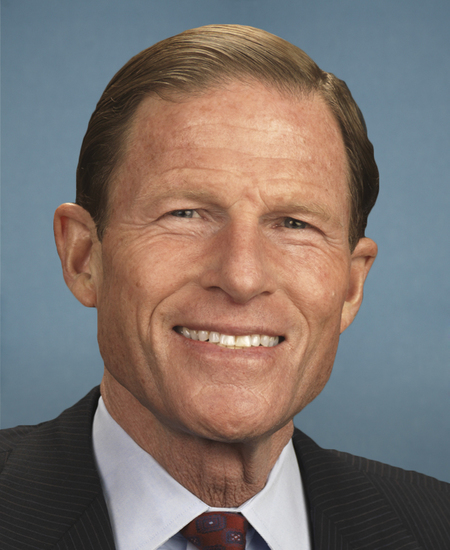
Photo of Richard Blumenthal
D United States Senate · Connecticut

Sen. Richard Blumenthal

Compare
Total votes
1,054
all sessions
Attendance
100%
1 missed
Higher than 82% of chamber peers
With party
97%
of cast votes
Near the chamber average
Bipartisan score
2%
crosses aisle rarely
Near the chamber average
Sponsored
2,861
bills & resolutions
Higher than 99% of chamber peers
Committees
14
assignments
2,861 bills and resolutions

Sponsored bills

Total
2,861
Primary
330
Co-sponsor
2,531
This page
2,861
matching current filters
Co-sponsor S 1467
Passed · United States Senate · Co-sponsor
Homebuyers Privacy Protection Act

Maddy summaryThis bill restricts how credit bureaus share consumer credit reports during mortgage applications. It limits sharing with third parties unless the request is for a firm mortgage offer or the recipient is the loan originator, servicer, or a bank holding the consumer's account. The law directly affects consumers (by limiting data sharing), credit bureaus (requiring new compliance), and mortgage lenders/banks (with restricted access). Key provisions require explicit consumer authorization for sharing and prevent broad data use during prescreening for home loans.

Passed Jun 17, 2025 1 co-sponsor
Co-sponsor S 2083
In committee · United States Senate · Co-sponsor
Pay Our Correctional Officers Fairly Act

Maddy summaryThis bill adjusts pay rates for Bureau of Prisons correctional officers working in the "Rest of U.S." pay locality. It requires these employees to be paid based on the nearest other pay locality within 200 miles that offers a higher wage, rather than the standard "Rest of U.S." rate. For employees in specific "covered" wage areas, the bill mandates payment at the highest applicable rate within their region. The changes apply to pay periods starting 180 days after the bill's enactment.

In committee Jun 12, 2025 1 co-sponsor
Primary S 2072
In committee · United States Senate · Lead sponsor
MORE Savings Act

Maddy summaryThe MORE Savings Act eliminates copays and deductibles for opioid treatment under Medicare, private health plans, and Medicaid. It requires Medicare beneficiaries to have no out-of-pocket costs for opioid treatment drugs, behavioral health services, and recovery support (like peer counseling and transportation). Private health plans must cover these services without cost-sharing starting in 2027, and Medicaid states get a 90% federal match for medication-assisted treatment. The bill directly affects Medicare beneficiaries, private insurance enrollees, and Medicaid recipients seeking opioid use disorder treatment.

In committee Jun 12, 2025 0 co-sponsors
Co-sponsor S 2084
In committee · United States Senate · Co-sponsor
Medicare and Medicaid Dental, Vision, and Hearing Benefit Act of 2025

Maddy summaryThis bill would add dental, vision, and hearing services to Medicare coverage for beneficiaries. It defines specific services including routine dental cleanings, eye exams, and hearing assessments, with coverage gradually increasing from 0% to 80% over eight years. The bill also establishes frequency limits, such as two dental cleanings per year and one eye exam annually. Medicaid would see increased federal funding (90% FMAP) for these services starting six months after enactment. This legislation directly affects Medicare beneficiaries, particularly seniors and people with disabilities, by expanding access to previously uncovered preventive health services.

In committee Jun 12, 2025 1 co-sponsor
Primary S 2070
In committee · United States Senate · Lead sponsor
Insurrection Act of 2025

Maddy summaryThe Insurrection Act of 2025 establishes specific conditions under which the President may deploy military forces domestically to address insurrections, rebellions, or widespread violence that overwhelm state and local authorities. It requires the President to consult Congress, issue a proclamation ordering lawbreakers to disperse, and submit a detailed report before deployment, with congressional approval needed within 7 days. The bill specifically protects voting rights by requiring that military deployment to address voting rights violations must comply with the Voting Rights Act of 1965. It also prohibits using National Guard members on training or other duty for domestic deployments. This legislation directly affects the President, Congress, state authorities, and military operations.

In committee Jun 12, 2025 0 co-sponsors
Co-sponsor S 2076
In committee · United States Senate · Co-sponsor
HCBS Relief Act of 2025

Maddy summaryThe HCBS Relief Act of 2025 increases federal funding for Medicaid home and community-based services (HCBS) by 10 percentage points (capped at 95%) for participating states during fiscal years 2026-2027. It directly affects states that submit approved applications, Medicaid beneficiaries receiving HCBS, and home health workers by requiring states to use funds to raise wages/benefits for HCBS workers, reduce waiting lists, support family caregivers, and improve service quality. Key provisions mandate that states detail specific activities (like wage increases, paid leave, and equipment purchases) in applications, ensure funds supplement rather than replace state spending, and report on outcomes by 2029. The bill aims to strengthen HCBS access and workforce stability without changing Medicaid eligibility rules.

In committee Jun 12, 2025 1 co-sponsor
Primary S 2071
In committee · United States Senate · Lead sponsor
Disaster Relief Medicaid Act

Maddy summaryThe Disaster Relief Medicaid Act creates a new Medicaid program for survivors of major disasters declared after January 1, 2027. It provides simplified eligibility during a two-year relief coverage period (starting when the disaster is declared), allowing people in affected areas to access medical assistance without meeting standard income requirements. The law includes provisions for continuous eligibility, mental health services, home and community-based care, and 100% federal funding for these services. States must provide streamlined applications and issue special Medicaid cards valid for the entire relief period. It also includes specific protections for children born to survivors and pregnant individuals during the disaster period.

In committee Jun 12, 2025 0 co-sponsors
Co-sponsor S 2073
In committee · United States Senate · Co-sponsor
State Public Option Act

Maddy summaryThe State Public Option Act creates a new Medicaid buy-in option for state residents who are not enrolled in other health insurance plans, beginning January 1, 2026. It establishes limits on premiums (capped at 8.5% of family income) and cost-sharing, while allowing participants to enroll through state health insurance exchanges and access premium tax credits similar to those for private insurance. The bill also requires coverage of comprehensive sexual and reproductive health care services, including abortion services, starting in 2026. Additionally, it includes provisions to improve payment rates for primary care services provided under Medicaid.

In committee Jun 12, 2025 1 co-sponsor
Co-sponsor S 2032
In committee · United States Senate · Co-sponsor
Choose Medicare Act

Maddy summaryThe Choose Medicare Act would create a new Medicare Part E public health plan available in the individual, small group, and large group insurance markets. This plan would provide gold-level coverage with essential health benefits, including reproductive services, and would be offered through health insurance exchanges. The bill establishes premium rates based on market type and geographic area, and creates annual out-of-pocket cost limits starting in 2027 (initially set at $6,700 for 2027). It would directly affect individuals and employers seeking health coverage, particularly those currently in the individual market or small/large group plans who may choose this new public option.

In committee Jun 11, 2025 1 co-sponsor
Co-sponsor S 2029
In committee · United States Senate · Co-sponsor
My Body, My Data Act of 2025

Maddy summaryThe My Body, My Data Act of 2025 requires companies and services handling personal reproductive or sexual health information - such as health apps, clinics, or digital platforms - to only collect, retain, or share this data when strictly necessary for a service a person has requested. It gives individuals the right to access, correct, or delete their data easily (within 15 days, without fees), and mandates clear privacy policies explaining how data is used. The bill also prohibits companies from retaliating against people who exercise these rights, such as by charging higher prices or denying services. Enforcement will be handled by the Federal Trade Commission, with individuals able to sue for violations and seek penalties of up to $1,000 per violation per day.

In committee Jun 11, 2025 1 co-sponsor
Showing 651 to 660 of 2,861 bills
Previous 1 … 65 66 67 … 287 Next