

Maddy summaryS 2561 (Close the Revolving Door Act of 2023) prohibits former members of Congress and congressional staff from lobbying the government for a lifetime or 6 years after leaving office, respectively. It also bans registered lobbyists or foreign agents from joining congressional offices within 6 years of lobbying those offices. The bill creates a public database called "lobbyists.gov" to track lobbying activities and requires lobbying firms with multiple registered lobbyists to report employees who are former lawmakers or senior congressional staff. These provisions aim to increase transparency and limit the movement between lobbying firms and Congress.
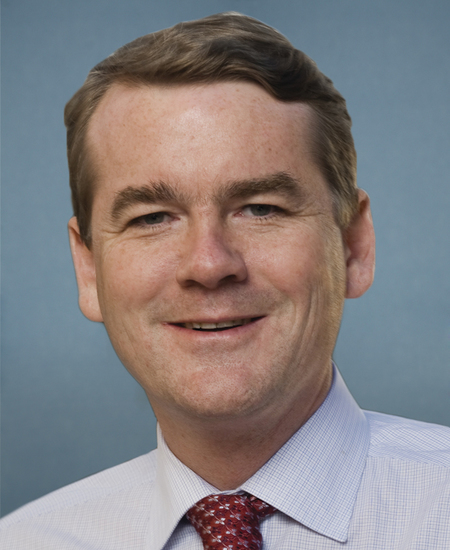
Sen. Michael F. Bennet
Sponsored bills
Maddy summaryThis bill amends the Watershed Protection and Flood Prevention Act to prioritize projects that provide multiple environmental and community benefits. It requires at least 50% of annual funding to go toward "multibenefit works of improvement," defined as projects that provide two or more specific benefits like improved fish habitat, better water quality, water conservation, or flood-risk reduction. The bill ensures that at least 20% of project benefits directly support agriculture or conservation in rural communities, while establishing new definitions for terms like "water conservation" and "multibenefit work of improvement." It also creates new notification requirements for Congress regarding major projects exceeding certain cost thresholds.
Maddy summaryThe EQIP Water Conservation Act of 2023 modifies the Environmental Quality Incentives Program (EQIP) to streamline payments for water conservation practices. It allows the Secretary to waive certain payment limits for contracts focused on water conservation or irrigation efficiency, directly affecting farmers and agricultural entities participating in EQIP. The key provision establishes a new formula to calculate maximum payments, ensuring they don't exceed a set amount based on the number of producers served and excluding prior payments received by those producers or the contracting entity. This change aims to simplify program administration while maintaining fiscal responsibility for water conservation incentives.
Maddy summaryThis bill (S 2647, SHINE for Autumn Act of 2023) provides federal funding to improve stillbirth data collection, research, and education. It authorizes $5 million annually for states to collect stillbirth data using existing health records while protecting privacy, $1 million for developing standardized data collection guidelines and public educational materials, and $3 million for specialized training programs in perinatal pathology and stillbirth research. The bill directly affects state health departments, medical professionals (like obstetricians and pathologists), and families impacted by stillbirth through improved data systems and educational resources. Key provisions require standardized data reporting, consultation with affected families and healthcare providers, and mandatory reports on program progress within five years of enactment.
Maddy summaryS 2706 amends the National Agricultural Research Act to require the USDA Secretary to fund multiyear cooperative agreements (up to 5 years) with eligible research centers for drought-focused policy research. It directs these centers - such as state agricultural experiment stations, universities, or public institutions - to study how policies affect agriculture, rural economies, and drought response, with priority given to centers with drought mitigation expertise. Key activities include supporting the U.S. Drought Monitor, developing drought resilience tools for western U.S. and Tribal lands, and creating communications products to improve drought preparedness. The bill authorizes $19 million for fiscal years 2024-2028 to support this research, aiming to inform federal drought programs without direct beneficiary assistance.
Maddy summaryThe CONNECT Act of 2023 establishes a broadband loan and grant program to expand high-speed internet access in rural communities. It creates technical assistance offices and mini-grants (up to $20,000) to help small providers (serving ≤20,000 subscribers) prepare applications, while prioritizing applications from local governments, nonprofits, and cooperatives. The bill streamlines federal permitting for broadband projects on federal lands and establishes a council to develop uniform speed requirements and application standards for federally funded broadband initiatives. It updates eligibility criteria to target areas without existing broadband service or with stalled projects, directly affecting rural communities, small internet providers, and federal agencies administering broadband programs.
Maddy summaryThis bill increases funding and expands benefits for two key nutrition programs: it raises the senior farmers' market program benefit to $35 per person (removing the previous cap) and increases WIC program benefits from $10 to $35 per person, while also raising income eligibility limits. It allocates $50 million annually (2024-2029) for grants and loans to build or improve farmers' markets in food deserts, requiring at least 50% of market space to sell locally grown food. A separate $7.5 million pilot funds 15 food banks (5 in urban, suburban, and rural areas across all Census regions) to contract with local farmers for produce, prioritizing food-insecure communities. The bill directly affects seniors, low-income families participating in WIC, local farmers, and food banks in underserved areas.
Maddy summaryThe Rural Outdoor Investment Act (S 2604) creates federal grants to fund outdoor recreation projects in rural communities, aiming to spur local economic development. It authorizes $30 million annually (2024-2028) for grants under existing programs, plus $12.5 million annually for a new "Recreation Economy for Rural Communities" grant program. The bill also requires training for rural small businesses and communities on accessing existing federal funding for outdoor recreation projects, including business development, infrastructure, and marketing. These provisions directly support rural areas, small businesses, and local planning efforts through targeted financial resources and capacity-building.
Maddy summaryThe Better CARE for Animals Act of 2023 strengthens enforcement of the existing Animal Welfare Act by requiring dealers and exhibitors to maintain valid licenses for animal sales or transport. It expands enforcement authority for both the USDA and the Attorney General to pursue civil penalties (up to $10,000 per violation per day), seize animals in violation cases, and use penalty funds to cover temporary care costs for animals during legal proceedings. The bill also clarifies that enforcement applies to rules and regulations under the Act, and mandates a new coordination agreement between the USDA and DOJ to address repeat violators. These changes directly affect animal dealers, exhibitors, and federal enforcement agencies, improving accountability for animal welfare violations.
Maddy summarySRES 312 is a non-binding Senate resolution recognizing the role of the Americans with Disabilities Act (ADA) in enabling independent living for people with disabilities and highlighting ongoing challenges like institutional segregation and disparities in healthcare, employment, and accessibility. It calls on federal agencies - including the Departments of Labor, Health and Human Services, Housing, and Transportation - to take specific actions to improve home- and community-based services, accessibility, and economic opportunities for people with disabilities. The resolution emphasizes addressing barriers identified 33 years after the ADA's passage, including pandemic impacts and racial disparities affecting disabled communities. As a symbolic resolution, it does not create new laws or funding but urges bipartisan collaboration and agency action to advance ADA goals.