

Save Our Future Act This bill imposes a fee on certain fossil fuels, including coal, petroleum products, and natural gas. It also imposes fees on fluorinated greenhouse gases imported into the United States and on facilities that emit greenhouse gases from processes other than fossil fuel combustion. The bill provides rebates to middle- and low-income taxpayers equal to $800 ($1,600 for joint returns), plus $300 times the number of taxpayer dependents. The bill directs the Department of the Treasury to provide cost mitigation grants to states and Indian tribes to assist with the transition to a low-carbon economy, assist rural households in reducing energy expenses, and for assistance to displaced coal industry workers. The bill creates an Office of Energy Veterans Assistance. It also provides funds through FY2032 for community assistance programs, including the Appalachian Regional Commission Revitalization Initiative and the Coal Communities Assistance Initiative. The bill provides funds for each fiscal year after FY2022 for assistance to environmental justice communities (i.e., communities most impacted by environmental harms and risks).
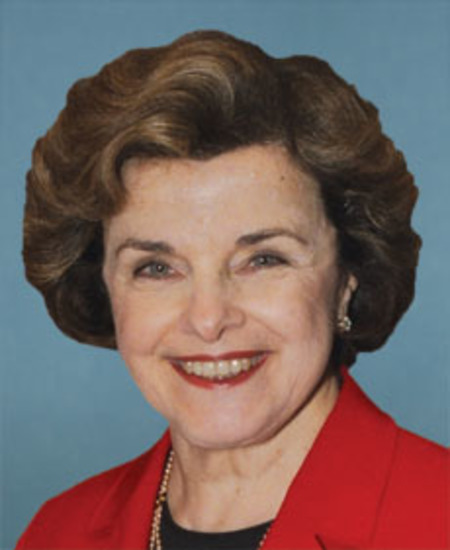
Sen. Dianne Feinstein
Sponsored bills
This resolution condemns the recent rise in anti-Semitic violence and harassment targeting Jewish Americans. The resolution (1) recommits to combating anti-Semitism in all forms; and (2) calls on elected officials, faith leaders, and civil society leaders to denounce and combat all manifestations of anti-Semitism. The resolution urges the President to continue the leadership role of the United States in combating anti-Semitism internationally, advance accurate Holocaust education and counter Holocaust denial and distortion, ensure the physical security of Jewish institutions and organizations, and produce an analysis that accounts for the level and scope of the threat that anti-Semitism poses to the people of the United States. The resolution urges law enforcement agencies to fully participate in the data collection process of the Federal Bureau of Investigation to improve anti-Semitic hate crime data collection.
Children Don't Belong on Tobacco Farms Act This bill prohibits as a form of oppressive child labor the employment of any employee under age 18 who has direct contact with tobacco plants or dried tobacco leaves.
No PFAS in Cosmetics Act This bill requires the Department of Health and Human Services to issue and finalize a rule to ban the use of intentionally added perfluoroalkyl or polyfluoroalkyl substances in cosmetics.
Relief for America's Small Farmers Act This bill provides loan forgiveness of up to $250,000 for certain borrowers who are actively engaged in farming, have an average annual adjusted gross income of $300,000 or less over the previous five years, and have certain Department of Agriculture farm loans. The loan forgiveness is subject to the condition that the applicable borrower must continue to be actively engaged in farming for at least two years after receiving such forgiveness. The bill provides emergency funding for loan forgiveness.
Refund Equality Act of 2021 This bill permits legally married same sex couples to amend their tax returns to file as married filing jointly for returns outside of the statute of limitations.
Basic Assistance for Students In College Act or the BASIC Act This bill directs the Department of Education (ED) to award planning and implementation grants to institutions of higher education in order to identify and meet the basic needs of students, including food, housing, transportation, and health care. ED must also implement an agreement to (1) share data with other federal agencies in order to identify students who may be eligible for certain federal benefits; and (2) coordinate efforts to enroll those students in federal benefits programs, including Medicaid and the Supplemental Nutrition Assistance Program.
Afghan Allies Protection Act of 2021 This bill modifies a program providing special immigrant visas to eligible citizens or nationals of Afghanistan who assisted U.S. efforts there and addresses related issues. The bill extends the program through 2023 and increases the number of visas available. An individual may become eligible for a visa after assisting U.S. efforts in Afghanistan for one year, whereas currently some individuals must have served for two years. Furthermore, for an applicant qualifying for a visa by performing duties with a NATO mission in Afghanistan, the bill eliminates a requirement that the duties performed qualify as sensitive and trusted duties. The bill removes a requirement that the individual has experienced or is facing an ongoing serious threat due to their assistance to the United States or NATO. The Department of State or the Department of Homeland Security may postpone the program's medical examination requirement. An individual who received a postponement must undergo a medical exam within 90 days of admission into the United States. The bill also expands surviving family member benefits for the Afghanistan program (and a similar program for Iraq) to a surviving spouse or child of an individual who submitted an application to the Chief of Mission that would have been approved but for the individual's death. Currently, such survivor benefits only apply if the deceased individual's petition was approved.
This resolution expresses support for the rights, freedoms, and equal treatment of lesbian, gay, bisexual, transgender, and queer (LGBTQ) individuals. The resolution r ecognizes that LGBTQ rights are human rights and protected by the laws of the United States and international treaties. Additionally, the resolution encourages the celebration of LGBTQ Pride Month in June.
Clean Water For Military Families Act This bill requires the Department of Defense (DOD) to conduct investigations into releases of perfluoroalkyl and polyfluoroalkyl substances (PFAS) at or surrounding DOD installations located in the United States, formerly used defense sites, and state-owned facilities of the National Guard. PFAS are man-made and may have adverse human health effects. DOD must also conduct response actions relating to PFAS contamination at the mentioned locations if any detection of PFAS exceeds specified standards for contamination or DOD finds remediation to be appropriate to protect human health or the environment.