

Secure and Fair Enforcement Banking Act of 2021 or the SAFE Banking Act of 2021 This bill generally prohibits a federal banking regulator from penalizing a depository institution for providing banking services to a legitimate cannabis-related business. Prohibited penalties include terminating or limiting the deposit insurance or share insurance of a depository institution solely because the institution provides financial services to a legitimate cannabis-related business and prohibiting or otherwise discouraging a depository institution from offering financial services to such a business. Additionally, proceeds from a transaction involving activities of a legitimate cannabis-related business are not considered proceeds from unlawful activity. Proceeds from unlawful activity are subject to anti-money laundering laws. Furthermore, a depository institution is not, under federal law, liable or subject to asset forfeiture for providing a loan or other financial services to a legitimate cannabis-related business. The bill also provides that a federal banking agency may not request or order a depository institution to terminate a customer account unless (1) the agency has a valid reason for doing so, and (2) that reason is not based solely on reputation risk. Valid reasons for terminating an account include threats to national security and involvement in terrorist financing, including state sponsorship of terrorism.
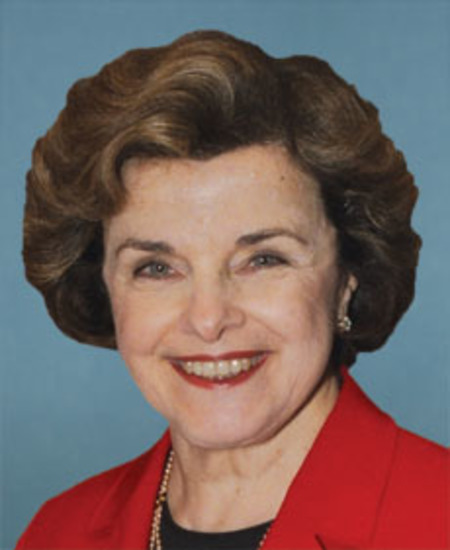
Sen. Dianne Feinstein
Sponsored bills
Smoke-Ready Communities Act of 2021 This bill authorizes the Environmental Protection Agency to make grants to air pollution control agencies to support the development and implementation of programs that support local communities in detecting, preparing for, communicating with the public about, or mitigating the environmental and public health aspects of wildfire smoke.
Smoke Planning and Research Act of 2021 This bill requires the Environmental Protection Agency (EPA) to research and mitigate the impacts of smoke emissions from wildland fires. Specifically, the EPA must establish (1) four Centers of Excellence for Wildfire Smoke at institutions of higher education, and (2) a grant program to support community mitigation efforts.
This bill removes the requirement that an individual transferring a Post-9/11 GI Bill educational assistance entitlement must specify the period for which the transfer must be effective for each dependent who is designated to receive the transfer.
This resolution expresses that the Senate has heard the announcement of the death of the Honorable Jacqueline R. Walorski, Congresswoman for the Second Congressional District of Indiana. The resolution also honors Representative Walorski for her service to Indiana and the United States. The resolution expresses that when the Senate adjourns today, it stands adjourned as a further mark of respect to the memory of Representative Walorski.
Taxing Big Oil Profiteers Act This bill imposes an additional 21% tax through 2025 on the excess profits (i.e., current profits over normal return) of oil and natural gas companies that have average annual gross receipts during a three-year period of over $1 billion. The bill imposes on publicly-traded domestic corporations a tax equal to 25% of the fair market value of the stock of the corporation repurchased during the taxable year. The tax does not apply to a repurchase made after 2025 or that is treated as dividend. It also does not apply if the total value of the stock repurchased during a taxable year does not exceed $1 million. The bill disqualifies certain large oil and natural gas companies from the use of the LIFO (last-in first-out) inventory accounting method.
Preventing a Patronage System Act of 2022 or the PPSA Act of 2022 This bill prohibits executive agency positions in the competitive service from being placed in the excepted service, unless such positions are placed in Schedules A through E as in effect on September 30, 2020. The bill also prohibits positions in the excepted service from being placed in any schedule other than the aforementioned schedules. On October 21, 2020, former President Donald Trump issued an executive order titled Creating Schedule F in the Excepted Service . The order placed executive agency positions that are of a confidential, policy-determining, policy-making, or policy-advocating character, and that are not normally subject to change as a result of a presidential transition, under a new schedule in the excepted service (Schedule F) instead of the competitive service. The order also required any such positions in the excepted service to be reclassified to Schedule F. The order was revoked by President Joe Biden on January 22, 2021.
Let Doctors Provide Reproductive Health Care Act This bill sets out protections for and establishes programs to support health care providers (and those who assist such providers) who offer reproductive health care services that are lawful in the state where the services are provided. Reproductive health care services refer to abortion services; contraceptive services; in vitro fertilization; or other reproductive care, education, and counseling that is provided (1) at a health care site or via telehealth, and (2) in a medically accurate manner. The bill prohibits individuals, entities, and states from preventing, restricting, or otherwise interfering with the provision of lawful reproductive health care services by health care providers. The Department of Justice, individuals, or providers may bring a lawsuit to enforce this bill, and states are not immune from suits for violations. Furthermore, states may not use federal funds to pursue legal cases or similar proceedings (e.g., adverse licensing proceedings) against health care providers, individuals, or entities that offer or assist with lawful reproductive health care services. Additionally, medical malpractice insurers may not deny coverage to or sue a health care provider because the provider offers or assists with lawful reproductive health care services. The bill also funds grants to assist health care providers who offer or refer for abortion services and face legal issues relating to their provision of reproductive health care services with legal matters and improving security.
Equal Access to Contraception for Veterans Act This bill prohibits the Department of Veterans Affairs from requiring payment from a veteran for any contraceptive item that is required to be covered by health insurance plans without a cost-sharing requirement.
Strengthening Welfare in Marine Settings Act of 2022 or as the SWIMS Act of 2022 This bill establishes prohibitions on capturing, importing, exporting, or breeding of orcas, beluga whales, false killer whales, or pilot whales for the purpose of public display. Specifically, the bill prohibits the National Oceanic and Atmospheric Administration from issuing any permit under the Marine Mammal Protection Act of 1972 that authorizes the taking (e.g., capturing) or importation of such orcas or whales for the purpose of public display. The bill further revises the act to make it unlawful to export such orcas or whales, unless they are being transported to marine mammal sanctuaries or for release into the wild. Further, the bill makes it unlawful under the Animal Welfare Act for any person to breed or artificially inseminate such marine mammals for purposes of using their progeny for public display.