

Maddy summaryThis bill prohibits public colleges and universities from denying religious student groups access to campus facilities or official recognition that is available to other student organizations. It directly affects public institutions of higher education and religious student organizations by requiring equal treatment based on the institution's policies for non-religious groups. The key provision states that no federal funds can be withheld from an institution that denies a religious group access to facilities or recognition due to its religious beliefs, practices, speech, leadership standards, or conduct codes. The law applies to all public colleges receiving funds under the Higher Education Act of 1965.
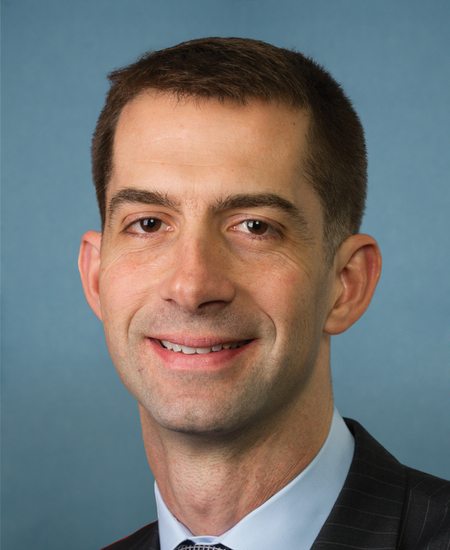
Sen. Tom Cotton
Sponsored bills
Maddy summaryS 973 requires federal contractors to certify they have not used racial hiring quotas in the past five years and prohibits them from implementing such quotas during contract performance. It directly affects all entities awarded federal contracts or subcontracts, including employers covered under specific labor certificates. The bill mandates that contracts include an equal opportunity clause banning race-based hiring systems, while explicitly excluding environmental, social, and governance (ESG), diversity, equity, and inclusion (DEI), and corporate social responsibility (CSR) initiatives from the definition of "national interest." Violations could lead to contract cancellation, termination, or debarment by the Department of Labor.
Maddy summaryThis bill prohibits U.S. federal agencies from using government funds to purchase solar panels made or assembled by entities linked to the Chinese government. It bans such purchases through contracts, grants, and government credit cards within 180 days of enactment, requiring agencies to follow new OMB guidelines. Agencies may request waivers if a Chinese-linked supplier is the only option, but must get approval from the State and Homeland Security Secretaries and report requests to Congress quarterly. The bill also mandates a study on domestic solar manufacturing capacity and a report tracking federal solar panel purchases from covered entities within 275 days. It directly affects federal procurement officers and solar panel suppliers with ties to China’s government.
Maddy summaryThis bill proposes a constitutional amendment to require the U.S. Supreme Court to have exactly nine justices. Currently, Congress sets the Court's size through legislation, but this amendment would make the nine-justice structure a permanent requirement in the Constitution. It would need ratification by three-fourths of state legislatures within seven years to become part of the Constitution. If adopted, it would prevent Congress from changing the Court's size via ordinary legislation.
Maddy summaryThis bill prohibits U.S. defense contracts and critical infrastructure operations (including ports) from using or sharing data with Chinese logistics platforms like LOGINK, a public Chinese transportation network. Starting two years after enactment, the Department of Defense cannot contract with entities using these platforms, and U.S. port operators must stop using or sharing data with them. The President must negotiate with U.S. allies (like Japan, Australia, and NATO members) to get them to ban similar platforms and counter China’s global influence on logistics standards. A report to Congress within one year will assess implementation efforts and potential impacts on military and commercial operations.
Maddy summaryThis bill directs the U.S. Treasury to instruct American representatives at multilateral development banks (like the World Bank and Asian Development Bank) to oppose new loans to China. It is based on findings that China exceeded the income threshold for graduation from development assistance in 2016 and has since received over $20 billion in loans from these institutions. The bill requires annual reports tracking China's borrowing, U.S. voting efforts to end lending to countries that have surpassed graduation thresholds, and the status of China's eligibility. It directly affects China's access to multilateral development financing and the operational policies of these banks.
Maddy summaryThis bill reduces the weight thresholds triggering enhanced federal sentencing for fentanyl and synthetic opioid offenses. It amends the Controlled Substances Act to lower quantities from 400 grams to 20 grams for mandatory minimums (and similar reductions for other penalties), directly affecting individuals convicted of fentanyl-related trafficking. The bill also directs the U.S. Sentencing Commission to update federal sentencing guidelines within 120 days to align with these changes. Additionally, it requires the U.S. Postal Service to increase chemical screening devices, dedicate personnel for 24/7 analysis, and allocates $9 million for interdiction efforts targeting fentanyl and synthetic opioids in mail shipments.
Maddy summaryThis bill amends federal law to mandate the death penalty or life imprisonment for the murder of law enforcement officers. It applies to federal officers (when killed in duty) and state/local officers (when the crime involves interstate commerce or weapons that traveled across state lines). Key provisions require courts to consider specific aggravating factors - such as ambush tactics, prior violence advocacy, or affiliation with extremist groups - when determining sentencing. The bill explicitly states it does not affect state or local jurisdiction over such cases.
Maddy summaryThis bill creates a government list of social media apps and platforms deemed untrustworthy due to foreign government influence. It requires the President to publish an annual list of entities owned or controlled by foreign governments (or acting on their behalf) that have over 1 million monthly users and either altered content for foreign interests or shared U.S. user data with such entities. Once listed, the bill blocks U.S. financial transactions with these entities, forces app stores to remove their apps, and requires internet providers to block access to their websites (with limited VPN exceptions). It also restricts visas for employees of listed entities and mandates foreign agent registration for former employees.
Maddy summaryThis bill prohibits federal, state, and local governments from enforcing any law that restricts the right to possess, carry, or transport firearms unless the law aligns with the U.S.'s historical tradition of firearm regulation. It directly affects states and localities that have enacted gun control measures, such as bans on carrying firearms across state lines or restrictions on commonly used firearms. Key provisions allow individuals or gun rights organizations to sue to block enforcement of such laws and require courts to award attorney fees to successful plaintiffs. The bill also clarifies that state laws offering stronger gun rights protections remain valid and unaffected.