

Maddy summaryThe Combating Violent and Dangerous Crime Act amends federal criminal statutes to clarify legal standards and increase penalties for specific violent crimes. It clarifies that assaults on federal officers are general intent crimes (removing the need to prove defendants specifically intended to harm officers), increases carjacking penalties to 20 years for first offenses (up from 15) and up to 40 years when weapons are used, and creates a new offense for distributing candy-flavored controlled substances to minors with penalties of up to 20 years for repeat violations. The bill also updates sentencing guidelines to require a 2-level enhancement for the new candy-flavored drug offense. These changes apply to existing federal criminal codes without creating new crime categories beyond the specified provisions.
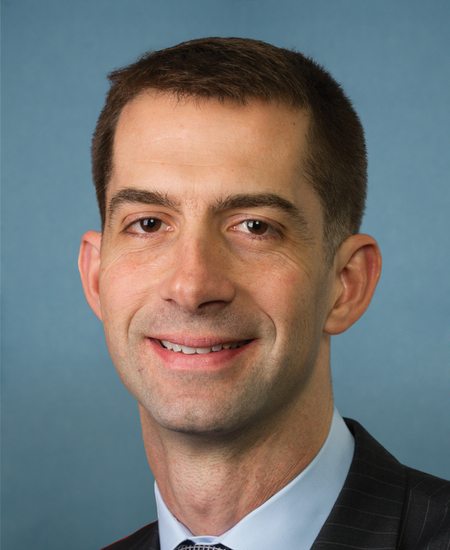
Sen. Tom Cotton
Sponsored bills
Maddy summaryS 1212 establishes federal standards for remote and electronic notarizations, enabling notaries to perform these services across state lines for individuals not physically present. Key provisions require identity verification (using two methods or a credible witness), mandatory audio/video recording of remote notarizations (retained for 5-10 years), and secure attachment of electronic signatures to documents. The bill ensures courts and states recognize these notarizations as valid regardless of whether the notary used electronic records or served a remotely located individual. It does not require notaries to offer these services but creates a uniform baseline for interstate recognition, while allowing states to maintain stricter rules.
Maddy summaryThis bill amends key labor laws to strengthen worker protections and clarify union election processes. It requires employers to provide voter lists for union elections with only one employee-chosen contact detail (like email or phone), mandates secret ballot elections for union representation, and restricts union dues from funding non-representational activities without written employee consent for at least 35 days. The bill also clarifies joint employment standards, making it harder for companies to avoid responsibility for workers' pay and conditions, and adds tribal sovereignty protections to labor law definitions. These changes directly affect employers, unions, and employees in collective bargaining contexts.
Maddy summarySRES 161 is a symbolic Senate resolution designating April 22-30, 2023, as "National Park Week." It does not create new laws or affect specific groups, but formally recognizes the National Park System's significance. The resolution highlights the parks' historical value, visitor impact (312 million visits in 2022), and economic contributions ($42.5 billion in 2021). It encourages public engagement with national parks but contains no funding, regulatory changes, or policy mechanisms. As a procedural resolution, it serves purely to honor the parks' legacy.
Maddy summaryThis bill prohibits healthcare providers and transplant centers from denying organ transplants or related services solely because a person has a disability. It requires covered entities (like hospitals and transplant centers) to make reasonable policy changes - such as involving a patient's support network or providing accessible communication - to ensure qualified individuals with disabilities can access transplants. The law clarifies that providers may only consider a disability medically significant if a physician determines it directly affects transplant success, and it establishes enforcement through the Department of Health and Human Services or lawsuits. The bill does not replace existing disability protections like the ADA but specifies how they apply to organ transplant processes.
Maddy summaryThis bill prohibits federal agencies from banning lead ammunition or tackle for hunting and fishing on federal lands and waters managed by the Interior Department or Agriculture Department. It directly affects hunters and anglers using these public areas by preventing federal restrictions on lead products, except in limited cases. The exception allows restrictions only on specific federal sites where state wildlife data shows lead use is harming wildlife, and only if approved by the state's fish and wildlife agency. The bill requires federal agencies to explain in public notices how any exception meets these state approval and wildlife harm criteria.
Maddy summaryThis bill restricts federal funding for state and local governments that qualify as "sanctuary jurisdictions" under its definition. A sanctuary jurisdiction is defined as any state or local area that prohibits sharing immigration status information or refusing to comply with federal immigration detainers (with an exception for crime victims/witnesses). The bill blocks funding for Economic Development Administration grants and Community Development Block Grants if projects are located in such jurisdictions or if recipients become sanctuary jurisdictions during the grant period. Recipients must return funds if they become sanctuary jurisdictions, and the U.S. government will reallocate those funds to non-sanctuary areas.
Maddy summaryS 1047, the Cellphone Jamming Reform Act of 2023, allows state and federal correctional facilities to use jamming systems to block cell signals from contraband devices or inmates within the facility. The bill restricts jamming to housing areas only, requires states operating such systems to cover all costs, and mandates consultation with local law enforcement before implementation. It also requires facilities to notify the Bureau of Prisons about their use of jamming systems. The Federal Communications Commission (FCC) is prohibited from blocking this specific use of jamming technology, but the law does not authorize jamming outside correctional facilities or for general security purposes.
Maddy summaryThe Protect American Power Infrastructure Act prohibits U.S. operators of defense-critical power systems (like those supporting military facilities) from using high-voltage electrical equipment - such as transformers, circuit breakers, and control systems - manufactured by companies linked to foreign adversaries (e.g., hostile governments) if the equipment poses security risks. The Secretary of Energy, with input from defense and security agencies, can block such transactions or approve them only after requiring security safeguards. The bill also mandates identifying and replacing existing high-risk equipment already in critical defense facilities and establishing a pre-approval system for safe equipment vendors. This directly affects power infrastructure owners, defense facility operators, and foreign-linked equipment suppliers.
Maddy summaryThis bill (SJRES 22) seeks to block a specific rule issued by the Department of Education regarding federal student loan modifications. It targets the rule titled "Waivers and Modifications of Federal Student Loans," which included a one-time debt relief program announced in October 2022. The resolution requests Congress disapprove the rule under the Congressional Review Act, preventing the Department from implementing it. If approved, the rule would have no legal effect, directly affecting how student loan borrowers could access modifications or debt relief under that specific policy.