

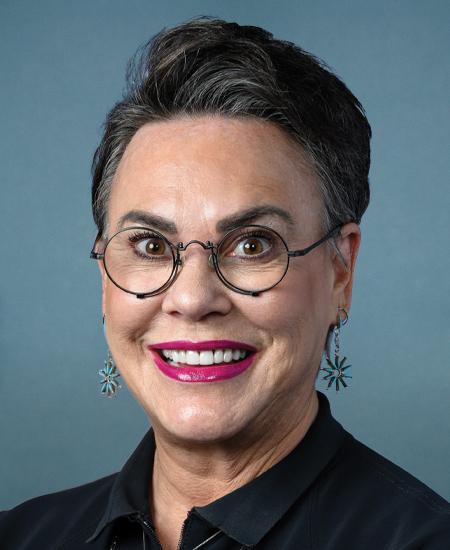
Photo of Harriet M. Hageman
R United States House · District At-Large · Wyoming

Rep. Harriet M. Hageman

Compare
Total votes
1,879
all sessions
Attendance
99%
26 missed
Higher than 89% of chamber peers
With party
90%
of cast votes
Lower than 88% of chamber peers
Bipartisan score
6%
crosses aisle rarely
Higher than 87% of chamber peers
Sponsored
648
bills & resolutions
Near the chamber average
Committees
6
assignments
648 bills and resolutions

Sponsored bills

Total
648
Primary
99
Co-sponsor
549
This page
648
matching current filters
Co-sponsor HR 8753
Passed · United States House · Co-sponsor
To direct the United States Postal Service to designate single, unique ZIP Codes for certain communities, and for other purposes.

Maddy summaryHR 8753 requires the U.S. Postal Service to assign a single, unique ZIP Code to 31 specific communities across 10 states, including Eastvale, CA, and The Villages, FL, within 270 days of the bill's enactment. This change directly affects residents and businesses in these communities by standardizing mail delivery addresses. The key mechanism mandates the USPS to establish one distinct ZIP Code per listed community, replacing any existing multi-part or shared codes. This is a procedural adjustment to improve mail sorting efficiency, not a substantive policy change.

Passed Dec 12, 2024 1 co-sponsor
Co-sponsor HR 5863
Signed into law · United States House · Co-sponsor
Federal Disaster Tax Relief Act of 2023

Maddy summaryThis bill provides tax relief for individuals affected by specific disasters by excluding certain compensation payments from taxable income. It covers wildfire relief payments for losses incurred in federally declared wildfires after 2014 (including expenses like repairs, lost wages, and emotional distress), and payments related to the February 2023 East Palestine, Ohio, train derailment (covering property damage, closing costs, and inconvenience). Payments already covered by insurance or other sources are excluded from this tax benefit. The relief applies to payments received during 2020-2025 for wildfires and from February 2023 onward for the East Palestine incident, with extended deadlines for related tax claims.

Signed into law Dec 12, 2024 1 co-sponsor
Co-sponsor HR 2685
In committee · United States House · Co-sponsor
Mining Schools Act of 2024

Maddy summaryThe Mining Schools Act of 2024 establishes a federal grant program to strengthen domestic mining education by funding eligible schools. It defines eligible "mining schools" as accredited mining/engineering programs at higher education institutions or specific geology/engineering departments at 4-year public universities in states with significant mining-related economic activity. The Department of Energy will award up to 10 competitive annual grants for recruiting students and enhancing programs focused on critical minerals, environmental reclamation, sustainable extraction, and domestic mineral production. An advisory board of industry and academic experts will help select grantees and ensure funds are used as intended. The program is authorized to receive $10 million yearly from 2024 through 2031.

In committee Dec 12, 2024 1 co-sponsor
Co-sponsor HR 5536
Signed into law · United States House · Co-sponsor
Grant Transparency Act of 2023

Maddy summaryThe Grant Transparency Act of 2023 requires federal agencies to clearly disclose how they evaluate competitive grant applications in their funding notices. Specifically, agencies must describe their rating systems, explain any weighted scoring methods (including how much each criterion is weighted), and detail other merit-based evaluation approaches. The law also mandates standardized reporting of basic application data, including the number of applications received and the city/state locations of all submitting organizations. This applies only to future notices of funding opportunity issued after the law takes effect (120 days post-enactment), does not create new funding, and does not override existing legal requirements for specific grant programs.

Signed into law Dec 11, 2024 1 co-sponsor
Primary HR 7375
In committee · United States House · Lead sponsor
Expression of Interest Sensibility Act

Maddy summaryThis bill modifies the Mineral Leasing Act to require fees for "expressions of interest" in federal oil and gas lease sales. It directly affects companies or individuals who submit expressions of interest for land available for oil/gas exploration but do not receive a lease bid. The key provision states that if land covered by an expression of interest is offered at a lease sale with no bids, the first submitter pays a fee; if a bid is successful, the winning bidder pays the fee. Expressions of interest remain active for at least five years unless the land is offered at a lease sale.

In committee Dec 10, 2024 0 co-sponsors
Primary HR 6085
In committee · United States House · Lead sponsor
To prohibit the implementation of the Draft Resource Management Plan and Environmental Impact Statement for the Rock Springs RMP Revision, Wyoming, and for other purposes.

Maddy summaryHR 6085 prohibits the U.S. Department of the Interior from finalizing, implementing, or enforcing the Draft Resource Management Plan and Environmental Impact Statement (RMP/EIS) for the Rock Springs RMP Revision in Wyoming. This bill specifically targets the document published by the Bureau of Land Management (BLM) on August 18, 2023 (88 Fed. Reg. 56654), blocking its use in managing federal lands in that area. The bill does not alter land management policies but prevents the BLM from moving forward with this particular planning process. It directly affects the BLM's administrative actions regarding the Rock Springs planning area in Wyoming.

In committee Dec 10, 2024 0 co-sponsors
Co-sponsor HR 1437
In committee · United States House · Co-sponsor
Black Vulture Relief Act of 2024

Maddy summaryThis bill allows livestock producers and their employees to take black vultures (Coragyps atratus) that are harming or threatening livestock, bypassing the usual protections under the Migratory Bird Treaty Act. It directly affects ranchers and farm workers in areas where black vultures cause livestock deaths or injuries. The key provision requires annual reporting to the U.S. Fish and Wildlife Service about any vultures taken, using a simplified form similar to existing reporting for permitted bird take. This creates a specific, limited exception to federal bird protections for livestock protection, with no new restrictions on vulture populations.

In committee Dec 10, 2024 1 co-sponsor
Co-sponsor HR 7198
Passed · United States House · Co-sponsor
Prove It Act of 2024

Maddy summaryThis bill amends the Regulatory Flexibility Act to require federal agencies to more thoroughly assess how proposed regulations impact small businesses, including indirect costs on businesses that aren't directly regulated but are affected by the rules (e.g., suppliers or partners). It creates a new process allowing small businesses or their representatives to petition the Small Business Administration's Chief Counsel to review an agency's claim that a rule won't significantly affect small entities, with strict timelines for agency responses. If an agency fails to cooperate with this review, the final rule cannot apply to small businesses. Agencies must also publish regulatory guidance online for small businesses to comment on, ensuring greater transparency in rulemaking.

Passed Dec 9, 2024 1 co-sponsor
Co-sponsor HR 10317
In committee · United States House · Co-sponsor
To amend title XIX of the Social Security Act to establish a community engagement requirement for certain individuals under the Medicaid program.

Maddy summaryHR 10317 would require certain Medicaid recipients aged 18-65 (excluding those under 18, over 65, pregnant, caregivers, students, or in treatment programs) to complete 80 hours monthly of community engagement activities - such as working, volunteering, or participating in job training - to maintain coverage. The bill adds new provisions to Medicaid law (Sections 1903(i)(28) and 1905(jj)) defining this requirement and specifying verification methods using existing state databases. States could disenroll individuals who fail to meet this requirement for three consecutive months. This change directly affects non-exempt Medicaid beneficiaries and modifies eligibility conditions under federal Medicaid rules.

In committee Dec 6, 2024 1 co-sponsor
Primary HR 10275
In committee · United States House · Lead sponsor
Regulatory Cooling Off Act of 2024

Maddy summaryHR 10275, the Regulatory Cooling Off Act of 2024, delays the implementation of new federal regulations by requiring agencies to wait at least six months after finalizing a rule before it takes effect. This directly affects federal agencies creating regulations and Congress, which must receive finalized rules six months prior to implementation for potential review. Key provisions include extending the waiting period from 30 days to six months, mandating agencies submit finalized rules to Congress six months before implementation, and requiring agencies to post rules on their websites at least 24 hours before Federal Register publication. The bill aims to provide more time for public and congressional review of new rules before they become active.

In committee Dec 3, 2024 0 co-sponsors
Showing 331 to 340 of 648 bills
Previous 1 … 33 34 35 … 65 Next