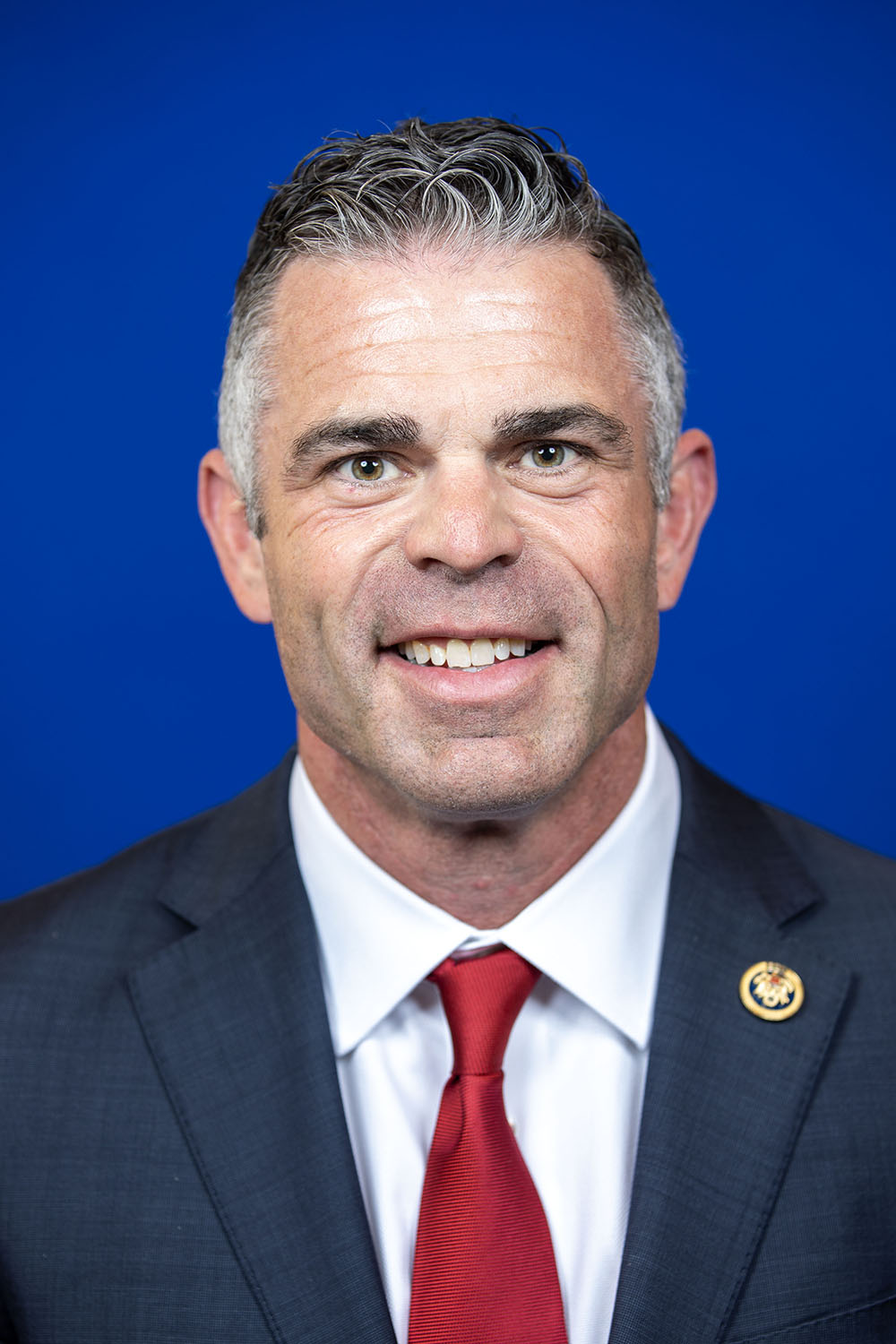
Photo of Tony Wied
R United States House · District 8 · Wisconsin On the 2026 ballot

Rep. Tony Wied

Compare
Total votes
730
all sessions
Attendance
99%
10 missed
Near the chamber average
With party
95%
of cast votes
Near the chamber average
Bipartisan score
2%
crosses aisle rarely
Near the chamber average
Sponsored
265
bills & resolutions
Near the chamber average
Committees
12
assignments
265 bills and resolutions

Sponsored bills

Total
265
Primary
21
Co-sponsor
244
This page
265
matching current filters
Co-sponsor HR 9009
In committee · United States House · Co-sponsor
Firearm Freedom Act of 2026

Maddy summaryThe Firearm Freedom Act of 2026 removes the federal ban on the possession and transfer of machineguns by repealing a specific section of the United States Code. This change would allow individuals who currently possess these weapons to keep them and would enable the legal transfer of machineguns between private citizens. The bill directly affects existing owners of machineguns and would alter the rules governing how these firearms can be sold or given away. By eliminating this restriction, the legislation aims to expand the types of firearms that are legally transferable under federal law.

In committee May 22, 2026 1 co-sponsor
Co-sponsor HR 1993
Passed · United States House · Co-sponsor
25th Anniversary of 9/11 Commemorative Coin Act

Maddy summaryThis bill authorizes the U.S. Mint to produce commemorative $5 gold and $1 silver coins marking the 25th anniversary of the September 11, 2001, terrorist attacks. The coins must feature designs honoring victims and first responders (including the inscription "Never Forget") and will be sold only during 2027-2028. All surcharges ($35 per gold coin, $10 per silver coin) collected from sales will fund the National September 11 Memorial and Museum at the World Trade Center, with no net cost to the federal government. The coins are legal tender but primarily intended for collectors, not circulation.

Passed May 21, 2026 1 co-sponsor
Co-sponsor HR 1329
Failed · United States House · Co-sponsor
Smithsonian American Women’s History Museum Act

Maddy summaryThe Smithsonian American Women’s History Museum Act authorizes the creation of a new Smithsonian museum dedicated to women’s history, to be located within the National Mall Reserve in Washington, D.C. If the site is managed by another federal agency, the bill requires that agency to transfer the land after notifying Congress and relevant committees. The museum must ensure exhibits and programs accurately represent diverse women’s experiences by consulting a broad range of experts and community voices. The Smithsonian will submit biennial reports to Congress detailing how the museum meets these representation standards.

Failed May 21, 2026 1 co-sponsor
Co-sponsor HR 7024
In committee · United States House · Co-sponsor
Hemp Planting Predictability Act

Hemp Planting Predictability Act This bill extends by two years the implementation of changes to the regulation of hemp products, which reimpose certain federal controls over some hemp products. Specifically, Congress enacted the FY2026 agriculture appropriations act (P.L. 119-37) on November 12, 2025. Effective November 12, 2026, the act modifies the statutory definition of hemp products that are considered to be lawful. This bill extends the effective date to November 12, 2028. As background, the 2018 farm bill excluded hemp from the Controlled Substances Act definition of marijuana and defined hemp . As a result, hemp and hemp-derived products at or below the 0.3% delta-9 tetrahydrocannabinol (THC, the psychoactive component of marijuana) concentration threshold were no longer regulated as Schedule I controlled substances and registration with the Drug Enforcement Administration was no longer required to cultivate or handle hemp and hemp-derived products. However, hemp remained subject to Department of Agriculture and Food and Drug Administration regulation. The 2025 changes to the definition of hemp, include changing the limit to a total THC concentration of not more than 0.3% on a dry weight basis rather than only delta-9 THC, explicitly including industrial hemp, excluding seeds from a cannabis plant that exceed a certain THC concentration, and excluding various types of hemp-derived cannabinoid products. Cannabinoids refer to unique chemical compounds that are found in hemp and marijuana (e.g., THC) and are known to exhibit a range of psychological and physiological effects.


In committee May 20, 2026 1 co-sponsor
Co-sponsor HR 2066
Signed into law · United States House · Co-sponsor
Investing in All of America Act of 2025

Maddy summaryThe Investing in All of America Act of 2025 amends the Small Business Investment Act of 1958 to adjust leverage rules for Small Business Investment Companies (SBICs), which provide capital to small businesses. It lowers the maximum allowable leverage ratio from 300% to 200% and expands eligible investments to include companies in rural areas, critical technology sectors, and small manufacturers. The bill caps excluded leverage at $125 million or 50% of a company’s private capital, whichever is lower, and requires annual inflation adjustments to these dollar amounts. These changes directly affect SBICs, private investment firms that support small business growth nationwide.

Signed into law May 19, 2026 1 co-sponsor
Co-sponsor HR 6260
Passed · United States House · Co-sponsor
Keeping Violent Offenders Off Our Streets Act of 2025

Maddy summaryHR 6260 amends federal law to clarify that fraud involving bail arrangements falls under existing fraud statutes. Specifically, it adds "including the posting of monetary bail, criminal bail bonds, and Federal immigration bail bonds" to a section of Title 18, U.S. Code. This change directly affects federal prosecutors and courts handling cases where individuals commit fraud related to securing bail. The bill does not create new penalties but ensures these bail-related fraud activities are explicitly covered under current legal definitions. It has no direct impact on the public or defendants beyond clarifying prosecutorial authority.

Passed May 18, 2026 1 co-sponsor
Co-sponsor HR 1346
Passed · United States House · Co-sponsor
To amend the Clean Air Act with respect to the ethanol waiver for Reid Vapor Pressure under that Act, and for other purposes.

Nationwide Consumer and Fuel Retailer Choice Act of 2025 This bill amends the Clean Air Act to address the limitations on Reid Vapor Pressure (a measure of gasoline's volatility) that are placed on gasoline during the summer ozone season. Specifically, the bill applies the waiver for Reid Vapor Pressure requirements that is applicable to gasoline blended with 10% ethanol (E10) to gasoline blended with up to 15% ethanol (E15). This change allows gasoline that is blended with 10% to 15% ethanol to be sold year-round. Currently, states may be excluded from the waiver for Reid Vapor Pressure requirements by submitting documentation supporting that the waiver would increase air pollution. The bill nullifies existing state exclusions, but states may submit documentation after enactment of the bill to be excluded going forward. The bill also modifies the Renewable Fuel Standard Program, which requires transportation fuel sold or introduced into commerce in the United States to contain minimum volumes of renewable fuel. Under the existing program, obligated parties, such as small refineries, must satisfy the volume obligations by either blending renewable fuels into their gasoline or diesel fuel products or by acquiring credits that represent the required renewable fuel volume. The bill directs the Environmental Protection Agency to return compliance credits to small refineries under certain circumstances.

Passed May 14, 2026 1 co-sponsor
Co-sponsor HR 8782
In committee · United States House · Co-sponsor
PLOW Storms Act

Maddy summaryThe PLOW Storms Act amends the Clean Air Act to classify snow removal vehicles and machinery as emergency vehicles. This change directly affects state, local, and tribal governments that own or operate equipment used to clear snow and ice from public roads and rights-of-way. By including these dedicated-use vehicles in the definition of emergency fleets, the bill allows them to operate under specific exemptions related to emissions standards during winter storm conditions. The legislation focuses on ensuring that essential snow clearing operations can proceed without regulatory hindrance during severe weather events.

In committee May 13, 2026 1 co-sponsor
Co-sponsor HR 3174
Passed · United States House · Co-sponsor
Made in America Manufacturing Finance Act

Maddy summaryThis bill increases loan limits for small manufacturers under two federal programs. It defines "small manufacturer" as a business primarily in U.S. manufacturing sectors (31-33) with all facilities in the U.S. The bill raises the maximum Small Business Administration 7(a) loan limit for these manufacturers from $3.75 million to $7.5 million (capping at $10 million), and doubles the export loan limit from $5 million to $10 million. These changes directly affect qualifying U.S.-based manufacturing businesses seeking federal loan support for operations or exports. The policy modifies specific loan caps without altering other program requirements.

Passed May 13, 2026 1 co-sponsor
Showing 31 to 40 of 265 bills
Previous 1 … 3 4 5 … 27 Next