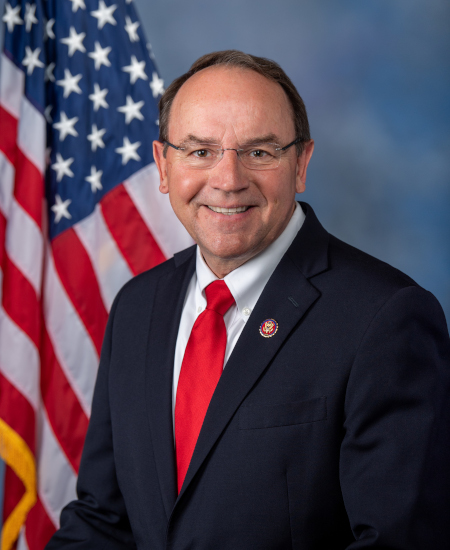
Photo of Thomas P. Tiffany
R United States House · District 7 · Wisconsin

Rep. Thomas P. Tiffany

Compare
Total votes
2,837
all sessions
Attendance
95%
137 missed
Lower than 93% of chamber peers
With party
90%
of cast votes
Lower than 86% of chamber peers
Bipartisan score
5%
crosses aisle rarely
Higher than 85% of chamber peers
Sponsored
912
bills & resolutions
Lower than 77% of chamber peers
Committees
6
assignments
912 bills and resolutions

Sponsored bills

Total
912
Primary
58
Co-sponsor
854
This page
912
matching current filters
Primary HR 7341
Passed · United States House · Lead sponsor
To make technical amendments to title 49, United States Code, as necessary to improve the Code.

Maddy summaryHR 7341 makes technical amendments to Title 49 of the U.S. Code to clarify cross-references and improve the legal code's internal consistency. The bill primarily updates references within Chapter 224 (related to direct loans and loan guarantees) by adding "of this title" after specific section numbers. It does not create new policies or affect people or organizations directly - it only adjusts how legal provisions cite each other. This is a routine procedural update to the federal code's structure.

Passed Dec 4, 2024 0 co-sponsors
Co-sponsor HR 10279
In committee · United States House · Co-sponsor
Taiwan PLUS Act

Maddy summaryHR 10279, the Taiwan PLUS Act, would reclassify Taiwan as part of the "NATO Plus" community (including Japan, Australia, South Korea, Israel, and New Zealand) for defense sales purposes. This would treat Taiwan as a major U.S. defense partner under specific export control laws for five years, streamlining defense sales processes. The bill aims to remove current notification requirements for defense articles and services, aligning Taiwan’s treatment with other key allies. It directly affects Taiwan’s ability to procure U.S. defense equipment through Foreign Military Sales and commercial channels, without altering existing U.S. policy toward Taiwan’s sovereignty.

In committee Dec 3, 2024 1 co-sponsor
Co-sponsor HR 7199
Signed into law · United States House · Co-sponsor
To designate the facility of the United States Postal Service located at S74w16860 Janesville Road, in Muskego, Wisconsin, as the "Colonel Hans Christian Heg Post Office".

Maddy summaryThis bill (HR 7199) renames a U.S. Postal Service facility in Muskego, Wisconsin (located at S74w16860 Janesville Road) as the "Colonel Hans Christian Heg Post Office." It updates all official federal references to this specific location to use the new name. The bill has no policy impact beyond administrative naming and affects only the postal facility and related government documents. It was signed into law on November 25, 2024.

Signed into law Nov 25, 2024 1 co-sponsor
Primary HR 6651
Signed into law · United States House · Lead sponsor
To designate the facility of the United States Postal Service located at 603 West 3rd Street in Necedah, Wisconsin, as the "Sergeant Kenneth E. Murphy Post Office Building".

Maddy summaryHR 6651 designates the U.S. Postal Service facility at 603 West 3rd Street in Necedah, Wisconsin, as the "Sergeant Kenneth E. Murphy Post Office Building." The bill updates all official government references (including laws, maps, and documents) to use this new name for the building. This is a commemorative act with no policy changes or direct impact beyond renaming the facility. The bill was signed into law on November 25, 2024.

Signed into law Nov 25, 2024 0 co-sponsors
Co-sponsor HR 5712
Signed into law · United States House · Co-sponsor
To designate the facility of the United States Postal Service located at 220 Fremont Street in Kiel, Wisconsin, as the "Trooper Trevor J. Casper Post Office Building".

Maddy summaryThis bill renames a U.S. Postal Service facility at 220 Fremont Street in Kiel, Wisconsin, as the "Trooper Trevor J. Casper Post Office Building." It directly affects the postal service location and all federal documents referencing it. The bill’s key provision updates all official references (laws, maps, records) to use the new name. No policy changes or funding are involved - this is a purely ceremonial naming resolution.

Signed into law Nov 25, 2024 1 co-sponsor
Co-sponsor HR 10216
In committee · United States House · Co-sponsor
Ending Racism in Government Contracting Act

Maddy summaryThis bill would eliminate preferences for socially and economically disadvantaged businesses in government contracting by amending multiple federal laws, including the Small Business Act and the Minority Business Development Act. It removes references to "disadvantaged businesses" and repeals provisions requiring agencies to track or prioritize contracts for these businesses. The bill also adds new prohibitions against considering race or ethnicity in contract awards, stating agencies may not take race or ethnicity into account when granting contracts. It would require agencies to remove all references to racial or ethnic considerations from contracting rules within 180 days of enactment. These changes would fundamentally alter government contracting practices by removing specific preferences that have been part of contracting programs for decades.

In committee Nov 21, 2024 1 co-sponsor
Co-sponsor HR 10005
In committee · United States House · Co-sponsor
EARA

Maddy summaryThe Expedited Appeals Review Act (EARA) requires the Board of Land Appeals to issue a final decision on appeals of specific Department of the Interior decisions within 6 months of a party’s request for expedited review, but not before 18 months have passed since the appeal was initially filed. If the Board misses this deadline, the Department’s decision is treated as final for judicial review, and courts must review it without giving special weight to the agency’s original decision. This law applies to appeals pending when the Act takes effect or filed afterward.

In committee Nov 19, 2024 1 co-sponsor
Co-sponsor HR 6951
In committee · United States House · Co-sponsor
College Cost Reduction Act

Maddy summary# Summary of Proposed Higher Education Act Amendments This document outlines significant proposed amendments to the Higher Education Act of 1965, primarily as part of the "College Cost Reduction Act." The key elements include: ## Accreditation Reform - Major overhaul of accreditation standards, requiring accrediting agencies to demonstrate independence from trade associations - New requirements for accrediting agencies to assess student achievement outcomes, including median value-added earnings relative to median total price charged - Introduction of an "Alternative Quality Assurance Experimental Site Initiative" to test non-accredited institutions - Protections for religious institutions, including a new process for appealing accreditation decisions related to religious mission - Removal of "litmus tests" that would require institutions to support specific political viewpoints ## Student Success Initiatives - Establishment of "Postsecondary Student Success Grants" to increase participation, retention, and completion rates for high-need students - Focus on evidence-based practices, with tiered requirements (tier 1, 2, and 3 reforms) - Mandatory inclusion of high-need student populations (low-income, first-generation, military-connected, etc.) - Requirements for institutions to report on completion rates, retention rates, and student demographics ## Regulatory Changes - Repeal of numerous existing regulations including: * Closed school discharges * Borrower defense to repayment * Pre-dispute arbitration * False certification requirements * Ability-to-benefit rules * Financial responsibility regulations - New restrictions on incentive compensation for recruiters - Changes to third-party servicer definitions and regulations ## Transfer and Credit Policies - New requirement that institutions cannot deny transfer credit based solely on the source of accreditation - Requirements for transparent transfer policies - Changes to reverse transfer policies ## Other Key Provisions - Modifications to the National Advisory Committee on Institutional Quality and Integrity (NACIQI) - New definitions for "total price" and "value-added earnings" - Changes to the process for institutions to change accrediting agencies - New requirements for institutions to report on student outcomes The overall focus of these proposed amendments is to reduce regulatory burden on institutions, promote transparency, improve student outcomes (particularly for high-need students), modernize accreditation processes, and protect religious institutions' rights in accreditation decisions.


In committee Nov 18, 2024 1 co-sponsor
Co-sponsor HR 8790
Passed · United States House · Co-sponsor
Fix Our Forests Act

Maddy summaryThe Fix Our Forests Act creates a new system for managing wildfire risk on federal lands by designating "firesheds" (landscape-scale areas with high wildfire risk) and establishing a central coordination center called the Fireshed Center. It streamlines environmental reviews for vegetation management projects in these areas, requires public tracking of wildfire risk and management activities through a Fireshed Registry, and limits legal challenges to these projects. The bill affects federal land management agencies (like the Forest Service and Bureau of Land Management), communities in wildfire-prone areas, and utility companies managing vegetation near power lines. It also includes provisions for community wildfire risk reduction programs and research on new wildfire management technologies, aiming to accelerate risk reduction while maintaining transparency about where and how these projects are implemented.

Passed Nov 12, 2024 1 co-sponsor
Showing 241 to 250 of 912 bills
Previous 1 … 24 25 26 … 92 Next