

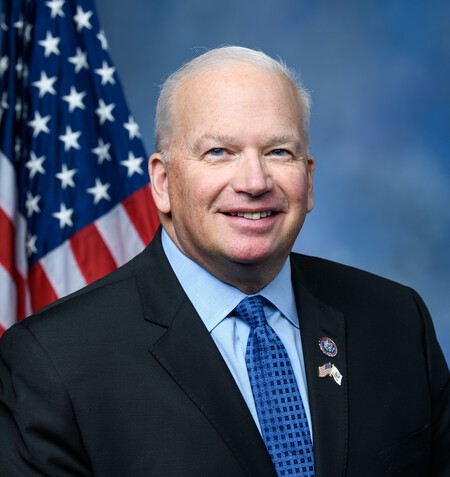
Photo of Scott Fitzgerald
R United States House · District 5 · Wisconsin On the 2026 ballot

Rep. Scott Fitzgerald

Compare
Total votes
2,837
all sessions
Attendance
99%
29 missed
Near the chamber average
With party
95%
of cast votes
Near the chamber average
Bipartisan score
3%
crosses aisle rarely
Near the chamber average
Sponsored
624
bills & resolutions
Near the chamber average
Committees
6
assignments
624 bills and resolutions

Sponsored bills

Total
624
Primary
74
Co-sponsor
550
This page
624
matching current filters
Co-sponsor HR 8337
In committee · United States House · Co-sponsor
Bank Resilience and Regulatory Improvement Act

Maddy summaryThe Bank Resilience and Regulatory Improvement Act increases regulatory thresholds for medium-sized banks from $10 billion to $50 billion in assets, exempting them from certain requirements. It establishes a 30-day notice period for regulatory applications and a 90-day deadline for approval decisions, with applications deemed approved if not acted upon within that timeframe. The bill creates an independent appeals process for banks challenging regulatory decisions and raises the asset threshold for "small bank holding company" status to $10 billion. These changes reduce regulatory burden for medium-sized financial institutions while maintaining oversight standards.

In committee Dec 3, 2024 1 co-sponsor
Primary HR 7199
Signed into law · United States House · Lead sponsor
To designate the facility of the United States Postal Service located at S74w16860 Janesville Road, in Muskego, Wisconsin, as the "Colonel Hans Christian Heg Post Office".

Maddy summaryThis bill (HR 7199) renames a U.S. Postal Service facility in Muskego, Wisconsin (located at S74w16860 Janesville Road) as the "Colonel Hans Christian Heg Post Office." It updates all official federal references to this specific location to use the new name. The bill has no policy impact beyond administrative naming and affects only the postal facility and related government documents. It was signed into law on November 25, 2024.

Signed into law Nov 25, 2024 0 co-sponsors
Co-sponsor HR 6651
Signed into law · United States House · Co-sponsor
To designate the facility of the United States Postal Service located at 603 West 3rd Street in Necedah, Wisconsin, as the "Sergeant Kenneth E. Murphy Post Office Building".

Maddy summaryHR 6651 designates the U.S. Postal Service facility at 603 West 3rd Street in Necedah, Wisconsin, as the "Sergeant Kenneth E. Murphy Post Office Building." The bill updates all official government references (including laws, maps, and documents) to use this new name for the building. This is a commemorative act with no policy changes or direct impact beyond renaming the facility. The bill was signed into law on November 25, 2024.

Signed into law Nov 25, 2024 1 co-sponsor
Co-sponsor HR 5712
Signed into law · United States House · Co-sponsor
To designate the facility of the United States Postal Service located at 220 Fremont Street in Kiel, Wisconsin, as the "Trooper Trevor J. Casper Post Office Building".

Maddy summaryThis bill renames a U.S. Postal Service facility at 220 Fremont Street in Kiel, Wisconsin, as the "Trooper Trevor J. Casper Post Office Building." It directly affects the postal service location and all federal documents referencing it. The bill’s key provision updates all official references (laws, maps, records) to use the new name. No policy changes or funding are involved - this is a purely ceremonial naming resolution.

Signed into law Nov 25, 2024 1 co-sponsor
Co-sponsor HR 807
Signed into law · United States House · Co-sponsor
Working Dog Commemorative Coin Act

Maddy summaryThe Working Dog Commemorative Coin Act (HR 807) directs the U.S. Treasury to mint three types of commemorative coins honoring working dogs' service: $5 gold coins, $1 silver coins, and half-dollar coins with specific weight and composition requirements. Each coin will carry a surcharge ($35 for $5 coins, $10 for $1 coins, $5 for half-dollars) that will be paid directly to America's VetDogs to support their programs providing service dogs for veterans, the disabled, and others. The coins will be issued in 2027 with designs reflecting working dogs' roles in military, detection, therapy, and assistance work. The legislation specifies that all surcharge revenue must fund America's VetDogs' operations without creating new government programs. This is a commemorative measure focused on honoring working dogs' contributions through coin sales, with all surcharge funds going to a specific nonprofit organization.

Signed into law Nov 25, 2024 1 co-sponsor
Co-sponsor HR 8706
In committee · United States House · Co-sponsor
Dismantle DEI Act of 2024

Maddy summaryHR 8706, the "Dismantle DEI Act of 2024," would prohibit federal agencies from maintaining diversity, equity, and inclusion (DEI) offices, programs, or training by requiring the closure of existing DEI offices within 90 days and banning federal funding for DEI-related activities. The bill defines "prohibited diversity, equity, and inclusion practices" as those that discriminate based on race, color, ethnicity, religion, biological sex, or national origin, or require training that asserts a particular group is inherently superior or inferior. It would rescind several executive orders related to racial equity and gender inclusion, and prohibit the use of federal funds for DEI-related activities across all federal agencies, contractors, and grant recipients. The bill contains limited exceptions for Equal Employment Opportunity offices and disability rights enforcement offices as historically organized and operated.

In committee Nov 20, 2024 1 co-sponsor
Co-sponsor HR 6951
In committee · United States House · Co-sponsor
College Cost Reduction Act

Maddy summary# Summary of Proposed Higher Education Act Amendments This document outlines significant proposed amendments to the Higher Education Act of 1965, primarily as part of the "College Cost Reduction Act." The key elements include: ## Accreditation Reform - Major overhaul of accreditation standards, requiring accrediting agencies to demonstrate independence from trade associations - New requirements for accrediting agencies to assess student achievement outcomes, including median value-added earnings relative to median total price charged - Introduction of an "Alternative Quality Assurance Experimental Site Initiative" to test non-accredited institutions - Protections for religious institutions, including a new process for appealing accreditation decisions related to religious mission - Removal of "litmus tests" that would require institutions to support specific political viewpoints ## Student Success Initiatives - Establishment of "Postsecondary Student Success Grants" to increase participation, retention, and completion rates for high-need students - Focus on evidence-based practices, with tiered requirements (tier 1, 2, and 3 reforms) - Mandatory inclusion of high-need student populations (low-income, first-generation, military-connected, etc.) - Requirements for institutions to report on completion rates, retention rates, and student demographics ## Regulatory Changes - Repeal of numerous existing regulations including: * Closed school discharges * Borrower defense to repayment * Pre-dispute arbitration * False certification requirements * Ability-to-benefit rules * Financial responsibility regulations - New restrictions on incentive compensation for recruiters - Changes to third-party servicer definitions and regulations ## Transfer and Credit Policies - New requirement that institutions cannot deny transfer credit based solely on the source of accreditation - Requirements for transparent transfer policies - Changes to reverse transfer policies ## Other Key Provisions - Modifications to the National Advisory Committee on Institutional Quality and Integrity (NACIQI) - New definitions for "total price" and "value-added earnings" - Changes to the process for institutions to change accrediting agencies - New requirements for institutions to report on student outcomes The overall focus of these proposed amendments is to reduce regulatory burden on institutions, promote transparency, improve student outcomes (particularly for high-need students), modernize accreditation processes, and protect religious institutions' rights in accreditation decisions.

In committee Nov 18, 2024 1 co-sponsor
Co-sponsor HRES 1574
In committee · United States House · Co-sponsor
Calling for the removal of Federal Deposit Insurance Corporation Chairman Martin J. Gruenberg from his position, effective immediately.

Maddy summaryHRES 1574 is a non-binding House resolution calling for the immediate removal of Federal Deposit Insurance Corporation (FDIC) Chairman Martin J. Gruenberg. It cites concerns about his leadership, including alleged mistreatment of staff, a "toxic workplace," staffing shortages, and failures in bank supervision that contributed to financial institution failures. The resolution does not change law or remove Gruenberg (as the President appoints FDIC leaders), but formally demands his removal. It was introduced by 25 Republican representatives and referred to the Financial Services Committee.

In committee Nov 15, 2024 1 co-sponsor
Primary HR 8205
Passed · United States House · Lead sponsor
Keeping Violent Offenders Off Our Streets Act

Maddy summaryThe Keeping Violent Offenders Off Our Streets Act requires states and tribes to create a public safety report system for defendants charged with specific violent crimes, including murder, rape, assault, kidnapping, robbery, and firearm offenses. The system provides judges and prosecutors with free, detailed reports containing criminal history, bail eligibility, and offense-specific criteria within 48 hours of arrest. Prosecutors must deliver these reports to courts before bail decisions, and courts must consider them when setting bail for these defendants. The reports are also submitted to the National Crime Information Center, and the bill additionally amends federal law to include bail bonds in fraud-related provisions.

Passed Nov 12, 2024 0 co-sponsors
Co-sponsor HR 10103
In committee · United States House · Co-sponsor
TRIPS Waivers Act

Maddy summaryHR 10103, the "Timely Reporting of IP Rights Waivers Act" (not a TRIPS waiver bill), requires the U.S. government to submit detailed reports to Congress 60 days before negotiating any international agreement that could reduce or restrict U.S. intellectual property rights. It applies to patents, copyrights, plant varieties, trademarks, and trade secrets, mandating analysis of impacts on U.S. rights holders and systems. The bill does not change IP laws or grant waivers but adds transparency by requiring Congress to review potential effects before negotiations begin. It directly affects U.S. businesses, inventors, and creators whose IP rights could be impacted by international deals.

In committee Nov 8, 2024 1 co-sponsor
Showing 241 to 250 of 624 bills
Previous 1 … 24 25 26 … 63 Next