Screening for Communities to Receive Early and Equitable Needed Services for Cancer Act or the SCREENS for Cancer Act of 2022 This bill reauthorizes through FY2027 and makes changes to the National Breast and Cervical Cancer Early Detection Program. This program provides funding to states for breast and cervical cancer screening, diagnostic, and treatment services for individuals who have low incomes, are uninsured, or otherwise lack access to such services.
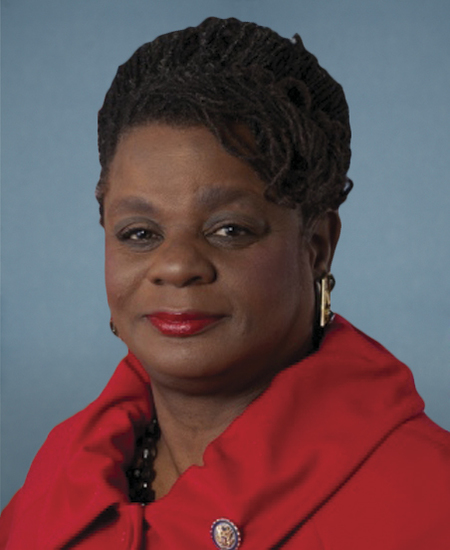
Rep. Gwen Moore
Sponsored bills
Affordable and Accessible Infant Formula Act This bill provides through November 14, 2022, duty-free treatment to infant formula. During this time period, articles of infant formula shall not be subject to (1) any additional safeguard duties that may be imposed under subchapter IV of chapter 99 of the Harmonized Tariff Schedule; or (2) any other import quotas, tariff-rate quotas, additional duties, or any other duties, fees, exactions, or charges that otherwise would apply to such articles. Importers shall provide the applicable and anticipated tariff classifications for articles of infant formula on applicable customs entry documents.
Downpayment Toward Equity Act of 2021 This bill establishes a grant program through the Department of Housing and Urban Development for states and other entities to provide qualifying assistance to certain first-time, first-generation home buyers in purchasing their first homes. Qualifying assistance includes assistance for mortgage down payments, mortgage closing costs, reduction of mortgage interest rates, subsidies for shared equity homes, or for certain preoccupancy modifications to a home to accommodate persons with disabilities. The bill also establishes grant requirements regarding home buyer income, types of housing, homeowner occupancy, types of mortgages, and home buyer counseling.
Maddy summaryHRES 1190 is a symbolic resolution expressing congressional support for designating November 9 as "Gold Star Father’s Day" to honor fathers who lost children in military service. It directly affects Gold Star Fathers - men who have lost a child while serving in the U.S. Armed Forces - and aims to recognize their sacrifice alongside existing observances like Gold Star Mother’s Day (established in 1936). The resolution does not create new laws or benefits but seeks to promote annual recognition of these fathers’ loss, aligning with the 2015 Gold Star Fathers Act that ensured fathers received similar benefits to mothers of fallen service members. It was introduced in June 2022 with bipartisan co-sponsors.
This resolution celebrates the 50th anniversary of the Federal Pell Grant program and expresses support for the designation of National Federal Pell Grant Day.
Hmong Congressional Gold Medal Act This bill provides for the award of a Congressional Gold Medal to the Hmong people in recognition of their highly distinguished service in the Vietnam War and the fight against communism.
Recovering America’s Wildlife Act of 2022 This bill provides funding for the conservation or restoration of wildlife and plant species of greatest conservation need, including endangered or threatened species, and establishes related requirements. TITLE I--WILDLIFE CONSERVATION AND RESTORATION (Sec. 101) This title establishes and funds a subaccount of the Wildlife Conservation and Restoration Account, which was established under the Pittman-Robertson Wildlife Restoration Act. The subaccount must be used to support efforts of states, territories, or the District of Columbia to recover and manage wildlife and plant species of greatest conservation need. The Department of the Interior must use a portion of the funding from the subaccount for grants to state fish and wildlife departments, the District of Columbia fish and wildlife department, fish and wildlife departments of territories, nonprofit organizations, or regional associations of fish and wildlife departments. The grants must be used for innovative recovery efforts for species of greatest conservation need, species listed as endangered or threatened species, or the habitats of such species. Funding for the subaccount must supplement existing funds available to the states from funds distributed under the Dingell-Johnson Sport Fish Restoration Act and the Wildlife Conservation and Restoration Account. Recipients of the funding from the subaccount must match federal funds as specified by the title. The Government Accountability Office must study and report on the progress of states, territories, the District of Columbia, and Indian tribes in protecting species of greatest conservation need, endangered species, and threatened species. TITLE II--TRIBAL WILDLIFE CONSERVATION AND RESTORATION (Sec. 201) This title establishes and funds a Tribal Wildlife Conservation and Restoration Account to support Indian tribes' efforts to recover and manage wildlife and plant species of greatest conservation need. Indian tribes are not required to provide matching funds. TITLE III--ENDANGERED SPECIES RECOVERY AND HABITAT CONSERVATION LEGACY FUND (Sec. 301) This title establishes and funds through FY2026 the Endangered Species Recovery and Habitat Conservation Legacy Fund. The U.S. Fish and Wildlife Service must use the fund to (1) implement an Endangered Species Recovery Grant Program; (2) address its interagency consultation responsibilities under the Endangered Species Act of 1973; (3) work with nonfederal entities to conserve wildlife habitat and at-risk species, threatened or endangered species, or species proposed to be listed as threatened or endangered species; or (4) address the development and permitting of voluntary conservation agreements under such act. Amounts made available under the fund must supplement other federal amounts made available to carry out such activities. The President must annually submit to Congress, together with the annual budget of the United States, a list of threatened species and endangered species for which recovery plans will be developed or implemented with amounts from the Endangered Species Recovery and Habitat Conservation Legacy Fund. TITLE IV--REPORT (Sec. 401) Interior must also report on information concerning the amount of grants and contracts that were awarded or are allocated under this bill to Historically Black Colleges and Universities, Hispanic-serving educational institutions, tribally controlled colleges and universities, minority-serving educational institutions, minority-owned business enterprises, women-owned business enterprises, and community-based organizations that are principally administered by, operated by, or serving minority communities.

Social Security Expansion Act This bill increases benefits and certain taxes related to the Social Security program. Changes to benefits include (1) increasing the primary insurance amount for certain beneficiaries; (2) revising the method of calculating cost-of-living adjustments; (3) establishing a new minimum benefit for certain low earners; and (4) allowing certain children of retired, deceased, or disabled workers to receive benefits until age 22 if they are a full-time student. Changes to taxes include (1) increasing the net investment income tax and making active trade or business income subject to this tax; and (2) extending payroll taxes on wages, salaries, and self-employment earnings to income above $250,000 (the maximum amount subject to the Social Security payroll tax is currently $147,000 for 2022). The bill also combines the existing Federal Old-Age and Survivors Insurance Trust Fund and the Federal Disability Insurance Trust Fund into a single Social Security Trust Fund.
This resolution declares gun violence to be a public health crisis. It also urges the Centers for Disease Control and Prevention to expand research and data collection on preventing gun violence and the Surgeon General to report on firearm injuries and violence prevention.
Protecting Our Kids Act This bill makes various changes to federal firearms laws, including to establish new criminal offenses and to expand the types of weapons and devices that are subject to regulation. Among the changes, the bill generally prohibits the sale or transfer of certain semiautomatic firearms to individuals who are under 21 years of age; establishes new federal criminal offenses for gun trafficking and related conduct; establishes a federal statutory framework to regulate ghost guns (i.e., guns without serial numbers); establishes a framework to regulate the storage of firearms on residential premises at the federal, state, and tribal levels; subjects bump stocks to regulation under federal firearms laws; generally prohibits the import, sale, manufacture, transfer, and possession of large capacity ammunition feeding devices; and requires the Department of Justice to report on the demographic data of persons who are determined to be ineligible to purchase a firearm based on a background check performed by the national instant criminal background check system.