

Record of Military Service for Members of the Armed Forces Act of 2022 This bill requires the Department of Defense (DOD) to create the Certificate of Military Service. The Certificate of Military service will be a standard record of military service for all members of active and reserve components of the armed forces to encompass all duty, including that of National Guard and Coast Guard duty. Under the bill, the document must (1) be standardized, (2) be the same for all members of the armed forces, and (3) replace and serve the same function as a discharge certificate or certificate of release (DOD Form DD-214). The bill also requires that a current record of service be issued to members of the reserve components upon the occurrence of any of the following events: permanent change to duty status (e.g., retirement or transfer to active duty), discharge or release from temporary active duty orders, specified promotions, and transfer to another state National Guard.
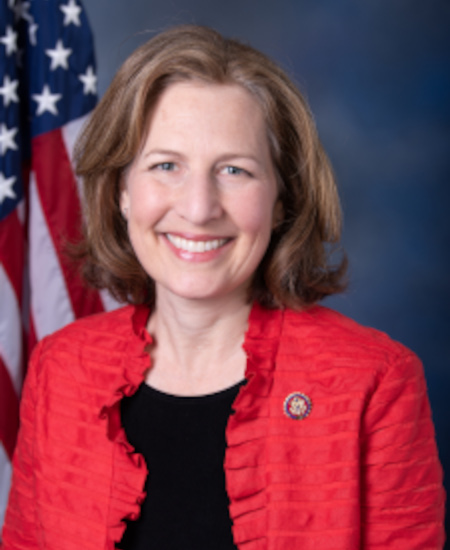
Rep. Kim Schrier
Sponsored bills
This resolution condemns the terrorist attack on Congregation Beth Israel in Colleyville, Texas, on January 15, 2022. It also expresses support for the affected community, commends the actions of law enforcement and emergency responders, and reaffirms a commitment to combat hate, bigotry, anti-Semitism, and violence against Jewish Americans.
Rural Investment in America Act This bill authorizes the Small Business Administration to make loans for certain costs to businesses that manufacture goods essential to critical infrastructure sectors in rural areas. Businesses that meet at least 75% of their job creation goals under such loans may receive partial loan forgiveness.
Women's Health Protection Act of 2021 This bill prohibits governmental restrictions on the provision of, and access to, abortion services. Specifically, governments may not limit a provider's ability to prescribe certain drugs, offer abortion services via telemedicine, or immediately provide abortion services when the provider determines a delay risks the patient's health. Furthermore, governments may not require a provider to perform unnecessary medical procedures, provide medically inaccurate information, comply with credentialing or other conditions that do not apply to providers whose services are medically comparable to abortions, or carry out all services connected to an abortion. In addition, governments may not (1) require patients to make medically unnecessary in-person visits before receiving abortion services or disclose their reasons for obtaining such services, or (2) prohibit abortion services before fetal viability or after fetal viability when a provider determines the pregnancy risks the patient's life or health. The bill also prohibits other governmental measures that are similar to the bill's specified restrictions or that otherwise single out and impede access to abortion services, unless a government demonstrates that the measure significantly advances the safety of abortion services or health of patients and cannot be achieved through less restrictive means. The Department of Justice, individuals, or providers may bring a lawsuit to enforce this bill, and states are not immune from suits for violations. The bill applies to restrictions imposed both prior and subsequent to the bill's enactment.
Gas Prices Relief Act of 2022 This bill provides for a temporary exemption through 2022 from the excise tax on gasoline (other than aviation gasoline) and from the Leaking Underground Storage Tank Trust Fund financing rate. The Department of the Treasury must transfer from the general fund to the Highway Trust Fund and the Leaking Underground Storage Tank Trust Fund amounts resulting from the exemption provided by this bill. The bill also expresses congressional policy that consumers immediately receive the benefit of this exemption.
This bill makes permanent the authority of the Department of Health and Human Services (HHS) to appoint personnel to the National Disaster Medical System for intermittent disaster response. (This system is a partnership between HHS, the Department of Defense, the Department of Homeland Security, and the Department of Veterans Affairs that responds to public health and other emergencies.)
Keeping School Meals Flexible Act This bill extends authority through June 30, 2023, for the Department of Agriculture (USDA) to waive certain requirements for the school meal programs to address COVID-19. The bill extends the authority for USDA to issue a single waiver of child nutrition program requirements to all states under the National School Lunch Program for purposes of providing meals and snacks with appropriate safety measures with respect to COVID-19; grant waivers of requirements to allow non-congregate feeding in the Child and Adult Care Food Program for purposes of providing meals and snacks with appropriate safety measures with respect to COVID-19; and grant waivers related to the nutritional content of meals served in child nutrition programs if it determines the waiver is necessary to provide meals and snacks, and there is a food supply chain disruption due to COVID-19.
Healthy Meal Time Act of 20 22 This bill requires the Department of Agriculture (USDA) to enter into an agreement with an independent, nonpartisan, science-based research organization to carry out a study on the time lunches are served, the time that recess is offered, and the duration of lunch periods at schools participating in the National School Lunch Program. USDA must also make the findings of the study publicly available online; establish a task force, in coordination with the Department of Education, to review the study, review other related research, and develop best practices for lunch and recess periods to ensure student health, including appropriate nutritional intake; and issue guidance regarding such best practices to schools participating in the National School Lunch Program.
Data Transparency and Drug Safety Act of 2022 This bill makes it a prohibited act under the Federal Food, Drug, and Cosmetic Act to destroy or falsify certain records pertaining to drugs regulated by the Food and Drug Administration (FDA). Specifically, the bill prohibits falsifying, destroying, omitting. or removing records or information that (1) must be produced during the development or manufacture of a drug, (2) must be produced in an application for FDA approval for a drug or maintained after a drug is approved, or (3) is subject to FDA inspection. A person (entity or individual) that violates this provision shall be subject to civil monetary penalties. The bill also provides for additional monetary penalties in instances where the violation is not sufficiently remedied after the responsible person has received written notice from the FDA of the violation.
Leading Infrastructure For Tomorrow’s America Act or the LIFT America Act This bill establishes several programs and incentives to modernize the nation's communications, drinking water, energy, transportation, health care, and other related infrastructure. For example, the bill provides incentives to make broadband internet more accessible and affordable. It also establishes grants to implement next generation 9-1-1 services. In addition, it supports drinking water programs, including the drinking water state revolving fund program. Further, it provides grants to treat perfluoroalkyl or polyfluoroalkyl substances (commonly referred to as PFAS) in drinking water and to replace lead service lines. The bill establishes a variety of programs to support clean energy infrastructure and address climate change, including efforts to (1) modernize the electric grid and make it more resilient, efficient, and secure; (2) increase energy efficiency in buildings; and (3) support renewable energy infrastructure. Further, it provides incentives for vehicle infrastructure, such as incentives to develop infrastructure for electric vehicles and grants to reduce air pollution at ports by electrifying port infrastructure. Additionally, the bill establishes grants and programs for health care infrastructure, including by providing support for the Centers for Disease Control and Prevention, laboratories, and state, local, tribal, and territorial health departments. Finally, the bill reauthorizes grant programs to remediate brownfield sites (i.e., sites contaminated with hazardous substances) through FY2026.