

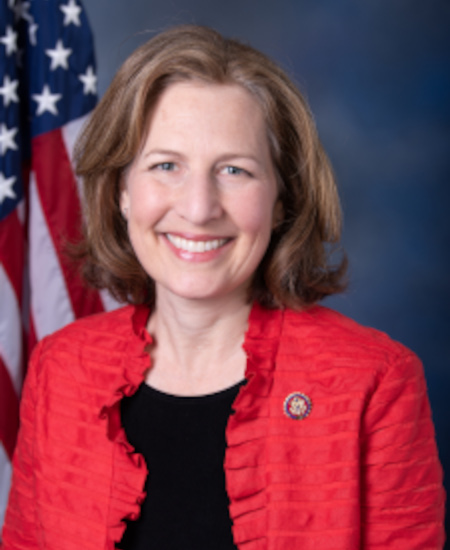
Photo of Kim Schrier
D United States House · District 8 · Washington On the 2026 ballot

Rep. Kim Schrier

Compare
Total votes
2,837
all sessions
Attendance
99%
24 missed
Near the chamber average
With party
94%
of cast votes
Lower than 83% of chamber peers
Bipartisan score
3%
crosses aisle rarely
Higher than 82% of chamber peers
Sponsored
1,071
bills & resolutions
Near the chamber average
Committees
4
assignments
1,071 bills and resolutions

Sponsored bills

Total
1,071
Primary
73
Co-sponsor
998
This page
1,071
matching current filters
Co-sponsor HR 247
In committee · United States House · Co-sponsor
Health Care Affordability Act of 2025

Maddy summaryThis bill increases healthcare affordability for low- and middle-income people by expanding eligibility for premium tax credits under the Affordable Care Act. It removes the previous 400% of poverty level cap for subsidy eligibility and replaces it with a new sliding scale based on income tiers, ranging from 0% to 8.5% of household income for coverage costs. The scale adjusts linearly across income levels, with households earning 300-400% of poverty paying 6.0%-8.5% of income (up from the prior fixed 400% cap), while lower-income households pay progressively less. These changes apply to tax years beginning after December 31, 2025, directly affecting individuals purchasing health insurance through marketplace plans.

In committee Jan 9, 2025 1 co-sponsor
Co-sponsor HR 82
Signed into law · United States House · Co-sponsor
Social Security Fairness Act of 2023

Maddy summaryHR 82, the Social Security Fairness Act of 2023, repeals two provisions that reduce Social Security benefits for certain government workers. It eliminates the Government Pension Offset (GPO), which cuts spousal or survivor benefits for people with pensions from jobs not covered by Social Security (like federal or state government roles), and the Windfall Elimination Provision (WEP), which lowers retirement benefits for those with similar pensions. The law takes effect for benefits paid after December 2023, requiring the Social Security Administration to adjust benefit calculations to remove these reductions. This change directly affects public-sector employees who previously had their Social Security benefits reduced due to their government pensions.

Signed into law Jan 5, 2025 1 co-sponsor
Co-sponsor HR 9421
Signed into law · United States House · Co-sponsor
To designate the facility of the United States Postal Service located at 108 North Main Street in Bucoda, Washington, as the "Mayor Rob Gordon Post Office".

Maddy summaryThis bill (HR 9421) designates the existing United States Postal Service facility at 108 North Main Street in Bucoda, Washington, as the "Mayor Rob Gordon Post Office." It does not create new policies, alter services, or affect any population beyond changing the official name of this specific post office location. The bill simply requires all federal references to this facility to use the new name, honoring former Bucoda Mayor Rob Gordon. As a ceremonial naming resolution, it has no substantive policy impact or operational changes.

Signed into law Jan 4, 2025 1 co-sponsor
Co-sponsor HR 6492
Signed into law · United States House · Co-sponsor
EXPLORE Act

Maddy summary# Summary of the EXPLORE Act Legislative Text This is a comprehensive legislative text (likely the "EXPLORE Act" - Enhancing Recreation Opportunities for People of All Abilities, and Veterans) that establishes several key initiatives to improve outdoor recreation access across Federal lands. ## Key Focus Areas: ### 1. Accessibility for People with Disabilities (Title II - Access America) - Requires comprehensive assessments of outdoor recreation facilities on Federal lands within 5 years - Mandates development of 3 new accessible trails per region for each agency (Forest Service, National Park Service, BLM, USFWS) within 1 year - Requires development of 2 new accessible recreation opportunities per region within 1 year - Requires making accessibility information available on public websites within 7 years - Requires development of accessible features including trail bridges, parking, and restrooms ### 2. Military and Veterans Programs - Requires educational materials for military members/veterans on accessing Federal lands free of charge within 2 years - Establishes Military Veterans Outdoor Recreation Liaisons within relevant agencies within 1 year - Requires a National Strategy for Military and Veteran Recreation within 1 year - Creates a pilot program for veteran employment in conservation positions - Promotes partnerships with organizations providing outdoor recreation for veterans ### 3. Youth Access - Requires a strategy to increase youth recreation visits to Federal lands within 2 years - Extends the "Every Kid Outdoors" program until September 30, 2031 - Focuses on increasing opportunities for underserved youth ### 4. Recreation Permitting Modernization (Title III) - Defines special recreation permits and establishes fee structures - Creates categories for different types of recreation permits - Establishes a process for application and review of permits - Includes provisions for multijurisdictional trips across different Federal lands The legislation aims to improve access to outdoor recreation for people with disabilities, veterans, and youth while modernizing the permitting process for recreational activities on Federal lands. It requires specific timelines for implementation and includes detailed definitions and requirements for each component of the bill.

Signed into law Jan 4, 2025 1 co-sponsor
Co-sponsor HR 51
In committee · United States House · Co-sponsor
Washington, D.C. Admission Act

Washington, D.C. Admission Act This bill provides for the establishment of the State of Washington, Douglass Commonwealth, and its admission into the United States. The state is composed of most of the territory of the District of Columbia (DC), excluding a specified area that encompasses the U.S. Capitol, the White House, the U.S. Supreme Court building, federal monuments, and federal office buildings adjacent to the National Mall and the U.S. Capitol. The excluded territory shall be known as the Capital and serve as the seat of the government of the United States, as provided for in Article I of the Constitution. The state may not impose taxes on federal property except as Congress permits. The bill provides for the DC Mayor to issue a proclamation for the first elections to Congress of two Senators and one Representative of the state. The bill eliminates the office of Delegate to the House of Representatives. The bill applies current DC laws to the state. DC judicial proceedings and contractual obligations shall continue under the state’s authority. The bill also provides for specified federal obligations to transfer to the state upon its certification that it has funds and laws in place to assume the obligations. These include maintaining a retirement fund for judges and operating public defender services.  The bill establishes a commission that is generally comprised of members who are appointed by DC and federal government officials to advise on an orderly transition to statehood.

In committee Jan 3, 2025 1 co-sponsor
Co-sponsor HR 169
In committee · United States House · Co-sponsor
Prevent Family Fire Act of 2025

Maddy summaryHR 169, the Prevent Family Fire Act of 2025, creates a 10% tax credit for manufacturers selling qualifying safe firearm storage devices. The credit applies to the first retail sale of each device per year, capped at $400 per device, and excludes sales tax. A qualifying device must be designed to prevent unauthorized access or render firearms inoperable using an integrated combination, key, or biometric lock (excluding devices built into firearms or under recall). The credit is available for taxable years beginning after the bill's enactment through 2032, with annual reporting required by the Treasury.

In committee Jan 3, 2025 1 co-sponsor
Co-sponsor HR 1691
In committee · United States House · Co-sponsor
Ensuring Patient Access to Critical Breakthrough Products Act of 2024

Maddy summaryThis bill creates a 4-year transitional coverage period for Medicare to automatically cover "breakthrough medical devices" - new FDA-prioritized devices approved after March 2021 - as "reasonable and necessary" for treatment. During this period, these devices qualify for additional payments under Medicare's hospital and outpatient payment systems without requiring separate approval. After the 4-year period, Medicare must develop regular coverage based on additional data, with automatic coverage for all approved uses if no action is taken within two years. The bill requires Medicare to assign unique codes for these devices within three months of FDA approval and to update payment systems regularly. It also includes special provisions for "specified breakthrough devices" that lack existing Medicare benefit categories, requiring reports on their impact and cost to Congress.

In committee Dec 24, 2024 1 co-sponsor
Co-sponsor HR 6960
Signed into law · United States House · Co-sponsor
Emergency Medical Services for Children Reauthorization Act of 2024

Maddy summaryThis bill reauthorizes the Emergency Medical Services for Children (EMSC) program through fiscal year 2029, increasing annual funding from $22.3 million (2020-2024) to $24.3 million (2025-2029). It directly supports states and communities providing specialized emergency medical care for children, including pediatric trauma and transport services. The key provision extends and increases federal funding to maintain existing EMSC grant programs that train healthcare providers and improve pediatric emergency response systems. This ensures continued access to coordinated care for children in emergency situations across the United States.

Signed into law Dec 23, 2024 1 co-sponsor
Co-sponsor HR 1097
Signed into law · United States House · Co-sponsor
Everett Alvarez, Jr. Congressional Gold Medal Act of 2023

Maddy summaryThis bill, HR 1097 (Everett Alvarez, Jr. Congressional Gold Medal Act of 2023), authorizes the award of a Congressional Gold Medal to Everett Alvarez, Jr., in recognition of his service as a U.S. Navy pilot and Vietnam War prisoner of war. It directly honors Alvarez, who was the first U.S. pilot shot down in the Vietnam War, spent over 8.5 years in captivity, and later served in the Peace Corps and Veterans Administration. The bill’s key mechanism is directing the U.S. Mint to strike a gold medal bearing his name and image, with bronze duplicates available for sale to cover costs. It does not create new policies or affect any group beyond the honoree.

Signed into law Dec 23, 2024 1 co-sponsor
Co-sponsor HR 7516
In committee · United States House · Co-sponsor
Purchased and Referred Care Improvement Act of 2024

Maddy summaryThis bill (HR 7516) updates the Indian Health Care Improvement Act to clarify and improve reimbursement for Native American patients who pay out-of-pocket for authorized "purchased/referred care" services through the Indian Health Service (IHS). It requires the IHS to establish procedures within 120 days to reimburse patients within 30 days of receiving documentation (electronically or in-person) for such care. The bill replaces outdated terms like "contract health care" with "purchased/referred care" throughout the law and clarifies that the IHS is not liable to debt collectors for these payments. It directly affects Native American patients who receive IHS-authorized care outside of regular IHS facilities.

In committee Dec 18, 2024 1 co-sponsor
Showing 391 to 400 of 1,071 bills
Previous 1 … 39 40 41 … 108 Next