

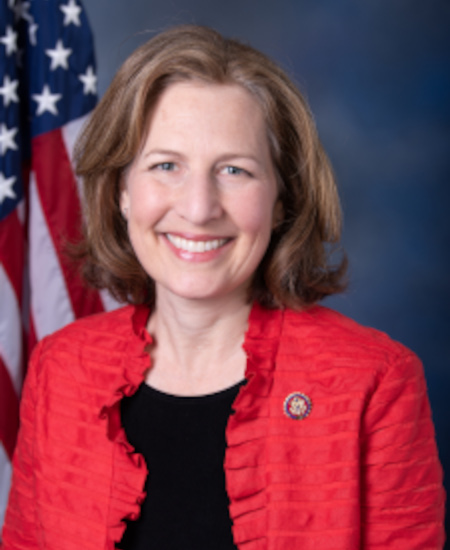
Photo of Kim Schrier
D United States House · District 8 · Washington On the 2026 ballot

Rep. Kim Schrier

Compare
Total votes
2,837
all sessions
Attendance
99%
24 missed
Near the chamber average
With party
94%
of cast votes
Lower than 83% of chamber peers
Bipartisan score
3%
crosses aisle rarely
Higher than 82% of chamber peers
Sponsored
1,071
bills & resolutions
Near the chamber average
Committees
4
assignments
1,071 bills and resolutions

Sponsored bills

Total
1,071
Primary
73
Co-sponsor
998
This page
1,071
matching current filters
Co-sponsor HR 783
In committee · United States House · Co-sponsor
Sustainable Cardiopulmonary Rehabilitation Services in the Home Act

Sustainable Cardiopulmonary Rehabilitation Services in the Home Act This bill permanently allows services relating to cardiac rehabilitation programs, intensive cardiac rehabilitation programs, and pulmonary rehabilitation programs to be furnished via telehealth at a beneficiary's home under Medicare.

In committee Jan 28, 2025 1 co-sponsor
Co-sponsor HR 768
In committee · United States House · Co-sponsor
Holocaust Education and Antisemitism Lessons Act

Maddy summaryHR 768, the Holocaust Education and Antisemitism Lessons Act, requires the U.S. Holocaust Memorial Museum Director to study how states and school districts currently teach about the Holocaust and antisemitism in K-12 schools. The study will examine curriculum requirements, teacher training, educational materials used, and assessment methods across all states and a representative sample of school districts and schools. It specifically aims to identify gaps, resources needed, and how schools address antisemitism and genocide prevention in their teaching. The Museum must submit a report to Congress within three years of the bill's enactment, detailing findings on current practices and challenges. This bill does not mandate new teaching requirements but seeks to understand existing approaches to Holocaust education.

In committee Jan 28, 2025 1 co-sponsor
Co-sponsor HR 786
In committee · United States House · Co-sponsor
Preserving Patient Access to Accountable Care Act

Maddy summaryHR 786 extends Medicare incentive payments for providers participating in "eligible alternative payment models" (like bundled care programs) by adjusting key timeline and percentage references in the Social Security Act. It specifically delays the expiration of these incentives from 2026 to 2027 for certain payments (adding a 3.53% rate for 2027) and extends subsequent years' references accordingly. This bill directly affects Medicare providers using alternative payment models by preserving their access to these financial incentives for an additional year. The key mechanism is technical, updating specific years and payment percentages in Medicare law without changing the underlying program structure. The bill does not create new programs but ensures existing incentives continue for providers in 2027 and beyond.

In committee Jan 28, 2025 1 co-sponsor
Co-sponsor HR 717
In committee · United States House · Co-sponsor
Wildlife Movement Through Partnerships Act of 2025

Maddy summaryHR 717 establishes a grant program to fund projects improving habitat connectivity for migratory wildlife, primarily benefiting big game species like deer, elk, and pronghorn. The bill provides federal funding (with up to 90% federal share) for states, tribes, nonprofits, and landowners to implement habitat improvements such as fence modifications, wildlife crossings, and habitat restoration in identified movement areas. Projects must include support from state or tribal wildlife agencies, and at least 50% of funding must target big game movement areas. The program coordinates with existing initiatives like the Migratory Big Game Initiative and requires annual reporting on conservation outcomes.

In committee Jan 23, 2025 1 co-sponsor
Co-sponsor HR 621
In committee · United States House · Co-sponsor
Protecting First Responders from Secondary Exposure Act of 2025

Maddy summaryThe Protecting First Responders from Secondary Exposure Act of 2025 requires federal funding to provide training and containment devices for first responders, specifically to prevent exposure to fentanyl and other dangerous substances during emergencies. This bill directly affects police, firefighters, and emergency medical personnel who face accidental exposure risks while responding to drug-related incidents. The key provision amends existing federal law to mandate both training resources and the purchase of specialized containment equipment for first responder use. The policy change aims to reduce health risks from secondary exposure without altering drug enforcement or criminal law.

In committee Jan 22, 2025 1 co-sponsor
Co-sponsor HR 583
In committee · United States House · Co-sponsor
BEACH Act of 2025

Beaches Environmental Assessment and Coastal Health Act of 2025 or the BEACH Act of 2025 This bill reauthorizes through FY2029 and expands an existing program of the Environmental Protection Agency (EPA) that awards grants to states and local governments to (1) monitor the water quality of coastal recreational waters adjacent to beaches or similar points of access that are used by the public; and (2) notify the public, local governments, and the EPA when the water is not safe for recreational activities. Specifically, the bill expands the program to allow the EPA to award grants for identifying sources of contamination (i.e., pathogens) for coastal recreation waters. It also allows grants to be used for monitoring and notification of contamination in (1) shallow waters upstream from recreational waters, and (2) recreational waters on beaches.

In committee Jan 22, 2025 1 co-sponsor
Co-sponsor HR 566
In committee · United States House · Co-sponsor
Cleaner Air Spaces Act of 2025

Maddy summaryHR 566, the Cleaner Air Spaces Act of 2025, provides federal grants to air pollution control agencies to establish local programs targeting low-income households with vulnerable residents (such as those with health conditions or elderly members) in wildfire smoke-prone areas. The bill authorizes $30 million over three years to fund programs that must establish accessible clean air centers, distribute at least 1,000 free, certified air filtration units per program (with replacements), provide educational materials, and partner with community organizations. Agencies must track unit types and costs, survey participants on program effectiveness, and report results to Congress within three years. The program directly affects covered households by improving access to clean air during smoke events through tangible, funded support.

In committee Jan 20, 2025 1 co-sponsor
Co-sponsor HR 516
In committee · United States House · Co-sponsor
To amend the Internal Revenue Code of 1986 to modify the railroad track maintenance credit.

This bill increases the annual limit on the tax credit for qualified railroad track maintenance expenses (also referred to as the short line railroad tax credit) and expands eligibility for claiming the credit. Under current law, the tax credit is limited each tax year to $3,500 multiplied by the sum of the number of miles of railroad track owned or leased by the taxpayer (miles owned or leased) and the number of railroad track miles assigned to the taxpayer by a Class II or III railroad (miles assigned). This bill increases the annual limit to $6,100 multiplied by the sum of miles owned or leased and miles assigned. The $6,100 amount used in the calculation of the tax credit limit is adjusted for inflation for tax years beginning after 2025. The bill also expands eligibility for the tax credit to include gross expenses for maintaining railroad tracks owned or leased as of January 1, 2024. Under current law, the tax credit is limited to gross expenses for maintaining railroad tracks owned or leased as of January 1, 2015.

In committee Jan 16, 2025 1 co-sponsor
Co-sponsor HR 447
In committee · United States House · Co-sponsor
Reliability for Ratepayers Act

Maddy summaryHR 447, the Reliability for Ratepayers Act, modifies the Bonneville Power Administration's (BPA) compensation rules to help retain and hire staff. It requires BPA's administrator to create a compensation plan based on industry surveys, ensuring pay for employees - including senior staff - is competitive with similar roles at Western U.S. consumer-owned utilities. The plan must be reviewed annually, updated as needed, and published, with specific salary thresholds disclosed publicly. This bill directly affects BPA employees and its administrator, granting exemptions from standard federal civil service pay rules to implement the new framework. It does not change electricity rates or reliability for consumers, as the title may suggest.

In committee Jan 15, 2025 1 co-sponsor
Co-sponsor HRES 23
In committee · United States House · Co-sponsor
Proxy Voting for New Parents Resolution

Maddy summaryThe Proxy Voting for New Parents Resolution (HRES 23) would allow U.S. House Members who have given birth or whose spouse has given birth to appoint another Member as a proxy to cast their vote or record their presence in the House and committees for up to 12 weeks after childbirth. To use this, the new parent must submit a signed letter to the Clerk detailing the birth or medical condition and naming the proxy; the proxy must vote exactly as instructed and announce the vote as "by proxy." The proxy vote does not count toward quorum, and the new parent can revoke the proxy at any time by submitting a new letter or casting their own vote. This resolution applies to all House Members, including Delegates and the Resident Commissioner, though they cannot cast votes for the House itself.

In committee Jan 9, 2025 1 co-sponsor
Showing 381 to 390 of 1,071 bills
Previous 1 … 38 39 40 … 108 Next