

Maddy summaryHR 4444 would replace the current "undue hardship" standard for discharging student loan debt in bankruptcy with a new, more accessible standard. This change directly affects the 43 million Americans with federal student loans, particularly those struggling with payments (over 6 million are 90+ days delinquent as of June 2025), who currently face an extremely low success rate (less than 0.01%) under the existing Brunner test. The bill amends Section 523(a)(8) of the bankruptcy code to remove "undue hardship," giving courts flexibility to use reasonable criteria while maintaining existing bankruptcy requirements like means testing. This aims to provide a fairer path to relief for borrowers who cannot repay their debts, addressing a system where most bankruptcy filings for student loans fail.
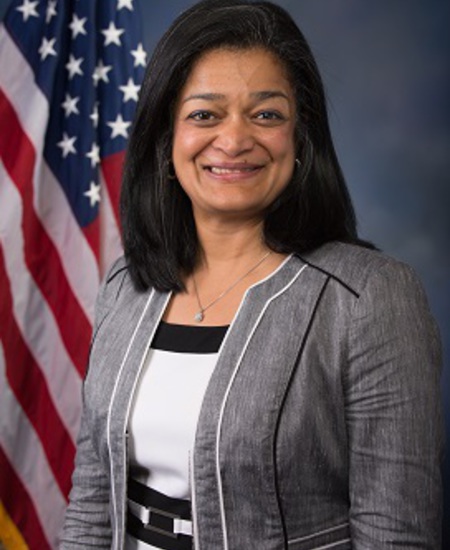
Rep. Pramila Jayapal
Sponsored bills
Maddy summaryThis bill prohibits U.S. Immigration and Customs Enforcement (ICE) from using federal funds to detain or transport U.S. citizens during civil immigration enforcement actions. It directly affects ICE operations by blocking funding for any activity that would hold or move citizens outside the U.S. under immigration laws. The key mechanism is a specific funding restriction in the bill text, stating no funds may be used for detaining or transporting citizens. This applies to all civil immigration enforcement activities defined under the Immigration and Nationality Act. The bill does not create new enforcement powers but limits how existing funds can be spent.
Maddy summaryThis bill establishes federal worker heat protection standards to prevent heat-related illness and injury. It requires employers to provide a workplace free from heat stress hazards, including access to cool water, scheduled rest breaks, shaded cooling areas, and training on heat illness symptoms. The Secretary of Labor must create these standards within one year, incorporating evidence-based practices like engineering controls (e.g., ventilation), administrative measures (e.g., adjusted schedules), and employer-paid personal protective equipment. The law directly affects all employers in high-heat work environments - such as construction, agriculture, and manufacturing - and strengthens whistleblower protections for workers reporting safety violations.
Maddy summaryThe Housing Is a Human Right Act of 2025 creates new federal programs to address homelessness and housing instability. It establishes a CDBG Plus program to fund permanent affordable housing, supportive services, and basic infrastructure like public bathrooms and rest areas for homeless individuals. The bill prohibits criminalizing homelessness (such as sleeping in public) and requires jurisdictions to adopt "Housing First" approaches that connect people to housing without preconditions like sobriety requirements. It also creates new taxes on luxury real estate sales and large landlords to fund these programs, and includes provisions to help homeless people vote by removing barriers like ID requirements. The bill directly affects people experiencing homelessness, housing instability, and those who are cost-burdened (spending over 22% of income on housing), as well as local governments and housing providers.
Maddy summaryHR 4440, the *Protecting Federal Employee Rights to Personnel Files Act of 2025*, requires federal agencies to provide current and former employees with copies of their official personnel files. Current employees must receive copies within seven days of requesting them, while employees who separated after the law's enactment get copies within seven days of separation. Former employees who separated before the law's enactment must receive copies within 21 days of requesting them from the Office of Personnel Management. The bill mandates these copies be provided in both electronic and physical formats, directly affecting all federal workers seeking access to their personnel records.
Maddy summaryThis bill would allow states to create their own universal health care systems by applying for waivers that replace federal health programs with state-based coverage. States would need to demonstrate they can cover at least 95% of residents within 5 years, maintain comparable benefits and affordability, and provide comprehensive coverage including reproductive health services. The federal government would redirect funds that would have gone to federal programs like Medicaid and Medicare to the states, with states required to submit regular reports on coverage progress and costs. The bill includes specific protections for Indian health care providers and ensures coverage for vulnerable populations without imposing new costs on them. This framework would apply to states that choose to implement their own universal health care system rather than relying on existing federal programs.
Maddy summaryHR 4387, the People's Response Act, establishes a new Division on Community Safety within the Department of Health and Human Services to fund evidence-based, nonpunitive approaches to community safety that reduce reliance on law enforcement and criminal legal systems. The bill creates four grant programs totaling $13.5 billion (2026-2030) to support community-based organizations ($4 billion), local governments ($3.5 billion), states ($3.5 billion), and first responder hiring ($2.5 billion), with specific requirements to prioritize communities disproportionately impacted by the criminal legal system. These grants mandate the use of "qualified approaches to community safety" including crisis intervention, violence prevention, community-led safety planning, and support for survivors of violence, while requiring at least 30% of funds to go to rural areas and staff hired with grant funds to earn at least $17 per hour. The bill requires recipients to submit regular reports on how funds are used and their impact on reducing criminal legal system involvement, with an emphasis on racial equity and community input. It aims to shift resources away from carceral systems toward community-driven safety solutions that address root causes of violence and support marginalized communities.
Maddy summaryThis bill directs the Department of Health and Human Services to significantly increase federal research funding for uterine fibroids ($30 million annually from 2026-2030), expand coordination of NIH research, and establish a Medicaid data system to track treatment access and costs. It mandates public education on fibroid symptoms, prevalence (especially among Black women, who face higher risk and severity), and non-hysterectomy treatment options. The bill also requires disseminating evidence-based provider resources on managing fibroids while preserving fertility. These provisions directly affect the estimated 26 million U.S. women with fibroids - particularly women of color - and aim to address the current lack of research and treatment data.
Maddy summaryThis bill directs the Health and Human Services Secretary to fund research on early detection and intervention for uterine fibroids, aiming to develop evidence-based approaches for healthcare settings. It authorizes grants to states to support screening (including advanced imaging), patient navigation services, and public education campaigns focused on early detection, with priority given to areas with socially vulnerable populations at higher risk. The bill also funds research into disparities in pain management during fibroid surgery and conditions like Asherman’s Syndrome. These provisions directly affect women with uterine fibroids, particularly in underserved communities, by expanding access to early detection services and targeted research.
Maddy summaryHR 4382 authorizes the U.S. Mint to produce commemorative coins for the 2028 Los Angeles Olympics/Paralympics and 2034 Salt Lake City Winter Olympics/Paralympics. It specifies gold, silver, and half-dollar coin designs with defined mintage limits (e.g., up to 100,000 $5 gold coins for each event), all bearing inscriptions like "2028" or "2034" and standard coin features. A surcharge ($5-$50 per coin) is added to sales, with all funds directed to the respective Olympic committees to support event hosting and legacy programs like youth sports. The bill ensures no net cost to the government by requiring surcharge revenues to cover all design, production, and marketing expenses before funds are disbursed.