

Maddy summaryThe FOSTER Act (HR 6283) creates a new federal grant program to fund opioid abuse prevention and treatment services specifically for children and caregivers in kinship care settings. It directs states and local agencies to use these funds for workforce training, health care services, and recruiting foster/adoptive parents to support kinship caregivers - defined as relatives (by blood, marriage, or adoption) raising children when biological parents cannot. The bill authorizes $255 million annually from 2028 through 2033, with 1% of funds dedicated to these services. This policy directly affects state/local agencies and kinship caregivers across the U.S., focusing on improving support systems for children in these arrangements.
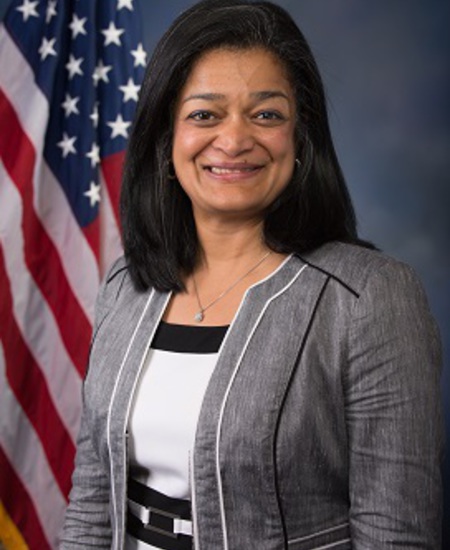
Rep. Pramila Jayapal
Sponsored bills
Maddy summaryHR 6256, the Floodplain Enhancement and Recovery Act, simplifies regulatory processes for communities and landowners undertaking projects to restore natural floodplain functions. It exempts such projects from standard flood insurance map change fees and allows limited increases in flood levels (up to 1 foot) in designated floodways, provided projects don’t harm critical infrastructure and communities submit post-completion analysis within 180 days. The bill amends existing flood insurance law to prioritize ecosystem restoration by adjusting fee and approval requirements, directly affecting local governments managing floodplains and developers working on restoration projects.
Maddy summaryHRES 899 is a symbolic House resolution recognizing the Transgender Day of Remembrance and memorializing transgender people killed by violence in 2024-2025. It directly affects transgender individuals, particularly transgender women of color, by acknowledging the epidemic of violence against them - citing 27 U.S. victims (including names like Rick Alastor Newman and Kyla Jane Walker) and 241 global cases in 2025. The resolution’s key provisions include formally recognizing the violence epidemic, memorializing specific lives lost, and affirming the need for solutions to protect transgender people. It does not create new laws but expresses congressional support for addressing systemic violence and discrimination faced by transgender communities.
Maddy summaryThis bill amends the Internal Revenue Code to reform health savings account (HSA) rules. It imposes income limits on deductible contributions (phasing out for individuals earning over $200,000 or couples over $300,000), requires receipts for medical expense reimbursements within two years, and bans HSA use for spa/beauty treatments or exercise equipment over $500 annually. It also creates a new tax on excessive HSA fees (like maintenance or transfer fees) and requires trustees to report fee details to the IRS. These changes, effective after December 31, 2025, directly affect HSA account holders seeking tax-free medical expense coverage.
Clean Cloud Act of 2025 This bill establishes an emissions standard and fee system regarding the electricity used by data centers or cryptomining facilities that exceed a specified size. Additionally, the bill appropriates collected fees for various purposes, including to fund zero-carbon electricity generation, long-duration energy storage, and grants to lower residential electricity consumer costs. The bill requires the Environmental Protection Agency (EPA) and the Energy Information Administration to annually determine the greenhouse gas emission intensity of the total annual electricity consumed by (1) covered facilities from the electric grid, and (2) covered facilities from electricity generation assets located behind the power meter of the facilities. The EPA must determine and publish the greenhouse gas emissions intensities of the electric grid of each region to establish a baseline for the assessment of fees. Each calendar year from 2027 through 2034, the baseline for each region is reduced by 11% of the original baseline. For 2035 and after, the baseline is set to zero emissions. The EPA must assess a fee on (1) owners of any electric utility providing power to a covered facility that exceeds the baseline emissions in that region for that year, and (2) covered facilities with respect to the greenhouse gas emissions from electricity generation assets located behind the power meter of the facility above the baseline of the region for that year. The electric utilities may not recoup the cost of the fee by raising rates or assessing fees on customers that are not covered facilities.
Maddy summaryHR 6181, the John Lewis Every Child Deserves a Family Act, prohibits child welfare agencies receiving federal funds from discriminating against children, youth, or prospective foster/adoptive parents based on religion, sex (including sexual orientation and gender identity), or marital status. It directly affects LGBTQ youth in foster care - overrepresented at 30% of the system - who face higher risks of trauma, group home placements, and suicide attempts compared to non-LGBTQ peers. Key provisions require agencies to collect data on sexual orientation and gender identity, establish a National Resource Center for LGBTQ youth support, provide cultural competency training, and eliminate discriminatory practices. The law aims to improve safety, permanency, and placement stability by expanding access to family-based care and ensuring equitable services for all children in the system.
Maddy summaryHR 6172, the Ending Forced Arbitration of Race Discrimination Act of 2025, prevents companies from requiring employees or consumers to use private arbitration to resolve race discrimination claims. It makes any pre-dispute arbitration agreement unenforceable for disputes involving alleged race, color, or national origin discrimination under federal, tribal, state, or local law. The bill ensures courts - not arbitrators - determine if this law applies to a case, giving people the choice to pursue claims in court instead of forced arbitration. It directly affects individuals alleging race discrimination who would otherwise be barred from court by such agreements. The law applies to claims arising on or after its enactment date.
Maddy summaryThis bill establishes fairer pay and retirement benefits for federal firefighters. It requires that overtime hours worked during a firefighter's regular schedule be included in retirement calculations, improving retirement payouts. The bill also sets a maximum 60-hour regular workweek for federal firefighters, to be defined by the Office of Personnel Management within one year. These changes directly affect federal firefighters by addressing pay disparities with municipal firefighters and enhancing recruitment and retention.
Maddy summaryHRES 581 is a procedural resolution that establishes rules for the House to consider H.R. 185, the Epstein Files Transparency Act. It waives all points of order against the bill, adopts a specific amendment (the full text of the Epstein Files Transparency Act), and limits debate to one hour equally divided between the Judiciary Committee's chair and ranking minority member. The resolution also requires the Attorney General to release unclassified DOJ records related to Jeffrey Epstein within 30 days, with limited exceptions for privacy or national security.
Maddy summaryHR 6148, the Patients Over Paperwork Act of 2025, repeals Section 71107 of Public Law 119-21, which had changed how states review Medicaid eligibility. It restores the previous rules for Medicaid eligibility redeterminations as if that section had never been enacted. This directly affects Medicaid beneficiaries and state Medicaid programs by reverting to the pre-2024 process for verifying ongoing eligibility.