

Maddy summaryHR 3962, the ESTUARIES Act, extends a deadline within the National Estuary Program. It amends Section 320(i)(1) of the Federal Water Pollution Control Act by changing the year "2026" to "2031" in a requirement related to program management. This change directly affects the National Estuary Program, which oversees coastal water quality protection and restoration efforts. The bill makes a specific procedural adjustment to the program's timeline without altering its core policies or funding.
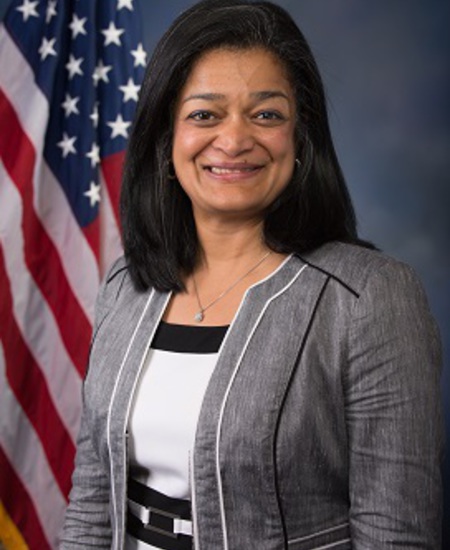
Rep. Pramila Jayapal
Sponsored bills
Maddy summaryThe Protect America's Workforce Act cancels an executive order issued on March 27, 2025, that excluded certain groups from federal labor-management relations programs, making it legally unenforceable. It also ensures that all collective bargaining agreements between federal agencies and labor unions, which were active as of March 26, 2025, remain fully effective until their agreed terms expire. This directly affects federal agencies, labor unions, and the employees covered by these agreements. The bill prevents federal funds from being used to implement the canceled executive order while preserving existing labor agreements.
Maddy summaryThe Empowering App-Based Workers Act requires digital labor platforms (like ride-hail and delivery services) to disclose how they use algorithms and electronic monitoring tools to determine worker pay and assignments. It caps the percentage of consumer payments that platforms can keep (take rate) at 25% for ride-hail services and mandates detailed weekly pay statements showing compensation, take rate, and other work metrics. The bill prohibits platforms from using algorithms to set different pay rates for similar work based on protected characteristics like race or gender. These provisions directly affect app-based workers, platform companies, and consumers, aiming to create more transparent and fair working conditions in the gig economy. The bill does not override existing state or local laws that provide greater protections for workers.
Maddy summaryThe Keeping All Students Safe Act prohibits the use of unlawful seclusion and restraint in schools receiving federal funding, including physical restraint that restricts breathing or blood flow, chemical restraint not prescribed for medical treatment, and mechanical restraint. The bill requires schools to use less restrictive interventions first, mandates that staff using physical restraint be trained and certified through State-approved programs, and requires immediate parent notification after any restraint incident. States must develop plans to monitor compliance, collect and report data on restraint incidents (disaggregated by race, disability status, and school type), and implement positive behavioral interventions. The bill provides $40 million annually for five years to support states in implementing these requirements and improving school climate through evidence-based approaches.
Maddy summaryThis bill amends the Higher Education Act to extend the loan limits for graduate and professional students indefinitely. It removes the previous expiration date (June 30, 2026) for these limits, meaning graduate and professional students will continue to have access to the same federal loan amounts without a set end date. The key change modifies Section 455(a) by eliminating the sunset provision and updating the effective date language in the law. This directly affects students pursuing advanced degrees who rely on federal loans for tuition and living expenses. The bill makes a technical adjustment to existing student loan policy without creating new benefits or altering eligibility criteria.
Maddy summaryThis concurrent resolution (HCONRES 65) is a symbolic congressional commendment of state and local governments that have affirmed reproductive rights as human rights. It recognizes efforts by jurisdictions like Carrboro, North Carolina; Austin, Texas; and Fulton County, Georgia, which passed resolutions or proclamations declaring abortion access a human right and condemning criminalization of pregnancy outcomes. The resolution urges states to repeal restrictive abortion laws and protect access to reproductive care, but it does not create new legal requirements or fund programs. As a procedural resolution, it has no binding effect on federal or state law.
Maddy summaryHR 6565, the Reuniting Families Act, would significantly reform family-based immigration by reclassifying spouses, permanent partners, and minor children of legal permanent residents as "immediate relatives," eliminating current visa backlogs for these family members. The bill creates a new legal definition of "permanent partner" to provide equal treatment for same-sex partners in immigration processes, expanding eligibility for family-based visas. It increases the worldwide level of family-sponsored immigrant visas and adjusts allocation numbers to reduce processing delays, while also providing specific relief for orphans, widows, widowers, and certain Filipino veterans. The bill also expands refugee family reunification provisions and increases diversity visa numbers from 55,000 to 80,000. These changes would directly affect family members seeking to reunite with U.S. citizens or legal permanent residents through family-based immigration pathways.
Maddy summaryHR 6589, the Ranked Choice Voting Act, would require all states to implement ranked choice voting for elections of U.S. Senators and Representatives, including primaries and general elections. Under this system, voters would rank candidates in order of preference, with ballots tabulated by eliminating the least preferred candidate in successive rounds until a candidate achieves a majority. The bill prohibits separate runoff elections for these offices and provides federal funding to states to cover implementation costs, with payments due by June 1, 2026. The law would apply to federal elections held on or after January 1, 2030, and would not affect state or local elections.
Maddy summaryThe Military in Law Enforcement Accountability Act requires the President to submit detailed justification to Congress before the military provides support to civilian law enforcement, including specific budget, timeline, and funding details, with a 30-day limit on such support unless Congress approves a longer period through a specific joint resolution process. It prohibits Department of Defense personnel (including military members) from holding civilian law enforcement positions concurrently, with limited exceptions for reserve members who must recuse during active duty. The bill also removes the military's authorization to deploy for "civil disturbances" without the new approval process and establishes a private right for individuals or governments to sue the federal government for violations. This directly affects the Department of Defense, military support to local police agencies, and DoD personnel's dual employment policies.
Maddy summaryHRES 926, the RESPECT Resolution, is a non-binding House resolution urging states to adopt equity-focused cannabis policies. It recommends specific actions to address racial disparities, including eliminating criminal penalties for cannabis possession, creating fairer business licensing (prioritizing communities harmed by past enforcement), automatically expunging cannabis convictions, and reinvesting tax revenue in affected communities. The resolution also calls for the U.S. to advocate at the United Nations for cannabis descheduling from international drug treaties. It directly affects states, localities, and communities disproportionately impacted by cannabis prohibition, particularly communities of color.