Emergency Grant Aid for College Students Act This bill directs the Department of Education to establish a grant program for institutions of higher education to provide emergency financial-aid grants to students.
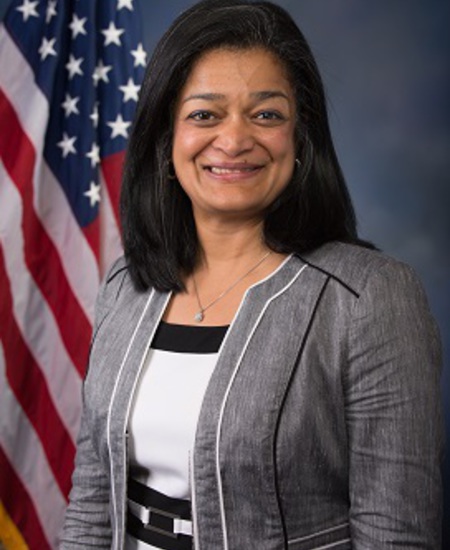
Rep. Pramila Jayapal
Sponsored bills
Telemental Health Parity Act of 2022 This bill requires private health insurance plans to apply benefits for mental health or substance use disorder services that are furnished via telehealth in the same manner as those services that are furnished in person. Under current mental health parity rules, insurance plans that provide benefits for mental health or substance use disorder services are generally required to make those benefits comparable to the benefits the plan provides for medical and surgical care.
Stop Anti-Abortion Disinformation Act or the SAD Act This bill prohibits advertisements that use deceptive or misleading statements related to the provision of abortion services. Abortion services include (1) surgical and non-surgical procedures to terminate a pregnancy, or (2) providing referrals for such procedures. The Federal Trade Commission must promulgate rules to implement the prohibition, and the bill provides for enforcement by the commission.
My Body, My Data Act of 2022 This bill establishes protections, subject to certain limits, for personal reproductive or sexual health information. This includes information relating to past, present, or future surgeries or procedures, such as the termination of a pregnancy. Specifically, commercial entities, including individuals, nonprofits, and common carriers, may not collect, retain, use, or disclose personal reproductive or sexual health information except (1) with the express written consent of the individual to whom such information relates, or (2) as is strictly necessary to provide a requested product or service. Commercial entities also must provide individuals with access to, and a reasonable mechanism to delete, any of their reproductive or sexual health information upon request. Further, commercial entities must maintain and publish a privacy policy describing their practices with respect to such information. The bill's provisions do not apply to entities that are subject to certain existing health-related privacy regulations, such as the privacy regulations issued under the Health Insurance Portability and Accountability Act of 1996. Additionally, the provisions do not apply to the disclosure of personal reproductive or sexual health information for the publication of newsworthy information of legitimate public concern. The bill provides for enforcement by the Federal Trade Commission and by private civil actions.
Save America’s Forgotten Equines Act of 2021 or the SAFE Act of 2021 This bill prohibits the transporting, receiving, possessing, purchasing, selling, or donation by a person of an equine (e.g., horse) that the person has reason to believe will be slaughtered for human consumption.
This resolution celebrates the 50th anniversary of the Federal Pell Grant program and expresses support for the designation of National Federal Pell Grant Day.
Good Jobs for Good Airports Act This bill addresses pay, benefits, and labor standards for certain airport service workers. Airport service workers include security officers, food service workers, cleaning staff, ticketing agents, and retail service workers. Specifically, the bill establishes a minimum wage and benefit standard for such airport service workers at large, medium, and small hub airports. It also prohibits small, medium, and large hub airports from accessing federal funds for airport development projects unless the airports certify that such airport service workers are paid no less than the higher of $15 per hour, the applicable state or local minimum wage and fringe benefits, or the prevailing wage and fringe benefits required under the Service Contract Act as established by the Department of Labor.
This resolution calls on the President to embrace the goals and provisions of the Treaty on the Prohibition of Nuclear Weapons and make nuclear disarmament the centerpiece of U.S. national security policy. It also calls on the United States to lead a global effort to prevent nuclear war.
This resolution recognizes the historical significance to the nation of Juneteenth Independence Day (commemorating the end of slavery in the United States).
Recovering America’s Wildlife Act of 2022 This bill provides funding for the conservation or restoration of wildlife and plant species of greatest conservation need, including endangered or threatened species, and establishes related requirements. TITLE I--WILDLIFE CONSERVATION AND RESTORATION (Sec. 101) This title establishes and funds a subaccount of the Wildlife Conservation and Restoration Account, which was established under the Pittman-Robertson Wildlife Restoration Act. The subaccount must be used to support efforts of states, territories, or the District of Columbia to recover and manage wildlife and plant species of greatest conservation need. The Department of the Interior must use a portion of the funding from the subaccount for grants to state fish and wildlife departments, the District of Columbia fish and wildlife department, fish and wildlife departments of territories, nonprofit organizations, or regional associations of fish and wildlife departments. The grants must be used for innovative recovery efforts for species of greatest conservation need, species listed as endangered or threatened species, or the habitats of such species. Funding for the subaccount must supplement existing funds available to the states from funds distributed under the Dingell-Johnson Sport Fish Restoration Act and the Wildlife Conservation and Restoration Account. Recipients of the funding from the subaccount must match federal funds as specified by the title. The Government Accountability Office must study and report on the progress of states, territories, the District of Columbia, and Indian tribes in protecting species of greatest conservation need, endangered species, and threatened species. TITLE II--TRIBAL WILDLIFE CONSERVATION AND RESTORATION (Sec. 201) This title establishes and funds a Tribal Wildlife Conservation and Restoration Account to support Indian tribes' efforts to recover and manage wildlife and plant species of greatest conservation need. Indian tribes are not required to provide matching funds. TITLE III--ENDANGERED SPECIES RECOVERY AND HABITAT CONSERVATION LEGACY FUND (Sec. 301) This title establishes and funds through FY2026 the Endangered Species Recovery and Habitat Conservation Legacy Fund. The U.S. Fish and Wildlife Service must use the fund to (1) implement an Endangered Species Recovery Grant Program; (2) address its interagency consultation responsibilities under the Endangered Species Act of 1973; (3) work with nonfederal entities to conserve wildlife habitat and at-risk species, threatened or endangered species, or species proposed to be listed as threatened or endangered species; or (4) address the development and permitting of voluntary conservation agreements under such act. Amounts made available under the fund must supplement other federal amounts made available to carry out such activities. The President must annually submit to Congress, together with the annual budget of the United States, a list of threatened species and endangered species for which recovery plans will be developed or implemented with amounts from the Endangered Species Recovery and Habitat Conservation Legacy Fund. TITLE IV--REPORT (Sec. 401) Interior must also report on information concerning the amount of grants and contracts that were awarded or are allocated under this bill to Historically Black Colleges and Universities, Hispanic-serving educational institutions, tribally controlled colleges and universities, minority-serving educational institutions, minority-owned business enterprises, women-owned business enterprises, and community-based organizations that are principally administered by, operated by, or serving minority communities.