

Active Shooter Alert Act of 2022 This bill requires a designated officer of the Department of Justice to act as the national coordinator of an Active Shooter Alert Communications Network regarding an emergency involving an active shooter. The bill sets forth duties of the coordinator, including to work with state, tribal, and local governments to encourage coordination of various elements of the network. The coordinator must also encourage federal, state, local, and tribal government agencies to establish procedures for responding to active shooters. Finally, the bill requires the Government Accountability Office to study and report on state and local responses to active shooters and situations requiring the issuance of a public alert or warning.
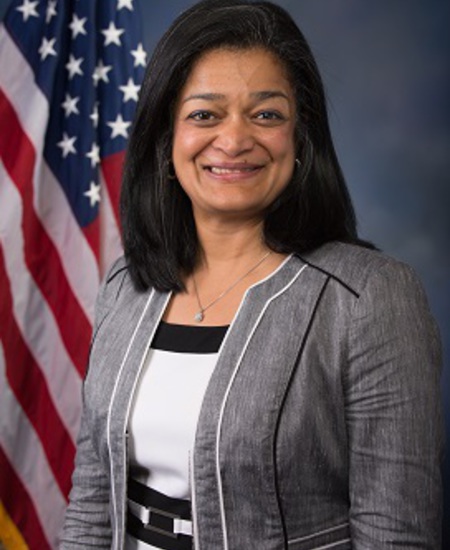
Rep. Pramila Jayapal
Sponsored bills
Promoting a Resolution to the Tibet-China Conflict Act This bill addresses issues relating to Tibet, including by establishing a statutory definition of Tibet that includes areas in Chinese provinces outside the Tibet Autonomous Region (TAR). For the purposes of U.S. policies and activities relating to Tibet, this bill defines Tibet to include the TAR and the Tibetan areas of the Qinghai, Sichuan, Gansu, and Yunnan provinces. (Generally, when China's government refers to Tibet, it means only the TAR, while Tibetan exile groups consider historical Tibet to include the TAR as well as areas in the provinces included in this bill's definition. China's government formally established the TAR in 1965.) Furthermore, the objectives of the Office of the U.S. Special Coordinator for Tibetan Issues shall include working to ensure that U.S. government statements and documents counter disinformation about Tibet by China's government and the Chinese Communist Party, including disinformation about Tibet's history and institutions. The bill also authorizes the office to take other actions to counter such disinformation. This bill also states that it is U.S. policy that the conflict between Tibet and China is unresolved and that Tibet's legal status remains to be determined in accordance with international law.
Public Health Air Quality Act of 2022 This bill requires the Environmental Protection Agency to take specified actions related to monitoring and improving air quality, including by implementing a program to administer or conduct emissions measurement and quantification, promulgating regulations related to specified source categories, and deploying not fewer than 1,000 air quality sensors.
Tax Filing Simplification Act of 2022 This bill directs the Internal Revenue Service (IRS) to establish a free on-line tax preparation and filing service and allows taxpayers to access third-party provided tax return information and information held by the IRS. The bill prohibits the IRS from entering into any agreement that restricts its legal right to provide tax return preparation services or to provide tax return filing services. The bill requires the IRS to establish and operate programs to (1) facilitate claims for the child care and the earned income tax credits, (2) provide software for the preparation and filing of individual income tax returns for taxable years beginning after 2022, (3) allow taxpayers to download third-party provided return information and IRS-held information to their tax returns, and (4) allow taxpayers to elect to have their tax returns prepared by the IRS. The bill also requires verification of taxpayer identity and requires the IRS to conduct an outreach campaign to provide the public with information about this bill's programs and software.
Speak Out Act This bill prohibits the judicial enforceability of a predispute nondisclosure clause or predispute nondisparagement clause in a sexual assault dispute or sexual harassment dispute involving conduct that allegedly violates federal, tribal, or state law.
Assuring Medicare’s Promise Act This bill increases net investment income tax revenues by applying such tax to the trade or business income of certain high income taxpayers and includes the increased tax revenues in the Federal Hospital Insurance Trust Fund.
LGBTQ I+ Data Inclusion Act This bill addresses federal data collection of voluntary, self-disclosed information on sexual orientation, gender identity, and variations in sex characteristics. Specifically, the bill requires federal agencies that collect information through a survey for statistical purposes that includes demographic data (where subjects self-report information or a proxy provides information about the subject or responds for all persons in a household) to review existing data sets to determine which data sets do not include information about sexual orientation, gender identity, and variations in sex characteristics. Such agencies must assess needed changes in survey methods related to asking questions on such matters. Agencies that publish reports relying on survey demographic data must include information on sexual orientation, gender identity, and variations in sex characteristics. Agencies may waive this publication requirement on a case-by-case basis if the confidentiality of the information cannot be maintained or if adding such information to the survey would impair the agency's ability to preserve the utility, accuracy, or objectivity of the survey while also generating relevant evidence about the LGBTQI+ community. The Government Accountability Office must report to Congress on the implementation of this bill's requirements by agencies.
This bill bars state or local officials from prohibiting or restricting the possession, sale, purchase, transportation, or use of contraceptives (i.e., drugs or devices that are primarily used to prevent pregnancy). Individuals or the Department of Justice may bring civil actions for violations of this bill.
Break Free From Plastic Pollution Act of 2021 This bill sets forth requirements and incentives to reduce the production of a variety of products and materials, including plastics, and increase efforts to collect, recycle, or compost products and materials. The bill makes certain producers of products (e.g., packaging, paper, single-use products, beverage containers, or food service products) fiscally responsible for collecting, managing, and recycling or composting the products after consumer use. In addition, the bill establishes (1) minimum percentages of products that must be reused, recycled, or composted; and (2) an increasing percentage of recycled content that must be contained in beverage containers. Beginning on January 1, 2023, the bill phases out a variety of single-use products, such as plastic utensils. The bill also sets forth provisions to encourage the reduction of single-use products, including by establishing programs to refund consumers for returning beverage containers and by establishing a tax on carryout bags. The bill creates a temporary moratorium on new or expanded permits for certain facilities that manufacture plastics until regulations are updated to address pollution from the facilities. The Environmental Protection Agency (EPA) must publish guidelines for a national standardized labeling system for recycling and composting receptacles. Producers must include labels on their products that are easy to read and indicate whether the products are recyclable, compostable, or reusable. The EPA must also ensure that certain clothes washers have filtration units as required by this bill. Finally, the bill establishes limitations on the export of plastic waste to other countries.
Health Equity and Accountability Act of 2022 This bill directs the Department of Health and Human Services (HHS) and others to undertake efforts to reduce health disparities. For example, the bill (1) requires more detailed reporting of demographic and health disparities data, including related to public health emergencies; (2) directs certain components of HHS to support health workforce diversity; and (3) increases access to culturally and linguistically appropriate health care. The bill also modifies eligibility and other requirements for Medicare, Medicaid, private health insurance, nutrition assistance, and other programs to reduce health disparities among vulnerable populations. The bill includes specific provisions with respect to noncitizens; maternal, infant, and child health; mental and behavioral health; specified conditions that disproportionately affect racial and ethnic minority groups, such as certain cancers, HIV/AIDS, kidney disease, and diabetes; investments in communities facing health and other inequities; and nondiscrimination in the provision of services in federally supported health programs. Additionally, the bill (1) revises health information technology programs to address health disparities, and (2) supports health impact assessments and other efforts pertaining to environmental justice and social determinants of health (i.e., nonmedical factors that influence health outcomes, such as income and educational attainment). The bill also requires various studies and reports on issues related to health care and health disparities, including a report by the Government Accountability Office on health workforce diversity.