

Maddy summaryThe TRACK Act of 2023 requires federal agencies (including HHS, NIH, Defense, and Veterans Affairs) to create a public database tracking all government funding for biomedical research and development. It compiles specific details about contracts, grants, licensing agreements, and tax benefits related to drug, device, and therapy development - including funding amounts, recipient organizations, product names/prices, and patent information. The database must be searchable by the public within one month of the bill’s enactment and updated every two weeks. This directly affects federal agencies managing biomedical funding and the private companies, institutions, and researchers receiving that support. The goal is to increase transparency about how taxpayer dollars fund medical product development.
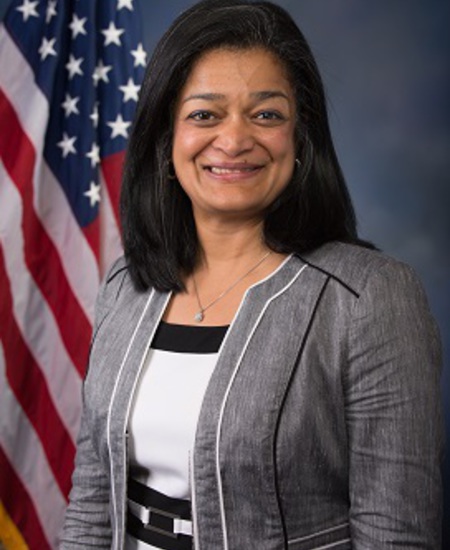
Rep. Pramila Jayapal
Sponsored bills
Maddy summaryHCONRES 23 is a non-binding resolution expressing Congress's support for recognizing March 10, 2023, as "Abortion Provider Appreciation Day." It honors abortion providers and clinic staff for delivering essential reproductive healthcare amid increased restrictions following the Supreme Court's Dobbs decision, which overturned Roe v. Wade. The resolution condemns the Dobbs ruling, affirms Congress's commitment to protecting providers' safety, and emphasizes ensuring access to abortion care. As a symbolic gesture, it does not create new laws or change existing policies.
Maddy summaryThe New Deal for New Americans Act of 2023 establishes a National Office of New Americans within the Executive Office of the President to coordinate federal efforts supporting immigrant and refugee integration. It creates several grant programs to provide legal assistance, English language training, and workforce development for immigrants, with specific provisions to reduce financial barriers to citizenship through fee waivers and modifications to English language requirements for seniors. The bill also establishes a "Proud to Be a United States Citizen Program" to promote naturalization and creates automatic voter registration for newly naturalized citizens. These provisions directly affect immigrants and refugees seeking citizenship and integration support, as well as federal agencies responsible for immigration services. The bill aims to improve access to citizenship, enhance integration into American society, and support refugees through comprehensive federal coordination.
Maddy summaryHR 1423, the 911 Community Crisis Responders Act of 2023, provides federal grants to states, tribes, and local governments to establish unarmed mobile crisis response teams. These teams respond to nonviolent 911 calls involving mental health, substance use, homelessness, or disabilities - instead of sending police - offering services like de-escalation, referrals to treatment, and transportation. The bill requires teams to operate in groups of two or more, avoid law enforcement oversight, and coordinate with 911 systems to triage calls. Grantees must collect data on call volumes, demographics, and outcomes like reduced ER visits, with reports submitted biannually to the Secretary and Congress.
Maddy summaryThis bill authorizes a Congressional Gold Medal to honor the "Hello Girls" - female telephone operators who served in the Army Signal Corps during World War I. They provided critical battlefield communications in France (connecting 26 million calls), wore military uniforms, and faced combat risks, but were denied veteran benefits for 60 years due to being classified as civilian contractors. The medal recognizes their pioneering service, devotion, and the decades-long struggle to gain military recognition. The award follows similar recognition for other WWII women veterans and aims to correct the historical injustice they faced.
Maddy summaryThe SVB Act (HR 1602) repeals Title IV of the 2018 Economic Growth, Regulatory Relief, and Consumer Protection Act, which had relaxed banking regulations. It directly affects banks previously subject to those relaxed rules, particularly smaller institutions that benefited from the 2018 changes. The bill’s key mechanism is restoring the pre-2018 regulatory framework, reversing the specific provisions that eased oversight. This returns banking oversight to the structure that existed before the 2018 law took effect, without creating new rules.
Maddy summaryHRES 219 is a symbolic resolution (not a binding bill) expressing the House’s support for inclusive public schools. It urges schools to adopt historically accurate, diverse educational materials that reflect the nation’s diversity, foster parent-educator partnerships, and eliminate discrimination based on race, disability, LGBTQ+ identity, or other factors. The resolution emphasizes creating safe, well-rounded learning environments that prepare all students for success while protecting students’ civil rights. It directly affects public school districts, educators, families, and students by encouraging practices that promote equity and inclusion.
Maddy summaryHRES 185 is a non-binding House resolution declaring racism a public health crisis in the United States. It directly affects communities of color - including Black, Latino, Native American, and Asian American populations - who experience significant health disparities like higher infant mortality rates, shorter life expectancy, and worse outcomes for conditions like heart disease and diabetes. The resolution cites evidence showing racism meets all four public health crisis criteria (widespread impact, unfair distribution, preventable, and lacking current solutions) and calls for a nationwide strategy to dismantle systemic racism and address its health impacts. It does not create new laws or funding but urges federal agencies to prioritize racial equity in health policy.
Mental Health in International Development and Humanitarian Settings Act or the MINDS Act This bill authorizes and requires certain actions by the U.S. Agency for International Development (USAID) to integrate mental health and psychosocial support (MHPSS) activities across U.S. development and humanitarian assistance programs. The bill authorizes USAID to designate an MHPSS coordinator. The coordinator's duties include (1) guiding, overseeing, and directing MHPSS programming and integration across U.S. development and humanitarian assistance programs; and (2) promoting best practices, coordination, and reporting in MHPSS across such programs. Focus populations for the coordinator include adult caretakers, children separated from a family unit, and displaced populations. In addition, the bill establishes a working group comprised of representatives from relevant USAID bureaus, the Department of State, and other federal agencies. The purpose of the working group is to ensure continuity and integration of MHPSS across U.S. development and humanitarian assistance programs. The provisions of the bill expire five years after enactment.
Maddy summaryHR 1499, the Good Jobs for Good Airports Act, requires airports receiving federal funding to pay covered service workers a minimum wage of at least $15 per hour (or higher if state/local laws or federal standards require it) and provide minimum fringe benefits. It directly affects workers in specific airport roles like security, ticketing, concessions, cleaning, and ramp services at small, medium, or large hub airports. The bill mandates annual certification from airport operators to verify compliance with these wage and benefit standards, tied to eligibility for federal airport grants under the Infrastructure Investment and Jobs Act. It does not override stricter state or local laws but ensures minimum standards for workers supporting airport operations.