

Maddy summaryThis bill extends workplace safety protections under the Occupational Safety and Health Act to people working in correctional facilities, including those in prison labor programs, work release, and maintenance roles. It requires states and federal prisons to annually report on safety conditions, injuries, and compliance with safety standards, beginning two years after enactment. The bill also creates $20 million annually in federal grants to help states update their safety laws and enforcement for incarcerated workers. These provisions directly affect incarcerated individuals performing labor in state or federal correctional facilities and the agencies operating them.
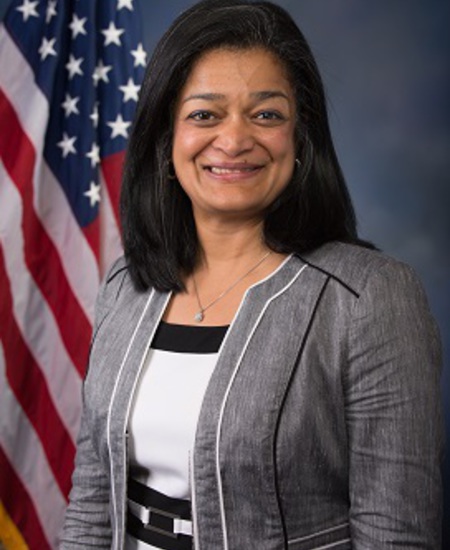
Rep. Pramila Jayapal
Sponsored bills
Maddy summaryThis bill requires U.S. public schools to include Asian Pacific American history in all K-12 American history and civics education. It amends the Elementary and Secondary Education Act to mandate that curriculum standards, teacher training, and national assessments explicitly cover this history as part of American history. The policy directly affects students and teachers nationwide by changing how history is taught in public schools. The key mechanism is requiring specific curriculum updates to address gaps in current Eurocentric teaching, ensuring students learn about APA contributions, experiences, and challenges as integral to U.S. history.
Maddy summaryHR 2689, the Trust in Government Act of 2023, requires federal agencies to modernize service delivery by creating online tools and reducing paperwork for citizens. It directly affects the public interacting with agencies, mandating specific changes like fully online passport renewals (State Department), expanded IRS electronic filing options (Treasury), centralized online permitting (Interior), simplified SNAP/WIC enrollment (Agriculture), and Social Security document uploads (HHS). Key provisions eliminate physical document requirements where possible, introduce telehealth for workers' compensation (Labor), and establish a single digital platform for veterans' services (VA). Agencies must certify compliance to the Office of Management and Budget (OMB) within 180 days, with quarterly reports to Congress on progress. The law aims to improve public perception of government interactions by making services more efficient and accessible.
Maddy summaryThe Transit to Trails Act establishes a federal grant program to fund transportation projects connecting critically underserved communities - defined as areas lacking adequate park access, low-income, communities of color, or environmental justice areas - to public lands and recreational spaces. Eligible entities, including states, local governments, tribal organizations, and park districts, can apply for grants to develop transportation connectors (like bus routes) and culturally appropriate education materials, with priority for projects using low-emission vehicles and offering discounted fares for low-income riders. Grants range from $25,000 to $500,000, with federal funding covering up to 80% of costs, and recipients must report on demographics served and project outcomes. The program is funded at $40 million annually in its fifth year, aiming to improve mobility to parks and recreation in communities historically excluded from such access.
Maddy summaryThis bill requires airlines to publish cargo hold dimensions online and offer refunds if a traveler's wheelchair (powered, manual, or scooter) cannot fit. It mandates annual reports tracking wheelchair mishandling (damage, loss, or delay) by type and directs research into whether passengers could safely remain seated in their wheelchairs during flights. The law aims to improve accessibility for travelers with disabilities who rely on mobility devices, with research focusing on costs, demand, and safety for in-cabin wheelchair seating. The Department of Transportation must report findings to Congress within specified timelines.
Maddy summaryHCONRES 37 is a non-binding congressional resolution expressing that Congress views climate change as an emergency requiring a massive national mobilization. It states that human-caused climate change severely impacts U.S. economic well-being, health, safety, and national security, and urges the President to use existing authorities to accelerate climate action. The resolution does not create new laws or funding but emphasizes the need for urgent, equitable efforts to reduce emissions, address environmental injustice, and support vulnerable communities disproportionately affected by climate impacts. It cites rising global temperatures, extreme weather costs ($165 billion in U.S. disasters in 2022), and the Inflation Reduction Act as context, while clarifying it does not declare an actual national emergency.
Defending the Human Rights of Palestinian Children and Families Living Under Israeli Military Occupation Act This bill limits U.S. assistance to Israel and establishes reporting requirements related to Israel's activities in the West Bank and its expenditures for offshore procurement. (Offshore procurement involves spending U.S. security assistance from the Foreign Military Financing program on Israeli-origin rather than U.S.-origin defense articles.) Specifically, the bill prohibits the use of any funds that are made available for assistance to Israel to support (1) military detention, interrogation, abuse, or ill treatment of Palestinian children; (2) seizure, appropriation, or destruction of Palestinian property and forcible transfer of civilians in the Israeli-controlled West Bank; or (3) certain activities to facilitate unilateral annexation by Israel of West Bank territory. The Department of State must report on the nature and extent of such activities carried out by Israel. Further, the Government Accountability Office must submit to Congress a report on related topics, such as (1) identifying specific programs and items to which funds for offshore procurement in Israel have been allocated, (2) identifying all end-use monitoring to which Israel is subject with respect to U.S.-origin defense articles, and (3) assessing the extent to which offshore procurement funds have supported illegal Israeli settlement activity in the occupied West Bank.
Maddy summaryThe SAFE Banking Act of 2023 would protect banks and financial institutions that provide services to state-legal marijuana businesses and hemp-related businesses by preventing federal regulators from taking adverse actions against them solely for serving these businesses. It clarifies that income from state-legal marijuana businesses can be considered for mortgage applications, and requires regulators to update guidance on suspicious activity reports related to these businesses. The bill does not require financial institutions to serve these businesses, but ensures they won't face penalties for doing so. It extends similar protections to hemp-related businesses, which have faced banking challenges despite being federally legal under the 2018 Farm Bill.
Maddy summaryHRES 356 is a non-binding House resolution supporting the designation of May 4, 2023, as a "National Day of Reason." It does not create new laws or affect any individuals or groups directly, as it is a symbolic gesture of support. The resolution encourages all citizens to observe this day, emphasizing reason, critical thinking, the scientific method, and free inquiry as vital to addressing societal challenges and advancing human welfare. It cites historical context, including the Founders' emphasis on reason and James Madison's views on knowledge as essential to liberty. The resolution was introduced by Rep. Raskin and others in May 2023, with no further legislative action noted.
Maddy summaryThis bill prohibits forced arbitration for race discrimination claims under federal, tribal, state, or local law. It makes pre-existing arbitration agreements unenforceable for disputes involving discrimination based on race, color, or national origin, allowing affected individuals to pursue cases in court instead. The law directly impacts employees, job applicants, and others facing alleged race discrimination who would otherwise be barred from court by mandatory arbitration clauses. It requires courts - not arbitrators - to decide if the law applies to a dispute, ensuring legal clarity for affected parties.