Vet Center Support Act This bill requires the Department of Veterans Affairs (VA) to report on the mental health care furnished by the VA to veterans in states and territories of the United States that have a ratio of one Vet Center per 100,000 or more veterans.
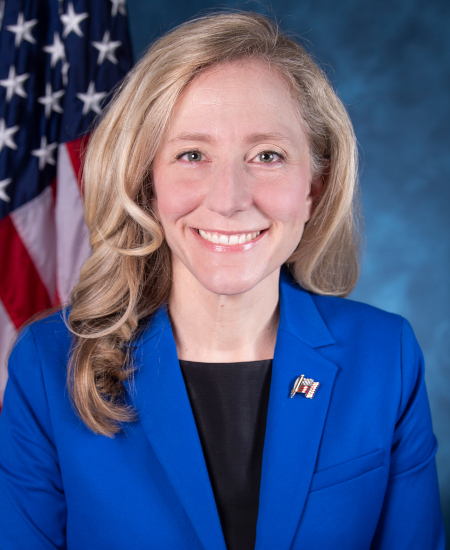
Rep. Abigail Davis Spanberger
Sponsored bills
Veterans Burn Pits Exposure Recognition Act of 2021 This bill requires the Department of Veterans Affairs (VA) to concede, for the purposes of health care benefits and wartime disability compensation, that a veteran was exposed to certain toxic substances, chemicals, and hazards from burn pits if such veteran served on active duty in a covered location during a specified time frame (unless there is affirmative evidence to establish that the veteran was not exposed during such service). A burn pit is an area used for burning solid waste in open air without equipment. Specifically, the bill covers the following locations and corresponding time periods: Iraq between August 2, 1990, and February 28, 1991, as well as from March 19, 2003, until burn pits are no longer used in this location; Somalia and Southwest Asia (including Kuwait, Saudi Arabia, Oman, and Qatar) from August 2, 1990, until burn pits are no longer used in these locations; and Afghanistan, Syria, Jordan, Egypt, Lebanon, Yemen, Uzbekistan, the Philippines, and Djibouti from September 11, 2001, until burn pits are no longer used in these locations. Under the bill, if an exposed veteran submits insufficient evidence to establish a service-connection for purposes of disability compensation, the VA shall provide a medical examination and request a medical opinion regarding a causal link between the disability and a toxin, chemical, or hazard.

This resolution recognizes and expresses support for the efforts of democracy and human rights activists in Cuba.
Joint Chiefs Landscape Restoration Partnership Act of 2021 This bill directs the Department of Agriculture (USDA) to establish a Joint Chiefs Landscape Restoration Partnership program to improve the health and resilience of forest landscapes across National Forest System lands and state, tribal, and private lands. Activities under the program may include reducing the risk of wildfire, protecting water quality and supply, or improving wildlife habitat for at-risk species.
Repairing Existing Public Land by Adding Necessary Trees Act or the REPLANT Act This bill directs the Department of Agriculture (USDA) annually for each of the 10 years after enactment of this bill to transmit to Congress an estimate of the sums necessary to be appropriated, in addition to the funds available from other sources, to replant and otherwise treat an acreage equal to the acreage to be cut over that year, plus a sufficient portion of the backlog of lands found to be in need of treatment to eliminate the backlog within the 10-year period. After such 10-year period, USDA shall transmit annually to Congress an estimate of the sums necessary to replant and otherwise treat all lands being cut over and maintain planned timber production on all other forested lands in the National Forest System to prevent the development of a backlog of needed work larger than the needed work at the beginning of the fiscal year. Each reforestation activity included in a renewable resource assessment shall be carried out in accordance with applicable Forest Service management practices and definitions, including definitions relating to silvicultural practices and forest management. The Forest Service shall, based on recommendations from regional foresters, create a priority list of reforestation projects that primarily take place on priority land, promote effective reforestation following unplanned events, and may include activities to ensure adequate and appropriate seed availability. USDA shall give priority to projects on the priority list.
This resolution expresses support for the designation of Journeyman Lineworkers Recognition Day. (A journeyman lineworker is a person who builds and maintains electrical power systems.)
Preserving Rules Ordered for The Entities Covered Through 340B Act of 2021 or the PROTECT 340B Act of 2021 This bill prohibits pharmacy benefit managers (PBMs) and health insurance plans from discriminating against health providers participating in the 340B drug pricing program, including pharmacies contracted with such providers to dispense 340B drugs. The 340B program allows certain providers to receive covered outpatient drugs at reduced prices from manufacturers. Specifically, PBMs and insurance plans may not reimburse 340B participants at a lower rate than other entities not participating in the program; impose differing terms (such as fees, charge-backs, or audits) on 340B participants; interfere with an individual's choice to receive drugs from a 340B participant; require 340B participants to identify which drugs fall within the program; or refuse to contract with a 340B participant on the basis that they utilize the program. Violations of this bill are subject to a civil penalty of not more than $5,000 per violation per day. These prohibitions also apply to prescription drug (Part D) sponsors under Medicare. The bill also provides for a process to prevent duplicate 340B drug discounts to states under Medicaid.
This bill repeals the joint resolution of March 9, 1957, that provided for the use of certain funds to promote peace and stability in the Middle East.
This bill repeals the January 14, 1991, resolution authorizing the use of military force against Iraq.
Trans-Sahara Counterterrorism Partnership Program Act of 2021 This bill provides statutory authority for the Trans-Sahara Counterterrorism Partnership Program, an interagency program launched in 2005 to partner with countries in the Sahel and Maghreb regions of Africa to counter terrorism and violent extremism. The Department of State, in consultation with the Department of Defense and the U.S. Agency for International Development, shall establish the partnership program, which must coordinate all U.S. programs in North and West Africa related to various counterterrorism activities, such as building foreign-military capacity, enhancing border security, promoting youth employment, and supporting independent media to counter terrorist propaganda. The State Department must submit comprehensive, five-year strategies that include specified activities for the Sahel and Maghreb regions and for program counterterrorism efforts. Further, program activities must, among other things (1) be carried out in countries where there is an adequate level of partner country committment, and (2) have clearly defined outcomes and specific plans with indicators to regularly monitor and evaluate outcomes and impact. Such activities must also take into account the counterterrorism and development strategies of partner countries and align with such strategies to the extent possible. The State Department shall notify Congress before obligating funds for such programs, and must submit annual reports about program activities.