Protecting Ballot Measures From Foreign Influence Act This bill prohibits contributions or donations by foreign nationals in connection with state or local ballot initiatives or referenda.
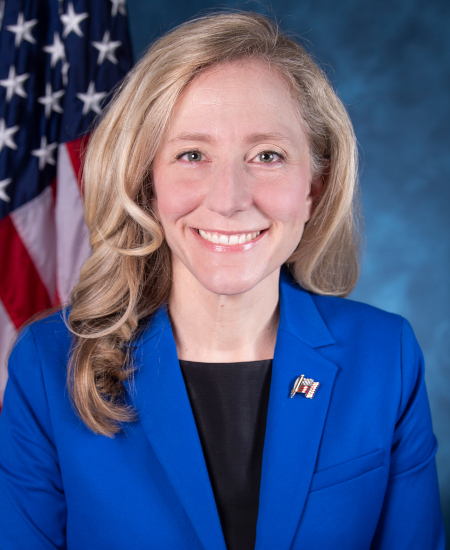
Rep. Abigail Davis Spanberger
Sponsored bills
Critical Infrastructure Manufacturing Feasibility Act This bill requires the Department of Commerce to study and report on products that are in high demand across the critical infrastructure sectors. Critical infrastructure sectors are those whose assets, systems, and networks are vital to national security, the economy, public health or safety, or any combination of those matters. The study must (1) identify the products in high demand across those sectors that are being imported due to manufacturing, material, or supply chain constraints; and (2) analyze the costs, benefits, and feasibility of manufacturing those products in the United States.
Radiation Exposure Compensation Act Amendments of 2021 This bill expands two programs that compensate individuals who were exposed to radiation during certain nuclear testing or uranium mining and subsequently developed medical conditions, including cancers. First, the bill expands and extends a program that compensates individuals who were exposed to radiation from atmospheric nuclear testing or other sources and subsequently developed specified cancers. Under current law, this program compensates individuals who were present in a designated geographic area during a period of nuclear testing and certain individuals employed in uranium mining. The bill expands the designated areas to include Colorado, Idaho, Montana, New Mexico, and Guam and additional areas in Arizona, Nevada, and Utah; makes more individuals who worked in uranium mining eligible for the program; increases the amount of compensation awarded to and provides medical benefits for eligible claimants; and extends for 19 years following the bill's enactment the fund that supports this program and the statute of limitations for filing claims (currently, the program terminates on July 10, 2022). Second, the bill makes certain individuals employed in uranium mines or mills eligible for a program that compensates workers, including Department of Energy employees and contractors, for illnesses caused by occupational exposure to radiation and hazardous substances during development and testing of the nation's nuclear weapons stockpile. The bill also establishes a grant program in the National Institute of Environmental Health Sciences for institutions of higher education to study the epidemiological impacts of uranium mining and milling among individuals without occupational exposure.

Better Cybercrime Metrics Act This bill establishes various requirements to improve the collection of data related to cybercrime and cyber-enabled crime (cybercrime). Among the requirements the Department of Justice (DOJ) must enter into an agreement with the National Academy of Sciences to develop a taxonomy for categorizing different types of cybercrime faced by individuals and businesses; DOJ must establish a category in the National Incident-Based Reporting System for collecting cybercrime reports from federal, state, and local officials; DOJ's Bureau of Justice Statistics and the Bureau of the Census must include questions about cybercrime in the annual National Crime Victimization Survey; and the Government Accountability Office must assess the effectiveness of reporting mechanisms for cybercrime and disparities in reporting cybercrime data and other types of crime data.
American Cybersecurity Literacy Act This bill requires the National Telecommunications and Information Administration to develop and conduct a cybersecurity literacy campaign to increase knowledge and awareness of best practices to reduce cybersecurity risks.
Stopping Grinch Bots Act of 2021 This bill makes it unlawful to use automated tools (i.e., bots) to intentionally bypass a website's security measures in order to purchase and resell its products or services in interstate commerce.
This resolution commemorates the 125th anniversary of the National Grain and Feed Association. It also recognizes the National Grain and Feed Association for 125 years of promoting the noble purpose of its members in transforming the American farmer's bounty into safe, nutritious, sustainable, and affordable human and animal food.
Maddy summaryHRES 815 is a symbolic resolution introduced in the U.S. House of Representatives on November 18, 2021. It expresses congressional support for National Rural Health Day, which recognizes the importance of rural health care and celebrates providers serving rural communities. The resolution highlights challenges like hospital closures and access barriers faced by rural health facilities but does not create new laws or funding. It simply affirms commitment to improving rural health care accessibility through policy, without specifying concrete changes. As a procedural resolution, it has no binding effect on legislation or funding.
IDEA Full Funding Act This bill provides permanent, mandatory funding for the grant program that assists states and outlying areas in providing special education and related services to children with disabilities.
Provider Relief Fund Improvement Act This bill extends deadlines, expands the uses of, and makes other changes pertaining to the Provider Relief Fund. The fund reimburses health care providers for increased expenses or lost revenue attributable to COVID-19. Specifically, the bill extends the deadline by which providers must use any reimbursements they received in 2020 from the fund to the end of the COVID-19 emergency. Providers must use reimbursements received in the first half of 2021 by the end of the emergency or June 30, 2022, whichever is later. Additionally, the Department of Health and Human Services must distribute the remaining provider relief funds by March 31, 2022. Providers must use these funds by June 30, 2023. The bill also allows the use of the funds for workplace safety activities, such as hiring additional security personnel.