

Asset Seizure for Ukraine Reconstruction Act This bill establishes a working group to determine the legal mechanisms that may be used to seize assets belonging to certain foreign persons (i.e., individuals and entities) affiliated with Russia's political leadership and addresses related issues. The interagency working group must determine the constitutional mechanisms by which the President may take steps to seize and confiscate assets belonging to any sanctioned foreign person whose wealth is derived through support for or corruption related to the regime of Russian president Vladimir Putin. The working group must report to Congress on certain issues including (1) recommendations to impose additional energy-related sanctions on Russia's government, and (2) any additional authorities the President needs to take steps to seize and confiscate the assets. The President must report to Congress a determination as to whether to expand existing sanctions related to certain Russian government activities to cover additional persons.
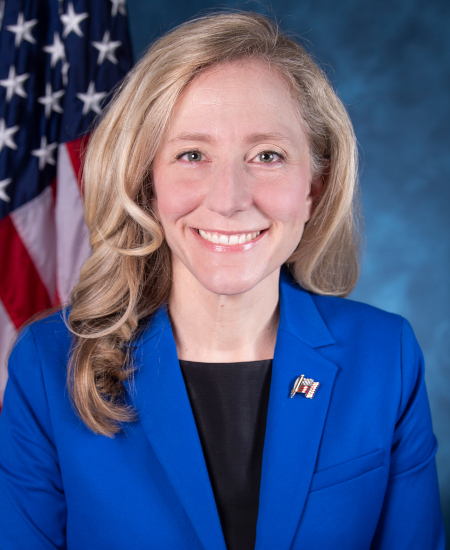
Rep. Abigail Davis Spanberger
Sponsored bills
Armenian Genocide Education Act This bill requires the Library of Congress to maintain a public website and otherwise support educational initiatives to promote understanding about the Armenian Genocide.
Sexual Harassment Independent Investigations and Prosecution Act This bill provides for the inclusion of sexual harassment as an offense subject to the authority of special trial counsel under the Uniform Code of Military Justice (UCMJ) and sets forth requirements related to independent investigations of sexual harassment under the UCMJ.
This resolution recognizes that Black women are experiencing high, disproportionate rates of maternal mortality and morbidity in the United States and that Black Maternal Health Week is an opportunity to deepen the national conversation about Black maternal health.
Public Health and Border Security Act of 2022 This bill requires the Department of Health and Human Services (HHS) to meet conditions related to notification and planning before terminating certain restrictions on imports and individuals entering the United States. Current law authorizes HHS to restrict entries and imports from foreign countries to prevent the introduction of communicable diseases. HHS exercised this authority as part of its COVID-19 response, including to allow for the expulsion of undocumented migrants at the border without any asylum processing. Under this bill, HHS may not terminate the restrictions for (1) at least 60 days after it notifies Congress of the end of the COVID-19 emergency, and (2) at least 30 days after it submits to Congress a plan for addressing the possible influx of migrants or imports resulting from lifting the restrictions.
Ensuring Lasting Smiles Act This bill requires private health insurance plans to cover diagnosis and treatment of congenital anomalies and birth defects, such as reconstructive services and items. Coverage must include services and items that functionally improve, repair, or restore any body part that is medically necessary for normal bodily functions or appearance, as determined by the treating physician. Coverage limits and cost-sharing requirements for such services and items may not be more restrictive than those applicable to all medical and surgical benefits under the plan.
Strengthening Supply Chains Through Truck Driver Incentives Act of 2022 This bill allows certain licensed commercial truck drivers a $7,500 tax credit in a taxable year. The adjusted gross income of such drivers may not exceed $90,000 ($135,000 in the case of a joint tax return and $112,500 for heads of household). Such drivers must have driven a truck in a trade or business for a specified number of hours in a taxable year. The credit expires after December 31, 2023.
Summer Barrow Prevention, Treatment, and Recovery Act This bill reauthorizes through FY2027 and modifies multiple grants, programs, and other activities that support prevention and treatment of substance use disorders. Specifically, the bill addresses mental health and substance use disorder services for homeless populations; priority substance use prevention and treatment needs that are of regional and national significance; access to treatment in areas with high or increasing rates of opioid use; data collection, research, and other activities to prevent and respond to underage drinking; diversion of individuals with mental health illnesses from the criminal justice system to community-based services; increased access to emergency treatments for known or suspected opioid overdoses (e.g., naloxone), including by expanding the prescriptive authority of certain health care providers; implementation of comprehensive state-based plans to respond to opioid use disorders; and use of opioid alternatives for pain management in hospitals and emergency departments.
Emmett Till Antilynching Act This bill makes lynching a federal hate crime offense. Specifically, the bill imposes criminal penalties—a fine, a prison term of up to 30 years, or both—on an individual who conspires to commit a hate crime offense that results in death or serious bodily injury or that includes kidnapping or an attempt to kidnap, aggravated sexual abuse or an attempt to commit aggravated sexual abuse, or an attempt to kill.
Family Health Care Affordability Act of 2022 This bill modifies the requirement for determining the affordability of employer-sponsored minimum essential health care coverage under the Patient Protection and Affordable Care Act (PPACA). (Under current law, the coverage is unaffordable, and an employee may be eligible for premium assistance tax credits, if the employee's required contribution for an individual plan exceeds 9.5% of household income.) The bill specifies that, with respect to an employee's family members who are eligible to enroll in the plan, affordability must be determined using the cost of family coverage rather than individual coverage to expand the eligibility of families for premium assistance tax credits.