Daniel Anderl Judicial Security and Privacy Act of 2021 This bill generally prohibits federal agencies and private businesses from publicly posting the personally identifiable information (e.g., home addresses) of federal judges and their immediate family members. It also (1) requires information to be removed upon written request from the federal judge concerned, (2) prohibits data brokers from purchasing or selling such information, and (3) establishes programs to protect such information at the state and local level and to enhance security for judges.
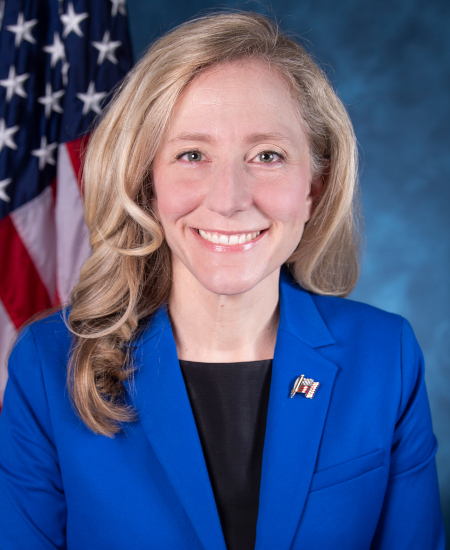
Rep. Abigail Davis Spanberger
Sponsored bills
CARA 3.0 Act of 2021 This bill addresses substance use disorders by expanding access to treatment and recovery services, providing for housing protections, and requiring other activities. Specifically, the bill reauthorizes, establishes, and expands support for treatment and recovery services. This includes increasing access to treatment in the criminal justice system and other settings and for particular populations, such as pregnant and postpartum individuals and youth and young adults. Additionally, the bill expands Medicare and Medicaid coverage for treatment, including by expanding telehealth access to medication to treat substance use disorders. The bill also temporarily requires that non-opioid pain treatment options be reimbursed separately, instead of on a packaged basis, under Medicare. As a condition of receiving certain federal funding, states must mandate the use of prescription drug monitoring programs (PDMPs) by prescribers and dispensers and impose additional PDMP requirements. Moreover, prescribers of potentially addictive drugs must complete continuing education requirements. The bill also revises the registration process for providers who prescribe certain medications to treat substance use disorders, including by eliminating the provider's patient limit for such medications. In addition, the Substance Abuse and Mental Health Services Administration must carry out activities to promote access to high-quality recovery housing. The bill also sets out protections for individuals with substance use disorders who live in, or apply to live in, federally assisted housing. Furthermore, the bill requires other activities to address substance use, such as support for workforce education and training; public awareness campaigns and similar outreach; and research on prevention strategies, insurance coverage, and treatment modalities.

3D Printed Gun Safety Act of 2021 This bill makes it unlawful to intentionally publish digital instructions for programming a three-dimensional printer to make a firearm.
Measuring What Matters Act This bill establishes a working group—the U.S. Commission on Reforming Police Metrics—to study best practices for measuring public trust in police institutions and including such findings in police performance measurement. The working group must report on its findings and conclusions, including recommendations. The bill requires the Department of Justice to establish a pilot program to award competitive grants for technical assistance and financial support to local police departments and sheriff departments that carry out the recommendations of the working group.
Golden Visa Accountability Act This bill requires the Department of State to establish and maintain a database containing information about investor visa denials due to the applicant's involvement in corruption or serious human rights abuses. (Generally, the United States offers immigrant visas to qualified individuals who invest in the United States and create a certain number of full-time jobs.) Initially, the database must include records related to such denials of U.S. investor visas. The bill also requires the State Department to eventually expand the database to include records of such denials of investor visas in other countries. The State Department shall prioritize including records from European Union countries and from Australia, Canada, New Zealand, and the United Kingdom. The State Department may admit a foreign country to be part of the database if the State Department determines (1) that country will be honest and forthcoming with its records, and (2) that country's investor visa program is at risk of abuse by corrupt foreign officials.
H-2B Returning Worker Exception Act of 2021 This bill modifies the H-2B (temporary nonagricultural workers) nonimmigrant visa program, including by exempting certain workers from an annual numerical limit on such visas and requiring civil penalties for program violations. Under this bill, if a worker seeking a H-2B visa has been counted toward the 66,000 annual cap on such visas in one of the three preceding fiscal years, that worker shall not be counted against the cap again. Furthermore, the Department of Homeland Security (DHS) must impose a civil monetary penalty on an employer for (1) failing to meet requirements related to an H-2B visa petition, or (2) making a willful misrepresentation of material fact in such a petition. DHS must also ensure the establishment of an electronic platform (1) for employers to submit and request approval of an H-2B petition, and (2) to act as a single point of access for applicants and the relevant government agencies. The Department of Labor must maintain a publicly available online database of all job orders by H-2B employers. Furthermore, Labor may take certain actions to enforce program requirements, such as imposing penalties and seeking injunctions. The bill provides statutory authority for the current practice of limiting the program to workers who are nationals of countries approved by DHS. DHS may make exceptions to this limitation in individual cases if it is in the U.S. interest to do so. DHS shall select approved countries based on various factors, such as the rate of overstay by H-2B visa holders from each country.
Foreign Corruption Accountability Act This bill temporarily authorizes the President to impose visa-blocking sanctions against any foreign person that engages in public corruption activities (e.g., soliciting or accepting bribes or engaging in extortion) against the United States. The President may terminate the sanctions by making a determination that the person (1) is no longer engaged in (or has taken significant verifiable steps to cease) the sanctionable conduct, or (2) will not knowingly engage in sanctionable conduct in the future. In addition, the President may also terminate the sanctions if it is in U.S. national security interests. The President must notify Congress at least 15 days before terminating the sanctions. The President must annually report to Congress on the imposition and termination of sanctions on foreign persons for engaging in public corruption. The authority to impose the sanctions terminates six years after this bill's enactment.
Justice for Victims of Kleptocracy Act of 2021 This bill requires the Department of Justice to publish and regularly update its website with an accounting of property that is forfeited to the United States as a result of foreign government corruption. It also expresses the sense of Congress that recovered assets shall be returned for the benefit of the people harmed by the corruption.
Establishing Accreditation Grants for Law Enforcement Act of 2021 or the EAGLE Act of 2021 This bill requires the Department of Justice to provide grants to eligible local law enforcement agencies for activities related to obtaining qualified accreditation or recertification. Such accreditation or recertification shall be provided by a professional law enforcement organization involved in developing standards for law enforcement at the national, state, regional, or tribal level, such as the Commission on Accreditation for Law Enforcement Agencies.
Afghan Allies Protection Act of 2021 This bill provides for 4,000 additional special immigrant visas to qualified nationals of Afghanistan who were employed by or on behalf of the United States or the International Security Assistance Force after October 6, 2001. The visa allotment, in addition to any unused allocations of such special immigrant visas since FY2015, shall be available beginning FY2021, and unused visas shall carry over to subsequent fiscal years until exhausted.