

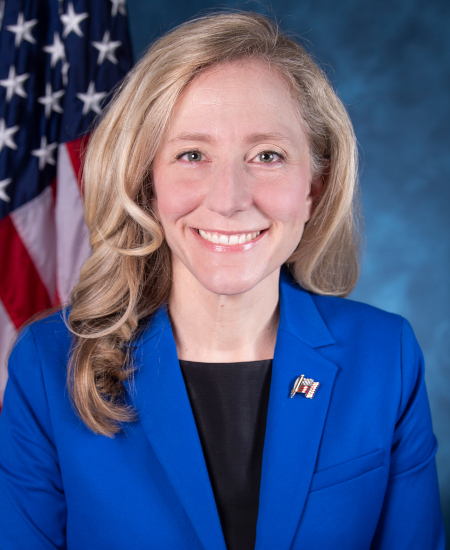
Photo of Abigail Davis Spanberger
D United States House · District 7 · Virginia

Rep. Abigail Davis Spanberger

Compare
Total votes
2,168
all sessions
Attendance
99%
19 missed
Higher than 78% of chamber peers
With party
95%
of cast votes
Near the chamber average
Bipartisan score
3%
crosses aisle rarely
Near the chamber average
Sponsored
950
bills & resolutions
Near the chamber average
Committees
0
assignments
950 bills and resolutions

Sponsored bills

Total
950
Primary
78
Co-sponsor
872
This page
950
matching current filters
Primary HR 5553
In committee · United States House · Lead sponsor
Patawomeck Indian Tribe of Virginia Federal Recognition Act

Patawomeck Indian Tribe of Virginia Federal Recognition Act This bill extends federal recognition to the Patawomeck Indian Tribe. Specifically, the bill makes the tribe and its members eligible for services and benefits provided to federally recognized tribes, without regard to the existence of a reservation for the tribe. The service area of the tribe is considered to be Stafford and King George Counties, Virginia. Next, the bill sets forth requirements for the tribe regarding its membership roll, governing documents, and governing body. Interior, upon the request of the tribe, may take certain land into trust for the benefit of the tribe. Further, the bill prohibits the tribe from conducting gaming activities.

In committee Sep 18, 2023 0 co-sponsors
Co-sponsor HR 5399
In committee · United States House · Co-sponsor
Humane Cosmetics Act of 2023

Maddy summaryThe Humane Cosmetics Act of 2023 bans cosmetic animal testing in the United States, prohibiting companies from conducting or contracting such testing after its enactment (effective 1 year later). It also bans selling or transporting cosmetics developed using animal testing conducted after that date within U.S. interstate commerce. The law directly affects cosmetic manufacturers, retailers, and suppliers operating in the U.S. market, requiring them to use non-animal testing methods for safety evaluations. Exceptions exist for foreign regulatory requirements or when no alternative testing methods are available for specific ingredients.

In committee Sep 15, 2023 1 co-sponsor
Co-sponsor HJRES 89
In committee · United States House · Co-sponsor
Requiring the advice and consent of the Senate or an Act of Congress to suspend, terminate, or withdraw the United States from the North Atlantic Treaty and authorizing related litigation, and for other purposes.

Maddy summaryHJRES 89 requires the President to obtain Senate approval (with a two-thirds vote) or new congressional legislation to suspend, terminate, or withdraw from the North Atlantic Treaty (NATO). It prohibits using federal funds for such actions until Congress passes a two-thirds resolution or enacts a law authorizing withdrawal. The bill mandates 180-day written notification to relevant congressional committees (Foreign Affairs and Foreign Relations) before any withdrawal action and authorizes Congress to sue to block unilateral executive moves. This directly affects the executive branch's ability to act unilaterally on NATO membership, reinforcing congressional oversight of treaty obligations.

In committee Sep 14, 2023 1 co-sponsor
Co-sponsor HR 5439
In committee · United States House · Co-sponsor
National Risk Management Act of 2023

National Risk Management Act of 2023 This bill requires the Cybersecurity and Infrastructure Security Agency of the Department of Homeland Security (DHS) to establish a recurring process to identify and assess risks to critical infrastructure and requires the President to deliver to Congress a national critical infrastructure resilience strategy designed to address the risks identified. The process must include elements to collect relevant information from Sector Risk Management Agencies relating to the threats, vulnerabilities, and consequences related to the particular sectors of such agencies; allow critical infrastructure owners and operators to submit relevant information to DHS for consideration; and outline how DHS will solicit input from other federal departments and agencies. DHS must brief the Senate and House homeland security committees on (1) the national risk management process activities undertaken pursuant to the strategy, and (2) the amounts and timeline for funding that DHS has determined would be necessary to address risks of cybersecurity threats and physical threats and successfully execute the full range of activities proposed by the strategy.

In committee Sep 13, 2023 1 co-sponsor
Primary HR 5451
In committee · United States House · Lead sponsor
African Diaspora Heritage Month Act of 2023

Maddy summaryThis bill designates an annual "African Diaspora Heritage Month" through a presidential proclamation. It requires the President to annually designate a month for observance, encouraging state/local governments and educational institutions to host related programs and activities. The bill does not create new funding or alter existing programs - it establishes a ceremonial recognition of the African diaspora community's contributions to U.S. society and U.S.-Africa relations.

In committee Sep 13, 2023 0 co-sponsors
Co-sponsor HR 5440
In committee · United States House · Co-sponsor
Protecting Americans from Foreign Commercial Spyware Act

Maddy summaryThis bill prohibits U.S. foreign aid to countries determined by the President to use foreign commercial spyware against U.S. persons. It requires the President to assess if a country has acquired such spyware, used it against journalists or activists, or failed to address misuse before blocking aid. The prohibition excludes military assistance and allows a presidential waiver for national security reasons. The President must annually report to Congress on spyware use by countries receiving aid, using intelligence community data.

In committee Sep 13, 2023 1 co-sponsor
Co-sponsor HR 5383
In committee · United States House · Co-sponsor
GIVE MILK Act

Maddy summaryHR 5383, the GIVE MILK Act, amends the Child Nutrition Act to allow WIC participants with young children to choose their preferred milk type (whole, low-fat, or nonfat) instead of receiving a default option. This change directly affects WIC participants caring for children aged 12 months to 4 years, aligning with dietary guidelines for that age group. The key provision requires the Secretary of Agriculture to issue the milk type elected by the participant or their guardian, updating WIC program regulations under Section 17(f) of the Child Nutrition Act. The bill focuses on enabling participant choice based on established nutritional recommendations for childhood development.

In committee Sep 8, 2023 1 co-sponsor
Co-sponsor HR 5344
In committee · United States House · Co-sponsor
Jobs in the Woods Act

Maddy summaryThe Jobs in the Woods Act creates a federal grant program to train workers for forestry jobs in rural communities. It provides competitive grants (ranging from $500,000 to $2 million) to eligible groups like states, tribes, nonprofits, or schools for career training programs in forestry operations and products. Priority is given to projects addressing aging workforces, youth engagement through school partnerships, and job placement. The program is funded at $10 million annually from 2024 through 2028, targeting low-income rural areas with populations under 50,000.

In committee Sep 5, 2023 1 co-sponsor
Co-sponsor HR 4856
In committee · United States House · Co-sponsor
GusNIP Expansion Act of 2023

Maddy summaryThis bill expands the Gus Schumacher Nutrition Incentive Program (GusNIP) to increase access to healthy food for low-income SNAP participants. It raises the incentive funding percentage from 50% to 80% for eligible purchases, creates new cooperative agreements to scale state programs (requiring 90% of funds to be used for redeemed incentives at retailers), and expands a produce prescription program where healthcare providers can refer patients to buy fresh produce. The bill allocates increased annual funding through 2029, including $57.5 million annually for 2024-2028, and requires a study on transitioning produce prescription costs to health insurance within 10 years. It directly affects SNAP recipients, participating retailers (including farmers markets), and community health centers.

In committee Aug 28, 2023 1 co-sponsor
Co-sponsor HR 5266
In committee · United States House · Co-sponsor
Interdiction of Fentanyl in Postal Mail at Federal Prisons Act

Maddy summaryThis bill requires the Bureau of Prisons to develop and implement a strategy for scanning all incoming mail at federal prisons to stop fentanyl and other synthetic drugs from entering facilities. It directs the Bureau to evaluate existing scanning technology within 180 days and submit a detailed plan to Congress within 90 days, including how to provide digital copies of mail to inmates within 24 hours and physical copies within 30 days (if safe). The strategy must achieve 100% mail scanning capacity at all federal prisons, prioritize high-security facilities, and include a budget proposal for fiscal years 2024-2026. This directly affects federal prisons, inmates, and Bureau employees by changing mail processing procedures to enhance safety and reduce staffing burdens from manual mail checks.

In committee Aug 25, 2023 1 co-sponsor
Showing 211 to 220 of 950 bills
Previous 1 … 21 22 23 … 95 Next