

Maddy summaryHR 1605, the Separation of Powers Restoration Act of 2025, amends federal law to change how courts review agency actions. It requires courts to independently re-examine all legal questions - including interpretations of laws and regulations - when reviewing agency decisions, rather than deferring to the agency's interpretation. This applies to all judicial reviews of agency actions under existing law, unless a specific law explicitly exempts such cases by citing this new provision. The bill directly affects federal courts and agencies like the EPA or FDA by altering the standard for reviewing their regulatory interpretations.
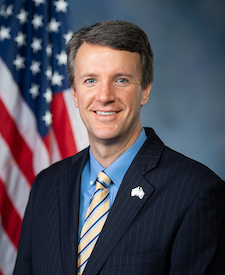
Rep. Ben Cline
Sponsored bills
Maddy summaryHR 3461 requires the U.S. Commerce Department to add China's Ministry of Public Security's Institute of Forensic Science (including its aliases) to the sanctions list within 60 days of enactment, restricting U.S. exports to it. This directly affects the Chinese government entity and U.S. businesses that might engage in trade with it. The bill includes a waiver provision allowing the President to bypass this if certifying the institute isn't involved in human rights abuses against Uyghurs and other minority groups in Xinjiang. The key mechanism is the mandatory listing on the Commerce Department's entity list, with limited executive authority to delay it.
Maddy summaryThis resolution blocks a Department of Energy rule that would have set new energy efficiency standards for gas-fired instant water heaters. It prevents the rule from taking effect, meaning appliance manufacturers would not have to meet the proposed efficiency requirements. The rule, submitted in December 2024, directly affected manufacturers of these water heaters and consumers purchasing them. Congress approved this disapproval through a joint resolution passed on May 9, 2025.
Maddy summaryHR 3229, the Foreign Agents Transparency Act, amends the Foreign Agents Registration Act (FARA) to strengthen transparency for individuals working as agents of foreign governments. It clarifies that agents must register for the entire period they represent a foreign principal (not just during active work) and allows the Attorney General to issue compliance orders even after an agent’s work with a foreign principal ends. The bill also requires the Attorney General to submit annual, machine-readable reports to Congress detailing enforcement actions against agents, including the names of individuals involved, the rationale for actions, and their current status. These changes apply to agents who served within five years before the bill’s enactment.
Maddy summaryHR 3231, the American Energy Act, streamlines oil and gas drilling permit processing by requiring the government to approve applications even during pending lawsuits (unless a court has already canceled the lease), and limits court challenges to lease sales. It sets a four-year expiration for drilling permits and bars courts from halting development or lease awards based on environmental lawsuits (like those under NEPA) after bids are opened, unless imminent environmental harm is proven with no other remedy. This directly affects oil and gas companies seeking permits, federal agencies managing leases, and courts handling related litigation. The bill changes procedural rules for permits and lease sales without altering environmental standards.
Maddy summaryThis bill provides a 3-year transition period for newly insured banks to meet federal capital requirements, easing compliance for institutions that recently became federally insured. It allows these banks to request temporary deviations from approved business plans, with regulators required to respond within 30 days (or the request is automatically approved). Small rural banks with less than $10 billion in assets located in rural areas receive a lower 8% leverage ratio requirement during this transition. Additionally, the bill expands lending authority for certain banks to include agricultural loans and requires a federal study on increasing new bank formations in underserved areas.
Maddy summaryThis resolution expresses the U.S. House of Representatives' support for designating May 2, 2025, as "NKH Awareness Day" to raise public and medical community awareness of nonketotic hyperglycinemia (NKH), a rare genetic metabolic disorder affecting approximately 1 in 76,000 people worldwide. It directly supports the small community of NKH patients and their families, including the estimated 4 individuals diagnosed in Virginia, by highlighting the need for greater education and research. The resolution does not create new programs or funding but serves as a symbolic gesture to encourage increased attention to NKH diagnosis, research, and patient registry participation.
Maddy summaryHR 3033, the "Protecting the Mailing of Firearms Act," repeals a federal law (18 U.S.C. §1715) that previously prohibited mailing firearms and related items. This bill directly affects firearm sellers, buyers, and the U.S. Postal Service by removing the ban on mailing firearms, ammunition, and components. It also prohibits the Postmaster General from creating rules that would block firearm mailings or require disclosure of sales receipts, transaction records, or firearm serial numbers. The law takes effect immediately for pending cases and prevents new restrictions on firearm shipping through the postal system.
Maddy summaryThis bill amends federal laws governing short-barreled shotguns (SBS), which are shotguns with barrels under 18 inches or overall length under 26 inches. It removes state-level taxes, registration, or recordkeeping requirements for SBS owned legally under federal rules, preempts conflicting state laws, and requires the federal government to destroy existing SBS registration records within one year. The bill directly affects lawful owners of SBS who previously registered under the National Firearms Act, simplifying their compliance with federal standards. Key changes include updating definitions to better align with sporting use and eliminating state-level barriers for legally owned SBS.
Maddy summaryHR 3050 prohibits U.S. federal agencies from entering into contracts over $100,000 with companies that engage in a boycott of Israel after January 1, 2026. Companies must certify they are not boycotting Israel when bidding for such contracts, and contracts must include a requirement that companies refrain from boycotting Israel during the contract term. If a company violates this prohibition, the agency must terminate the contract 30 days after notifying the company, unless the company ends the boycott. This bill directly affects businesses with federal contracts exceeding $100,000 and defines "boycott" as actions taken due to boycott calls, without valid business reasons, or based on nationality, national origin, or religion.