

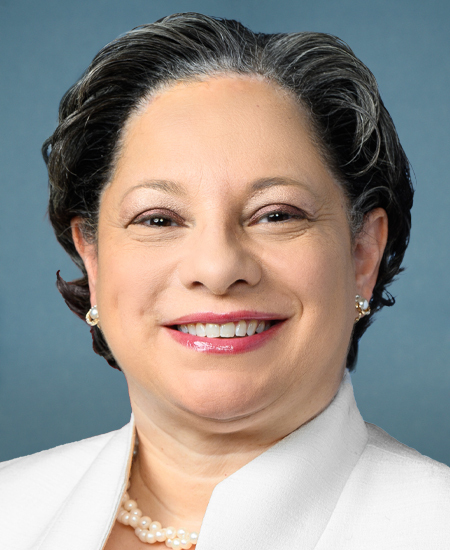
Photo of Jennifer L. McClellan
D United States House · District 4 · Virginia On the 2026 ballot

Rep. Jennifer L. McClellan

Compare
Total votes
1,767
all sessions
Attendance
99%
16 missed
Higher than 96% of chamber peers
With party
98%
of cast votes
Higher than 96% of chamber peers
Bipartisan score
1%
crosses aisle rarely
Lower than 96% of chamber peers
Sponsored
991
bills & resolutions
Higher than 83% of chamber peers
Committees
3
assignments
991 bills and resolutions

Sponsored bills

Total
991
Primary
50
Co-sponsor
941
This page
991
matching current filters
Co-sponsor HR 5443
In committee · United States House · Co-sponsor
Fair Housing Improvement Act of 2025

Maddy summaryHR 5443, the Fair Housing Improvement Act of 2025, expands federal housing anti-discrimination protections to include "source of income," "veteran status," and "military status." It defines "source of income" broadly to cover housing vouchers, Social Security benefits, child support, and other lawful income sources like savings or gifts. The bill adds these categories to all existing anti-discrimination provisions in the Fair Housing Act, prohibiting housing providers from refusing to rent or sell based on these factors. This directly affects renters and homeowners using housing assistance, veterans, active military members, and individuals receiving non-wage income.

In committee Sep 17, 2025 1 co-sponsor
Primary HRES 720
In committee · United States House · Lead sponsor
Expressing support for the designation of September 2025 as "African Diaspora Heritage Month".

Maddy summaryHRES 720 is a symbolic resolution expressing congressional support for designating September 2025 as "African Diaspora Heritage Month." It does not create legal requirements or allocate funding but encourages public observation through ceremonies and programs. The resolution highlights the African diaspora’s economic contributions (e.g., $24 billion in federal taxes in 2021), cultural diversity, and historical significance to U.S. society. It urges local governments to recognize the month and affirms that the diaspora’s contributions enrich American history and national identity. This is a non-binding gesture focused on recognition, not policy change.

In committee Sep 16, 2025 0 co-sponsors
Co-sponsor HR 5390
In committee · United States House · Co-sponsor
FAMILY Act

Maddy summaryThe FAMILY Act would establish a national paid family and medical leave insurance program that provides wage replacement benefits for workers needing time off for caregiving or medical reasons. It defines "qualified caregiving" to include caring for a family member with a serious health condition, personal medical needs, or recovery from violence (including domestic violence, sexual assault, or stalking). Benefits would be calculated based on earnings, with a minimum monthly benefit of $580 and maximum of $4,000, administered by a new Office of Paid Family and Medical Leave within the Social Security Administration. Eligible individuals would need to have worked for at least 8 quarters in the previous year and file an application with required documentation, while existing state paid leave programs would continue to operate alongside this federal program.

In committee Sep 16, 2025 1 co-sponsor
Co-sponsor HR 1860
Passed · United States House · Co-sponsor
Women Veterans Cancer Care Coordination Act

Maddy summaryHR 1860 establishes Regional Breast Cancer and Gynecologic Cancer Care Coordinators within the VA to improve care coordination for veterans diagnosed with breast or reproductive system cancers (like cervical, ovarian, or uterine cancer) who receive treatment through the Veterans Community Care Program at non-VA facilities. These coordinators, reporting to the VA’s Breast and Gynecologic Oncology System of Excellence, will directly connect veterans with community care providers, monitor treatment outcomes, document care in electronic records, and provide veterans with information on emergency care and mental health resources. The bill requires the VA to create regional care coordination networks, prioritizing rural veterans’ needs, and mandates a 3-year report comparing health outcomes between VA and community care for these veterans. It focuses on streamlining care coordination rather than creating new benefits or funding.

Passed Sep 16, 2025 1 co-sponsor
Co-sponsor HR 1670
In committee · United States House · Co-sponsor
Family Building FEHB Fairness Act

Maddy summaryThe Family Building FEHB Fairness Act (HR 1670) adds fertility treatment benefits to the Federal Employees Health Benefits (FEHB) program. It directly affects federal employees and their families who use FEHB coverage, expanding what medical services the program pays for. Key provisions define "fertility treatment" to include services like in vitro fertilization (IVF), embryo preservation, genetic testing of embryos, artificial insemination, and related medications. The bill amends existing law to require FEHB plans to cover these services starting one year after the bill becomes law. This change ensures federal employees have access to fertility care as part of their health benefits package.

In committee Sep 16, 2025 1 co-sponsor
Co-sponsor HR 491
In committee · United States House · Co-sponsor
Equal COLA Act

Equal COLA Act This bill applies a cost-of-living adjustment (COLA) for annuities paid under the Federal Employees Retirement System that is equal to the increase in inflation, regardless of the amount of the increase. Specifically, for any year in which the Consumer Price Index (CPI) has increased over the previous year, the COLA amount shall be increased by the change in the CPI from the previous year.  Current law applies an adjustment equal to the change in CPI only if the change is 2% or less. If the change is between 2% and 3%, the adjustment is limited to 2%. If the change is more than 3%, the adjustment is limited to 1% less than the change.

In committee Sep 16, 2025 1 co-sponsor
Co-sponsor HR 492
In committee · United States House · Co-sponsor
Saving the Civil Service Act

Saving the Civil Service Act This bill generally prohibits changes to the classification of positions in the competitive service and excepted service unless certain conditions are met. (Competitive service positions are subject to competitive examination while excepted service positions are appointed under one of five schedules. Competitive service positions have notice and appeal requirements for adverse actions that are not applicable to most excepted positions, including those of a confidential, policy-determining, policy-making, or policy-advocating character under Schedule C.) On October 21, 2020, President Donald Trump issued an executive order that placed executive agency positions that are of a confidential, policy-determining, policy-making, or policy-advocating character, and that are not normally subject to change as a result of a presidential transition, under a new Schedule F in the excepted service. The order was subsequently revoked by President Joe Biden. The bill prohibits executive agency positions in the competitive service from being placed in the excepted service, unless such positions are placed in a schedule in the excepted service as in effect on September 30, 2020. The bill also prohibits positions in the excepted service from being placed in any schedule other than the aforementioned schedules. Additionally, agencies may not (1) transfer occupied positions from the competitive or excepted service into Schedule C without the consent of the Office of Personnel Management, or (2) transfer employees in the excepted service to another schedule or transfer employees in the competitive service to the excepted service without employee consent.

In committee Sep 16, 2025 1 co-sponsor
Co-sponsor HRES 716
In committee · United States House · Co-sponsor
Supporting the designation of the week of September 15 through September 19, 2025, as "National Clean Energy Week".

Maddy summaryHRES 716 is a symbolic resolution designating September 15-19, 2025, as "National Clean Energy Week" to raise awareness about clean energy. It encourages voluntary actions like investing in clean energy technologies but does not create new laws, funding, or requirements. The resolution cites the clean energy sector's economic role (noting 8.5 million U.S. jobs in 2024 per the Department of Energy) and applauds national laboratories. As a non-binding gesture, it directly affects no individuals or entities but aims to promote existing clean energy initiatives.

In committee Sep 15, 2025 1 co-sponsor
Co-sponsor HR 5361
In committee · United States House · Co-sponsor
George Floyd Justice in Policing Act of 2025

Maddy summaryThe George Floyd Justice in Policing Act of 2025 would establish a National Police Misconduct Registry to track officer complaints, disciplinary actions, and misconduct records across all law enforcement agencies. It would require law enforcement agencies to implement body-worn camera programs with specific recording and retention policies, ban chokeholds and no-knock warrants in drug cases, and reform qualified immunity to make it easier to hold officers accountable for misconduct. The bill mandates comprehensive data collection on use of force incidents, requiring agencies to report detailed information about stops, searches, and force used, disaggregated by race, ethnicity, gender, and other demographics. These provisions would directly affect all Federal, State, and local law enforcement agencies that receive federal grant funding, with requirements for policy changes, training, and data reporting.

In committee Sep 15, 2025 1 co-sponsor
Co-sponsor HR 5356
In committee · United States House · Co-sponsor
National Infrastructure Bank Act of 2025

Maddy summaryThe National Infrastructure Bank Act of 2025 would establish a government-owned bank to finance infrastructure projects across the United States, aiming to address a $3.69 trillion financing gap identified by the American Society of Civil Engineers. The bank would provide loans up to $5 trillion for transportation, energy, environmental, and community development projects, with specific criteria focused on economic growth, environmental benefits, and serving disadvantaged communities. It would be governed by a 25-member Board of Directors with diverse regional and expertise qualifications, and would operate with tax exemptions and capital requirements to ensure financial stability. The bill also establishes regional economic accelerator planning groups to coordinate infrastructure development and create a pipeline of projects for the bank to finance.

In committee Sep 15, 2025 1 co-sponsor
Showing 241 to 250 of 991 bills
Previous 1 … 24 25 26 … 100 Next