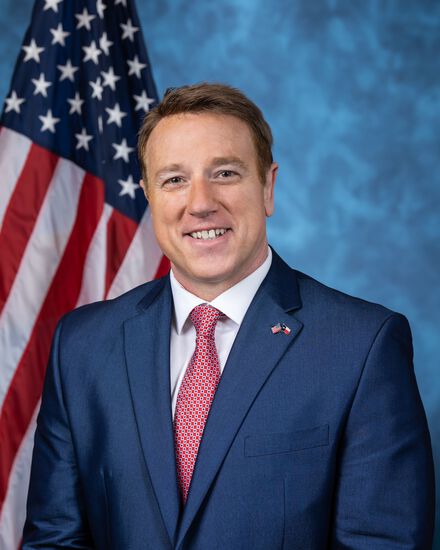
Photo of Pat Fallon
R United States House · District 4 · Texas On the 2026 ballot

Rep. Pat Fallon

Compare
Total votes
2,837
all sessions
Attendance
98%
65 missed
Near the chamber average
With party
93%
of cast votes
Near the chamber average
Bipartisan score
4%
crosses aisle rarely
Near the chamber average
Sponsored
748
bills & resolutions
Lower than 78% of chamber peers
Committees
8
assignments
748 bills and resolutions

Sponsored bills

Total
748
Primary
60
Co-sponsor
688
This page
748
matching current filters
Co-sponsor HR 714
In committee · United States House · Co-sponsor
Feral Swine Act

Feral Swine Act This bill extends through FY2028 the feral swine eradication and control pilot program to respond to the threat feral swine pose to agriculture, native ecosystems, and human and animal health.

In committee Mar 2, 2023 1 co-sponsor
Co-sponsor HR 1277
In committee · United States House · Co-sponsor
Military Spouse Hiring Act

Maddy summaryThe Military Spouse Hiring Act expands the Work Opportunity Tax Credit to include military spouses. Employers who hire a spouse of an active-duty military member - certified by a local agency as meeting eligibility requirements on the hiring date - can claim this tax credit. The credit reduces the employer's federal tax liability for hiring such individuals. This provision applies to new hires after the bill's enactment date.

In committee Mar 1, 2023 1 co-sponsor
Co-sponsor HR 1330
In committee · United States House · Co-sponsor
Taiwan Democracy Defense Lend-Lease Act of 2023

Maddy summaryThis bill authorizes the U.S. President to lend or lease defensive military equipment to Taiwan’s government to strengthen its ability to defend against potential aggression from China’s military, including scenarios like naval blockades, amphibious assaults, or missile strikes. It requires Taiwan to pay for damaged or lost equipment and to repay the U.S. for defense services or construction over 12 years, with interest rates subject to congressional review. The bill mandates a 90-day report to Congress assessing Taiwan’s defense needs, supply chain challenges, and timelines for delivering and integrating military equipment. It does not create new policy but establishes procedures for U.S. defense support to Taiwan under specific conditions.

In committee Mar 1, 2023 1 co-sponsor
Co-sponsor HR 1271
In committee · United States House · Co-sponsor
No Retaining Every Gun In a System That Restricts Your Rights Act

No Retaining Every Gun In a System That Restricts Your Rights Act This bill modifies the retention requirements for firearm transaction records of federal firearms licensees (FFLs) that go out of business. Current law generally requires FFLs that go out of business to deliver their firearm transaction records to the Bureau of Alcohol, Tobacco, Firearms and Explosives (ATF). This bill removes the requirement for FFLs that go out of business to deliver their firearm transaction records to the ATF. Further, the bill requires the ATF to destroy all out-of-business records it has collected from FFLs.

In committee Mar 1, 2023 1 co-sponsor
Co-sponsor HR 1297
In committee · United States House · Co-sponsor
To amend title 10, United States Code, to prohibit the Secretary of Defense from paying or reimbursing expenses relating to abortion services, and for other purposes.

Maddy summaryThis bill prohibits the Department of Defense from using funds to pay for or reimburse abortion services, except when the pregnancy endangers the mother's life, results from rape, or results from incest. It directly affects military personnel, civilian DOD employees, and contractors receiving medical care at military facilities by restricting funding for abortion-related expenses. Key provisions include amending federal law to ban reimbursement for travel or licensing costs related to abortion services and repealing a 2022 DOD memo that expanded access to such care. The bill explicitly blocks all funding for abortion services beyond the existing exceptions, with no new exceptions added. It does not change abortion access for civilians outside the military healthcare system.

In committee Mar 1, 2023 1 co-sponsor
Co-sponsor HR 1228
In committee · United States House · Co-sponsor
Combating Racist Training in the Military Act of 2023

Maddy summaryHR 1228 prohibits the U.S. military and Department of Defense-operated academic institutions from promoting specific anti-American or racist theories in training. It bans military programs that teach ideas such as "the U.S. is fundamentally racist," "the Constitution is fundamentally racist," or that "an individual’s worth is determined by race." The bill explicitly states it does not restrict protected speech, research access, or educational contexts that clearly disavow military endorsement of such theories. This directly affects military training curricula, workshops, and educational materials within the armed forces.

In committee Feb 28, 2023 1 co-sponsor
Co-sponsor HR 1200
In committee · United States House · Co-sponsor
National Right-to-Work Act

Maddy summaryHR 1200, the National Right-to-Work Act, prohibits requiring workers to join a union or pay dues as a condition of employment in both private-sector workplaces (covered by the National Labor Relations Act) and railroad industries (covered by the Railway Labor Act). The bill amends key sections of these laws to eliminate provisions that allowed union security agreements, meaning workers in unionized settings would no longer be forced to pay dues to retain their jobs. This directly affects employees in unionized workplaces across the U.S., particularly those in industries with existing union contracts that included mandatory dues. The law changes the legal framework to ensure union membership and dues payment remain voluntary for all workers.

In committee Feb 27, 2023 1 co-sponsor
Co-sponsor HR 1194
In committee · United States House · Co-sponsor
Fighting Presidential Budget Waste Act

Maddy summaryHR 1194, the "Fighting Presidential Budget Waste Act," requires the President and the Office of Management and Budget (OMB) to consider findings from the most recent GAO report on reducing government waste when preparing the annual federal budget. The bill specifically directs them to review the GAO report titled "Additional Opportunities to Reduce Fragmentation, Overlap, and Duplication and Achieve Billions of Dollars in Financial Benefits" (or a successor report). This mandate applies to all budget submissions under Section 1105 of Title 5, U.S. Code. The law does not create new spending or programs but changes the budget preparation process by requiring federal officials to factor in GAO recommendations for cost savings.

In committee Feb 24, 2023 1 co-sponsor
Co-sponsor HR 1122
In committee · United States House · Co-sponsor
CBDC Anti-Surveillance State Act

CBDC Anti-Surveillance State Act This bill limits the ability of the Federal Reserve to (1) provide direct services to individuals, and (2) use a central bank digital currency. A central bank digital currency is a digital currency (e.g., Bitcoin or Ether) issued by a government-backed central bank. Specifically, the bill prohibits the Federal Reserve and the Federal Open Market Committee from using any central bank digital currency to implement monetary policy. In addition, a Federal Reserve bank is prohibited from offering products or services directly to an individual, maintaining an account on behalf of an individual, or issuing a central bank digital currency directly to an individual. The Federal Reserve must (1) consult with each Federal Reserve bank with respect to any central bank digital currency study or pilot program, and (2) issue quarterly reports on the findings and determinations of any such study or program.

In committee Feb 21, 2023 1 co-sponsor
Co-sponsor HR 917
In committee · United States House · Co-sponsor
Protecting Military Installations from Foreign Espionage Act

Maddy summaryHR 917, the "Protecting Military Installations from Foreign Espionage Act," requires the Committee on Foreign Investment in the United States (CFIUS) to review certain foreign-owned real estate transactions near military sites. It specifically mandates CFIUS to review any purchase or lease of property within 100 miles of a military installation or 50 miles of designated military airspace, training routes, or firing areas - *if* the foreign buyer is linked to Russia, China, Iran, or North Korea. The bill eliminates CFIUS’s discretion for these transactions, forcing automatic review. It also ties approval of energy projects near such sites to CFIUS’s conclusion on these real estate deals, requiring the Defense Secretary to delay or block projects if national security risks are identified. This directly affects foreign entities from targeted nations and streamlines security reviews for military-adjacent properties.


In committee Feb 17, 2023 1 co-sponsor
Showing 391 to 400 of 748 bills
Previous 1 … 39 40 41 … 75 Next