

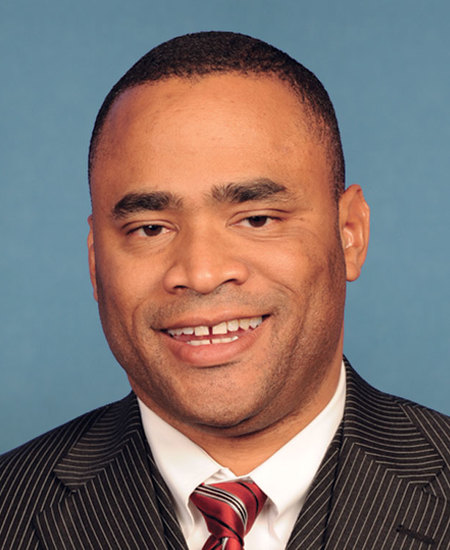
Photo of Marc A. Veasey
D United States House · District 33 · Texas

Rep. Marc A. Veasey

Compare
Total votes
2,837
all sessions
Attendance
99%
35 missed
Near the chamber average
With party
96%
of cast votes
Lower than 81% of chamber peers
Bipartisan score
2%
crosses aisle rarely
Higher than 80% of chamber peers
Sponsored
1,181
bills & resolutions
Near the chamber average
Committees
4
assignments
1,181 bills and resolutions

Sponsored bills

Total
1,181
Primary
39
Co-sponsor
1,142
This page
1,181
matching current filters
Co-sponsor HR 5351
In committee · United States House · Co-sponsor
Nationwide Right to Unionize Act

Maddy summaryHR 5351, the Nationwide Right to Unionize Act, repeals a federal law (Section 14(b) of the National Labor Relations Act) that currently allows states to enact "right-to-work" laws. This would prevent states from banning agreements requiring workers to pay union dues as a condition of employment, directly affecting workers in states with such laws. The bill's key mechanism is overriding state right-to-work statutes with federal law, ensuring union security agreements remain enforceable nationwide.

In committee Sep 5, 2023 1 co-sponsor
Co-sponsor HR 5290
In committee · United States House · Co-sponsor
Voters on the Move Registration Act of 2023

Voters on the Move Registration Act of 2023 This bill requires the Consumer Financial Protection Bureau to develop, and specified agencies to distribute, a statement providing individuals with information on how to register to vote and their voting rights. This information must be provided to individuals upon their participation in certain rental assistance programs or application for certain residential mortgages.

In committee Aug 25, 2023 1 co-sponsor
Co-sponsor HR 5292
In committee · United States House · Co-sponsor
Sustaining Our Democracy Act

Maddy summaryThe Sustaining Our Democracy Act creates a federal program to provide states with annual funding to improve election administration and increase voting access. It allocates $2 billion each year from 2024-2033 through the State Election Assistance and Innovation Trust Fund to support activities like upgrading voting equipment, training election workers, and expanding voting access for underserved communities, people with disabilities, and voters on Indian lands. States must submit detailed plans for using funds, which cannot be used for activities that restrict voting access or target election officials. The Act establishes an Office of Democracy Advancement and Innovation to administer the program, monitor fund usage, and oversee compliance with its requirements.

In committee Aug 25, 2023 1 co-sponsor
Co-sponsor HR 5266
In committee · United States House · Co-sponsor
Interdiction of Fentanyl in Postal Mail at Federal Prisons Act

Maddy summaryThis bill requires the Bureau of Prisons to develop and implement a strategy for scanning all incoming mail at federal prisons to stop fentanyl and other synthetic drugs from entering facilities. It directs the Bureau to evaluate existing scanning technology within 180 days and submit a detailed plan to Congress within 90 days, including how to provide digital copies of mail to inmates within 24 hours and physical copies within 30 days (if safe). The strategy must achieve 100% mail scanning capacity at all federal prisons, prioritize high-security facilities, and include a budget proposal for fiscal years 2024-2026. This directly affects federal prisons, inmates, and Bureau employees by changing mail processing procedures to enhance safety and reduce staffing burdens from manual mail checks.

In committee Aug 25, 2023 1 co-sponsor
Co-sponsor HR 5294
In committee · United States House · Co-sponsor
Unhoused Voter Opportunity Through Elections Act

Maddy summaryThe Unhoused Voter Opportunity Through Elections Act (HR 5294) protects voting rights for people experiencing homelessness by prohibiting states from denying voting access based on living in a "nontraditional abode" like shelters, public spaces, or locations where someone is considered homeless under federal law. Key provisions require election officials to make ballot drop boxes accessible to unhoused individuals, accept written attestations of residence instead of traditional proof, allow homeless shelters to be used as voting addresses, and mandate outreach to shelters about registration deadlines and election dates. The bill also creates a grant program to fund mobile voting centers and direct outreach services specifically for unhoused individuals. These changes would directly affect homeless individuals and election officials across all states, implementing concrete policy changes to improve voting access for a population often excluded from the electoral process.

In committee Aug 25, 2023 1 co-sponsor
Co-sponsor HR 5295
In committee · United States House · Co-sponsor
Expanding the VOTE Act

Maddy summaryHR 5295, the Expanding the VOTE Act, modifies Section 203 of the Voting Rights Act to expand language access for voters. It requires states and localities to provide voting materials (including ballots and instructions) in the language of covered language minority groups, with new provisions for American Indian and Alaska Native languages requiring tribal government consultation for unwritten languages. The bill creates $15 million in grants to help jurisdictions provide voting materials in languages that don’t currently trigger Section 203 coverage, while mandating continued provision for those groups in future elections. It also directs a study to evaluate lowering population thresholds for language protections and expanding the definition of covered languages.

In committee Aug 25, 2023 1 co-sponsor
Co-sponsor HR 4689
In committee · United States House · Co-sponsor
FASTER Act of 2023

Maddy summaryThe FASTER Act of 2023 streamlines the permitting process for interstate electric transmission facilities by establishing "national interest electric transmission corridors" where transmission capacity constraints affect consumers. It requires project sponsors to negotiate community benefit agreements with local communities, tribes, and other stakeholders before seeking permits, and designates the Federal Energy Regulatory Commission (FERC) as the lead agency to coordinate federal reviews. The bill sets a 5-year maximum timeline for permit decisions, establishes a prefiling process for early stakeholder engagement, and creates revenue-sharing mechanisms with states and counties from projects on federal land. It directly affects transmission project developers, local communities, tribal governments, and federal agencies involved in the permitting process. The legislation does not alter existing environmental laws but seeks to reduce delays while requiring meaningful community engagement for projects seeking certain federal grants.

In committee Aug 24, 2023 1 co-sponsor
Co-sponsor HR 5221
In committee · United States House · Co-sponsor
Homeless Children and Youth Act of 2023

Maddy summaryThe Homeless Children and Youth Act of 2023 amends the McKinney-Vento Homeless Assistance Act to better support homeless children and youth. It extends the timeframe for determining homelessness from 14 to 30 days, creates a new definition for "child or youth defined as homeless under any other Federal program" (including those covered by Head Start, Child Care Development Block Grant, and other programs), and requires that all individuals identified as homeless under any provision of the Act be eligible for services without additional verification. The bill mandates public reporting of detailed homeless data through the Homeless Management Information System (HMIS), including demographic information about homeless individuals by age, disability, and length of homelessness. It also requires that all homeless populations proposed to be served receive equal priority without discrimination based on subpopulation.

In committee Aug 15, 2023 1 co-sponsor
Co-sponsor HR 5196
In committee · United States House · Co-sponsor
Armed Forces Transgender Dependent Protection Act

Maddy summaryThis bill amends the Exceptional Family Member Program (EFMP) to protect transgender dependents of military members. It prohibits assigning service members to locations where local laws restrict medically necessary treatment for transgender dependents, including gender dysphoria, and allows members to request reassignment within 30 days of such a law taking effect. The bill explicitly adds "gender dysphoria" to the list of conditions qualifying as a "medical special need" under the EFMP. This directly affects transgender dependents (spouses or children) and their military-affiliated service members, ensuring access to required care without forced relocation to restrictive jurisdictions.

In committee Aug 11, 2023 1 co-sponsor
Showing 591 to 600 of 1,181 bills
Previous 1 … 59 60 61 … 119 Next