

Veterans Preventive Health Coverage Fairness Act This bill eliminates veterans' copayments for medication, hospital care, and medical services related to preventive health services provided by the Department of Veterans Affairs. The bill expands the definition of preventive health services to include (1) evidence-based items or services that have an A or B rating in the recommendations of the United States Preventive Services Task Force; (2) immunizations that have a recommendation from the Advisory Committee on Immunization Practices of the Centers for Disease Control and Prevention with respect to the individual involved; and (3) with respect to women, the preventive care and screenings provided for in the Health Resources and Services Administration Preventive Services Guidelines in effect as of January 1, 2017.
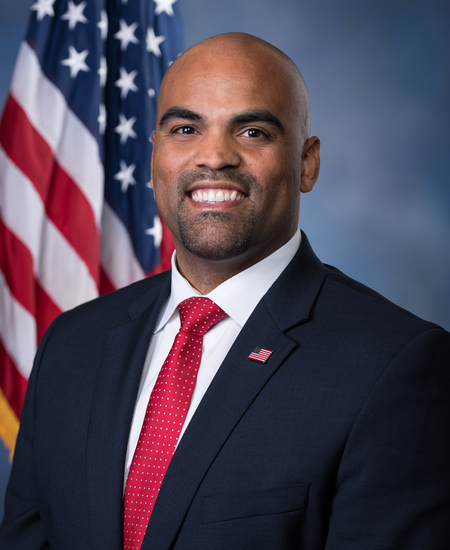
Rep. Colin Z. Allred
Sponsored bills
Veterans Claim Transparency Act of 2021 This bill requires the Department of Veterans Affairs (VA) to provide the representative of a veteran with an opportunity to review a proposed determination regarding a claim for compensation or benefits before such determination becomes final. The VA must notify the representative in writing that a proposed determination is ready for review and may not make a final determination until the review period has ended. Under the bill, a representative has up to 48 hours to review the proposed determination.
Preserving Rules Ordered for The Entities Covered Through 340B Act of 2021 or the PROTECT 340B Act of 2021 This bill prohibits pharmacy benefit managers (PBMs) and health insurance plans from discriminating against health providers participating in the 340B drug pricing program, including pharmacies contracted with such providers to dispense 340B drugs. The 340B program allows certain providers to receive covered outpatient drugs at reduced prices from manufacturers. Specifically, PBMs and insurance plans may not reimburse 340B participants at a lower rate than other entities not participating in the program; impose differing terms (such as fees, charge-backs, or audits) on 340B participants; interfere with an individual's choice to receive drugs from a 340B participant; require 340B participants to identify which drugs fall within the program; or refuse to contract with a 340B participant on the basis that they utilize the program. Violations of this bill are subject to a civil penalty of not more than $5,000 per violation per day. These prohibitions also apply to prescription drug (Part D) sponsors under Medicare. The bill also provides for a process to prevent duplicate 340B drug discounts to states under Medicaid.
This bill repeals the joint resolution of March 9, 1957, that provided for the use of certain funds to promote peace and stability in the Middle East.
This bill repeals the January 14, 1991, resolution authorizing the use of military force against Iraq.
Trans-Sahara Counterterrorism Partnership Program Act of 2021 This bill provides statutory authority for the Trans-Sahara Counterterrorism Partnership Program, an interagency program launched in 2005 to partner with countries in the Sahel and Maghreb regions of Africa to counter terrorism and violent extremism. The Department of State, in consultation with the Department of Defense and the U.S. Agency for International Development, shall establish the partnership program, which must coordinate all U.S. programs in North and West Africa related to various counterterrorism activities, such as building foreign-military capacity, enhancing border security, promoting youth employment, and supporting independent media to counter terrorist propaganda. The State Department must submit comprehensive, five-year strategies that include specified activities for the Sahel and Maghreb regions and for program counterterrorism efforts. Further, program activities must, among other things (1) be carried out in countries where there is an adequate level of partner country committment, and (2) have clearly defined outcomes and specific plans with indicators to regularly monitor and evaluate outcomes and impact. Such activities must also take into account the counterterrorism and development strategies of partner countries and align with such strategies to the extent possible. The State Department shall notify Congress before obligating funds for such programs, and must submit annual reports about program activities.
Global Health Security Act of 2021 This bill directs the United States to implement a strategy to strengthen global health security, including by requiring the President to create the Global Health Security Agenda Interagency Review Council to implement the Global Health Security Agenda. The agenda is an initiative launched by nearly 30 nations to address global infectious disease threats. The council's responsibilities include (1) providing policy recommendations on agenda-related goals, objectives, implementation, and other international efforts to strengthen pandemic preparedness and response; (2) helping federal agencies with implementation; and (3) reviewing the progress and challenges in achieving U.S. commitments, including assistance to help other countries meet agenda targets. The bill also directs the federal agencies involved with the agenda to prioritize its implementation and to take certain steps to achieve that goal. The President shall coordinate a strategy for responding to global health security emergencies and submit a report on the implementation of this strategy. Additionally, the Department of State should seek to enter into negotiations with donors, relevant United Nations agencies, and other multilateral stakeholders to establish a Fund for Global Health Security and Pandemic Preparedness that (1) closes gaps in global health security and pandemic preparedness; and (2) builds capacity in eligible partner countries related to global health security, infectious disease control, and pandemic preparedness. The fund should provide grants, technical assistance, and innovative funding mechanisms to achieve its purposes.
Equal Access to Contraception for Veterans Act This bill prohibits the Department of Veterans Affairs from requiring payment from a veteran for any contraceptive item that is required to be covered by health insurance plans without a cost-sharing requirement.
Cancer Drug Parity Act of 20 21 This bill requires group health plans that cover anticancer medications administered by a health care provider to provide no less favorable cost sharing for patient-administered anticancer medications. This requirement applies to medications that are (1) approved by the Food and Drug Administration; (2) medically necessary for the cancer treatment; and (3) clinically appropriate in terms of type, frequency, extent site, and duration. To comply with this requirement, plans may not, with respect to anticancer medications (1) change or replace benefits to increase out-of-pocket costs, (2) reclassify benefits to increase costs, or (3) apply more restrictive limitations to orally administered medications than to intravenously administered or injected medications.
Safe Schools Improvement Act of 2021 This bill requires states to direct their local educational agencies (LEAs) to establish policies that prevent and prohibit bullying and harassment of elementary and secondary school students. In particular, these policies must prohibit bullying and harassment based on race, color, national origin, sex, sexual orientation, gender identity, disability, or religion. Further, LEAs must provide (1) students, parents, and educational professionals with annual notice of the conduct prohibited in their disciplinary policies; (2) students and parents with grievance procedures that target such conduct; and (3) the public with annual data on the incidence and frequency of that conduct at the school and LEA level. The Department of Education must conduct and report on an independent biennial evaluation of programs and policies to combat bullying and harassment in elementary and secondary schools. The National Center for Education Statistics must collect state data to determine the incidence and frequency of the conduct prohibited by LEA disciplinary policies.