This resolution supports the work of the United States African Development Foundation as it creates pathways to prosperity for underserved communities on the African continent through community-led development, and it commits to continue supporting the work of the foundation as an independent agency.
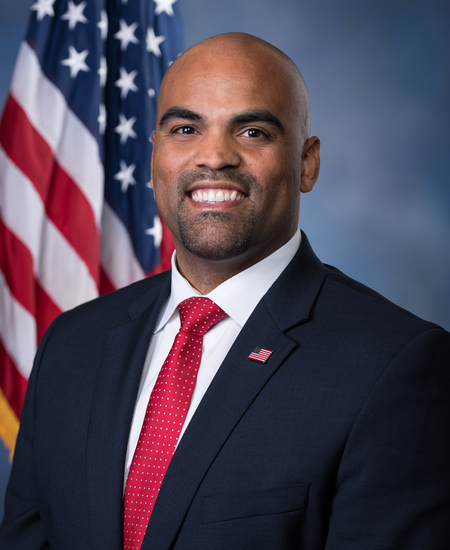
Rep. Colin Z. Allred
Sponsored bills
Youth, Peace, and Security Act of 2021 This bill requires the Department of State to coordinate the development and implementation of a whole-of-government strategy to promote the inclusive and meaningful participation of youth in peace building and conflict prevention, management, and resolution, as well as post-conflict and recovery efforts. The President must appoint a coordinator who, in addition to being responsible for leading the implementation of such strategy, is authorized to provide grants, emergency assistance, and technical assistance to eligible youth-led civil society organizations and youth peace-building implementers. The bill also authorizes the President to provide development assistance to expand training, technical assistance, and grants managed and controlled by youth leaders.
City and State Diplomacy Act This bill establishes within the Department of State the Office of City and State Diplomacy, which shall coordinate federal support for engagement by state and municipal governments with foreign governments. The head of the office shall be the Ambassador-at-Large for City and State Diplomacy, who shall be appointed by the President with the advice and consent of the Senate.
Closing the Meal Gap Act of 202 1 This bill revises the requirements for calculating Supplemental Nutrition Assistance Program (SNAP) benefits. The bill increases the minimum SNAP benefit and requires benefits to be calculated using the value of a low-cost food plan. The Department of Agriculture (USDA) must determine the requirements for the low-cost food plan, which is the diet required to feed a family of four, consisting of a man and a woman 19-50 years of age, a child 6-8 years of age, and a child 9-11 years of age. USDA must (1) reevaluate and publish the market baskets of the plan by January 1, 2027, and every five years thereafter, based on current food prices, food composition data, consumption patterns, and dietary guidance; and (2) make adjustments to the plan to account for household size, changes in the cost of the diet, and the costs of food in specified areas. The bill modifies the requirements for calculating household income to determine SNAP eligibility by (1) authorizing a standard medical expense deduction for households containing an elderly or disabled member, and (2) eliminating the cap on the excess shelter expense deduction. The bill eliminates certain work requirements for SNAP. The requirements apply to able-bodied adults who are ages 18-49 and have no dependent children. The bill allows Puerto Rico, American Samoa, and the Northern Mariana Islands to participate in SNAP. Currently, the three territories receive block grants instead of participating in SNAP.

Transition for Success Act This bill allows members of the reserve components of the Armed Forces to participate in the Department of Defense's Skillbridge program, which provides job training to service members who are transitioning into civilian life.
Rebuilding Economies and Creating Opportunities for More People Everywhere To Excel Act or the RECOMPETE Act This bill establishes a grant program to assist economically distressed local communities and labor markets that meet specified economic criteria, including employment criteria. The Economic Development Administration (EDA) must award 10-year grants to a local government, tribal government, economic development district, or consortium of local government units located in such areas. Each grant recipient must develop and implement a comprehensive strategy to address the economic challenges specific to the area. The grants may be used to increase employment opportunities, increase local per capita income, support economic development, and develop infrastructure and housing. Additionally, the EDA must periodically evaluate each grant recipient based on certain benchmark criteria and annually report on the implementation of the program. The bill specifies formulas for determining the grant amount for each community or market and the federal share of the cost of each program or activity conducted under the program.
Veterans Health Care Stamp Act This bill requires the U.S. Postal Service to issue and sell a Veterans Health Care Stamp to help fund the medical care and treatment of veterans.
Medicaid Saves Lives Act This bill requires and provides funds for the Department of Health and Human Services to establish a program that provides health benefits to the Medicaid expansion population in states that have not expanded Medicaid. Specifically, the program must provide coverage for individuals who are newly eligible for Medicaid under the Patient Protection and Affordable Care Act (i.e., the Medicaid expansion population) without premiums and in accordance with Medicaid cost-sharing and other requirements. The bill also extends and increases the temporarily enhanced Federal Medical Assistance Percentage (i.e., federal matching rate) for states that elect to participate in Medicaid expansion if they have not already done so.
Averting Loss of Life and Injury by Expediting SIVs Act of 2021 or the Allies Act of 2021 This bill increases the number of special immigrant visas available to qualified Afghan nationals who worked for the U.S. government or the North Atlantic Treaty Organization (NATO) missions in Afghanistan. The bill also relaxes certain qualifications for such visas. Specifically, this bill makes available an additional 8,000 visas for principal aliens under this special visa program, to be available until all such visas have been issued. (The numerical limitations in this program apply only to the principal alien who applies for the visa, not to any accompanying spouse or child.) Under this bill, an alien may qualify based on a credible basis for concern about the possibility of an ongoing serious threat in Afghanistan due to their work with the U.S. government or a NATO mission, where currently the alien must have experienced such a threat. The bill also eliminates a requirement for each applicant to submit a credible sworn statement describing that threat. Furthermore, for an applicant qualifying for a visa by performing duties for U.S. military personnel stationed with a NATO mission, this bill eliminates a requirement that the duties performed qualify as sensitive and trusted duties. If an alien submits a visa application that included an accompanying spouse or child but the alien passes away before the application is granted, the surviving spouse or child shall remain eligible to receive a visa under that application. Currently, a surviving spouse or child retains eligibility only if the application was approved before the alien passed away.
Securing America From Epidemics Act This bill authorizes the United States to participate in the Coalition for Epidemic Preparedness Innovations, an alliance of countries and private partners whose mission is to finance and coordinate the development of vaccines for high-priority, epidemic-potential threats. The President must report on certain matters concerning U.S. participation in coalition activities, including how this participation supports health security and biodefense priorities.