

Fiscal Year 2022 Veterans Affairs Major Medical Facility Authorization Act This act authorizes the Department of Veterans Affairs to carry out specified major medical facility projects during FY2022. The act also indicates the maximum amount that can be spent on each project.
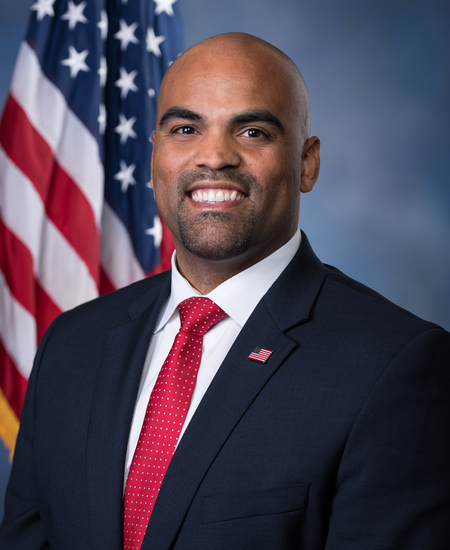
Rep. Colin Z. Allred
Sponsored bills
This bill designates the facility of the United States Postal Service located at 3900 Crown Road Southwest in Atlanta, Georgia, as the John R. Lewis Post Office Building.
National Center for the Advancement of Aviation Act of 202 2 This bill establishes the National Center for the Advancement of Aviation to (1) develop a skilled and robust U.S. aviation and aerospace workforce; (2) serve as a national independent forum to support collaboration and cooperation between aviation and aerospace stakeholders regarding the advancement of the U.S. aviation and aerospace workforce; and (3) serve as a repository for research conducted by institutions of higher education, research institutions, or other stakeholders regarding the aviation and aerospace workforce, or related technical and skill development. The center must perform the following duties improve access to aviation and aerospace education and related skills training to help grow the U.S. aviation and aerospace workforce; support Armed Forces personnel and veterans seeking to transition to a career in civil aviation or an aerospace-related field through outreach, training, apprenticeships, or other means; and amplify and support the research and development efforts conducted as part of the National Aviation Research Plan and work done at the Federal Aviation Administration Technical Centers regarding the aviation and aerospace workforce. Additionally, the center may issue grants to certain entities to create, develop, deliver, or update middle and high school aviation curricula and aviation curricula used at institutions of higher education, secondary educations institutions, or by technical training and vocational schools; support the professional development of educators using the curricula; establish new education programs that teach technical skills used in aviation maintenance; establish scholarships, internships or apprenticeships for individuals pursuing employment in the aviation maintenance industry; support outreach about educational opportunities and careers in the aviation maintenance industry; and support the transition to career in aviation maintenance, including for members of the Armed Forces.
Post-Disaster Mental Health Response Act This bill authorizes the provision of professional counseling services to victims of declared emergencies (current law limits such authorization to victims of major disasters).
Maximizing Outcomes through Better Investments in Lifesaving Equipment for (MOBILE) Health Care Act This bill allows a health center that currently receives funding through a Health Resources & Services Administration Health Center Program grant to use a New Access Point grant to set up a mobile unit regardless of whether the health center also establishes a permanent health care delivery site. New Access Point grants help health centers establish new delivery sites to provide comprehensive primary care to medically underserved populations. Under current law, health centers may only use the grants to set up a mobile unit if they also establish a permanent site.
Nonprofit Security Grant Program Improvement Act of 2022 This bill modifies the Nonprofit Security Grant Program of the Department of Homeland Security and reauthorizes appropriations for such program through FY2028. The Federal Emergency Management Agency (FEMA) must establish an office, headed by a senior FEMA official, to administer the program. Office responsibilities include those related to outreach, engagement, education, and technical assistance. FEMA must also publish grant guidelines and may prohibit states from closing application processes before the publication of the guidelines. FEMA must seek to enter into a contract or other agreement with an independent research organization for the conduct of a study that analyzes and reports on (1) the effectiveness of the program for preparedness against terrorism and other threats; (2) the risk-based formula and allocations under the program; and (3) the risk profile of and any identifiable factors leading to the low participation of traditionally underrepresented groups and states under the program.
Corruption, Overthrowing Rule of Law, and Ruining Ukraine: Putin's Trifecta Act or CORRUPT Act This bill requires the President to report to Congress, within 30 days of this bill's enactment, a determination as to whether specified Russian persons meet the criteria to be subject to sanctions under laws that authorize sanctions relating to corruption or human rights violations. Russian persons specified in this bill include businessperson Roman Arkadyevich Abramovich, Minister of Health Mikhail Albertovich Murashko, and First Deputy Premier Andrey Removich Belousov.
VA Zero Suicide Demonstration Project Act of 2021 This bill requires the Department of Veterans Affairs (VA) to establish the Zero Suicide Initiative pilot program for the purpose of improving safety and suicide care for veterans. The program must be implemented at five VA medical centers, including one that serves veterans in rural and remote areas.
Social Security Fairness Act of 2021 This bill repeals provisions that reduce Social Security benefits for individuals who receive other benefits, such as a pension from a state or local government. The bill eliminates the government pension offset , which in various instances reduces Social Security benefits for spouses, widows, and widowers who also receive government pensions of their own. The bill also eliminates the windfall elimination provision , which in some instances reduces Social Security benefits for individuals who also receive a pension or disability benefit from an employer that did not withhold Social Security taxes. These changes are effective for benefits payable after December 2021.
Peace Corps Reauthorization Act of 2022 This bill reauthorizes through FY2024 and modifies operations of the Peace Corps. Changes include increasing the readjustment allowance paid to volunteers when their service terminates and providing statutory authority for an executive order that grants returned volunteers noncompetitive eligibility for federal civil-service positions. Additionally, the bill entitles returned volunteers to sixty days of health care benefits. The Peace Corps must also provide volunteers with information about enrolling in U.S. health plans before service termination and mental health care during and after service. The bill also includes provisions to address involuntary termination of Peace Corps service in emergencies, including by expediting re-enrollment of involuntarily terminated volunteers. The Peace Corps must also adequately insure volunteers' safety and must coordinate with the Department of State to periodically update agreements concerning the security of Peace Corps volunteers and staff abroad. The bill also authorizes Peace Corps to recruit domestically based volunteers to serve in the United States at the request of another agency or to provide services in a host country virtually, modifies the Peace Corps National Advisory Council's membership and functions, expands whistleblower protections for volunteers, increases the rate of pay that applies to a volunteer's workers compensation claim, requires Peace Corps to implement a zero tolerance drug use policy regarding volunteer involvement with illegal drugs, and emphasizes the use of the internet in Peace Corps programs. Furthermore, the bill requires reporting, including on the provision of mental health services to volunteers.