

Greater Leadership Overseas for the Benefit of Equality Act of 2021 or the GLOBE Act of 2021 This bill contains provisions related to (1) the protection of LGBTQI individuals globally; and (2) immigration protections for vulnerable individuals. The bill establishes (1) an interagency group to respond to urgent threats to LGBTQI people in foreign countries, and (2) a permanent Special Envoy for the Human Rights of LGBTQI Peoples in the Department of State. The President shall impose visa-blocking sanctions on foreign persons responsible for violating the human rights of individuals based on sexual orientation, gender identity, or sex characteristics. The State Department shall establish the Global Equality Fund to provide assistance to nongovernmental organizations working to advance and protect human rights. The U.S. Agency for International Development shall establish the LGBTQI Global Development Partnership to work with the private sector and nongovernmental organizations to support LGBTQI rights. The bill removes prohibitions against providing foreign assistance to nongovernmental organizations that offer certain medical services (e.g., abortion-related services) using non-U.S. government funds. The bill contains several immigration-related provisions, such as those establishing that persecution based on sexual orientation or gender identity may form the basis of an asylum request, allowing certain applicants to file asylum claims more than a year after their arrival in the United States, including a permanent partnership between two partners as a marriage for immigration law purposes, providing for free counsel in certain immigration proceedings, and granting U.S. citizenship to a child born abroad through assistive reproductive technology from a U.S. citizen who is the child's nonbiological parent.
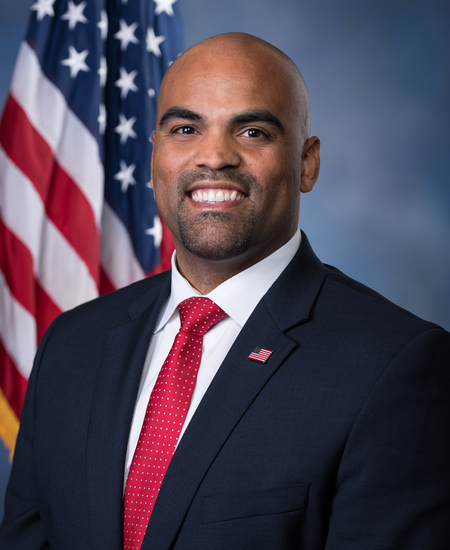
Rep. Colin Z. Allred
Sponsored bills
Taiwan Diplomatic Review Act This bill addresses issues concerning diplomatic relations with Taiwan. The bill directs the Department of State to seek to enter into negotiations with the Taipei Economic and Cultural Representative Office (TECRO) in the United States to rename its office in the District of Columbia as the Taiwan Representative Office in the United States. (The U.S.-Taiwan relationship is unofficial, and TECRO is Taiwan's principal representative in the United States.) In addition, the bill establishes a W nonimmigrant visa for aliens affiliated with Taiwan's diplomatic operations, including (1) an ambassador, public minister, or career diplomatic or consular officer accredited by Taiwan and accepted by the United States; (2) a designated principal representative of Taiwan to an international organization; and (3) the immediate family members of such individuals. Specified holders of a W visa shall be entitled to certain immunities afforded to holders of diplomatic visas. The bill also requires the President to appoint the Director of the American Institute in Taiwan with the advice and consent of the Senate. (After the U.S.-Taiwan relationship became unofficial, the United States conducted relations with Taiwan through the American Institute in Taiwan. The institute's office in Taipei performs many of the same functions as an embassy.)
Second Chance Opportunity for Re-Entry Education Act of 2021 or the SCORE Act of 2021 This bill directs the Bureau of Justice Assistance within the Department of Justice to establish a grant program—the Second Chance Opportunity for Re-Entry Education Grant Program—to promote reentry training programs and reduce recidivism to county jails for qualified nonviolent inmates.
Conrad State 30 and Physician Access Reauthorization Act This bill modifies the Conrad 30 Waiver program, which incentivizes qualified foreign physicians to serve in underserved communities. It also extends statutory authority for the program for three years from this bill's enactment. Aliens coming to the United States under a J-1 nonimmigrant visa to receive medical training typically must leave the country and reside for two years abroad before being eligible to apply for an immigrant visa or permanent residence. The Conrad program waives this requirement for individuals who meet certain qualifications, including serving for a number of years at a health care facility in an underserved area. The bill increases the number of waivers that a state may obtain each fiscal year from 30 to 35 if a certain number of waivers were used the previous year, and provides for further adjustments depending on demand. An alien physician may be employed at an academic medical center to meet the Conrad program's employment requirements if the alien's work is in the public interest, even if the medical center is not in an underserved area. Employment contracts for alien physicians under the Conrad program shall contain certain information, such as the maximum number of on-call hours per week the physician shall have to work. Certain alien physicians (along with the physician's spouse and children) shall be exempt from the direct annual numerical limits on immigration, including those physicians that have met certain requirements related to visas for physicians to serve in underserved areas.
Original National Domestic Violence Awareness Month Resolution of 2022 This resolution supports the goals and ideals of National Domestic Violence Awareness Month. Further, it expresses the sense of the House of Representatives that Congress should continue to raise awareness of and support programs to end domestic violence.
Major Richard Star Act This bill provides that combat-disabled uniformed services retirees with fewer than 20 years of creditable service may concurrently receive, without reduction, veterans' disability compensation and retired pay or combat-related special compensation.
Global Malnutrition Prevention and Treatment Act of 2021 This act sets out programs and otherwise directs the U.S. Agency for International Development (USAID) to carry out activities to prevent and treat malnutrition globally. Specifically, USAID may leverage resources to address malnutrition through the Global Nutrition Coordination Plan (an interagency effort to strengthen the impact of U.S. investments in nutrition) and its role on the board of directors of the U.S. International Development Finance Corporation. USAID must also select countries based on specified malnutrition-related indicators for purposes of targeting malnutrition prevention and treatment programs and update the selection within five years. Additionally, USAID may establish the Nutrition Leadership Council to coordinate federal government activities to prevent and treat malnutrition; and target resources and nutrition interventions to the populations most susceptible to severe malnutrition and otherwise support efforts to prevent and treat malnutrition globally. The act also requires USAID to provide to Congress an implementation plan and annual reports concerning its programs for treating and preventing malnutrition. The act's provisions terminate seven years after its enactment.
This concurrent resolution commemorates the 50th anniversary of the enactment of the Federal Water Pollution Control Act Amendments of 1972, commonly known as the Clean Water Act.
John Lewis Civil Rights Fellowship Act of 2022 This bill establishes the John Lewis Civil Rights Fellowship Program within the J. William Fulbright Educational Exchange Program (commonly referred to as the Fulbright Program). The fellowship program shall honor the legacy of Representative John Lewis and advance U.S. foreign policy priorities by promoting studies, research, and international exchange in the subject of nonviolent civil rights movements around the world. The Fulbright Foreign Scholarship Board shall annually select qualified individuals to serve as fellows in the fellowship program. The Bureau of Educational and Cultural Affairs may determine the number of fellows for each year, with at least 25 fellows each year whenever feasible. Each fellow shall (1) work in an internship or research position with an approved organization in a country with an operational Fulbright U.S. Student Program, and (2) receive an award sufficient to cover the fellow's reasonable costs during the fellowship period and certain travel and lodging expenses related to the program.
Global Food Security Reauthorization Act of 2022 This bill reauthorizes through FY2028 activities to implement the Global Food Security Strategy, a whole-of-government strategy to promote global food security, resilience, and nutrition. The bill also modifies aspects of the strategy, such as requiring the strategy to seek to improve the efficiency and resilience of agricultural production. The bill also reauthorizes through FY2028 activities related to the Emergency Food Security Program, an international market-based assistance program.