

Disposable ENDS Product Enforcement Act of 2023 This bill requires the Food and Drug Administration (FDA) to update its enforcement guidance regarding Electronic Nicotine Delivery System (ENDS) products to include certain disposable ENDS products. In April 2020, the FDA published revised guidance on how it intends to prioritize enforcement resources with respect to ENDS products that do not have premarket authorization (i.e., that have not received FDA approval). The guidance specifies that the FDA intends to prioritize enforcement against (1) flavored, cartridge-based ENDS products (except for tobacco or menthol flavored products); (2) other ENDS products for which the manufacturer has not taken adequate measures to prevent access to minors; (3) any ENDS products that are targeted or promoted towards minors; and (4) any ENDS products for which the manufacturer has not submitted an application for market approval or did not receive approval. For purposes of this guidance, cartridge-based ENDS products do not include disposable products that are completely self-contained . The bill requires the FDA to incorporate these products, including nicotine products that are not derived from tobacco, into its enforcement priorities. The bill additionally specifies that the FDA may prioritize enforcement against these products in advance of updating the guidance. The FDA must also annually report on its enforcement actions with respect to these products.
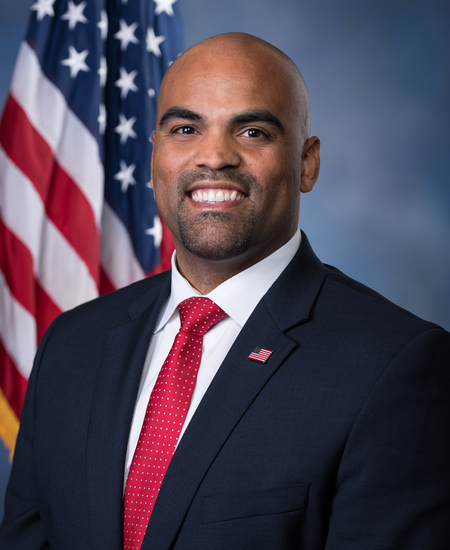
Rep. Colin Z. Allred
Sponsored bills
Maddy summaryHR 902, "Ellie’s Law," authorizes $10 million annually from fiscal years 2024 through 2028 for the National Institute of Neurological Disorders and Stroke to conduct broader research on unruptured brain aneurysms. The funding aims to study diverse patient populations by age, sex, and race, supplementing existing research budgets without replacing them. This bill directly affects researchers and future patients by increasing federal investment in a condition impacting 6.6 million Americans, with current federal spending at only $2.08 per affected person yearly. The legislation focuses on advancing scientific understanding to improve prevention and treatment, citing the high mortality rate (50% fatal) and significant healthcare costs ($4.1 billion annually in direct costs) associated with brain aneurysm ruptures.
Maddy summaryThe HELP Copays Act (HR 830) changes how health insurance plans calculate patient cost-sharing. It requires that payments made by third parties (like pharmacies, charities, or discount programs) toward medical costs count toward a patient's deductible, copay, or out-of-pocket limit. This directly affects insured individuals who receive financial assistance, discounts, or product vouchers for healthcare expenses. The law ensures these external payments reduce the patient's actual out-of-pocket costs more quickly, aligning with existing Affordable Care Act and Public Health Service Act requirements.
Shell Company Abuse Act This bill makes it unlawful to establish or use a corporation, company, or other entity with the intent to conceal an election contribution or donation by a foreign national. A violator is subject to criminal penalties—a fine, a prison term of up to five years, or both.
Maddy summaryThis bill expands health care coverage under TRICARE for military dependents. It eliminates a separate premium for young adults aged 21-26 enrolled in the TRICARE Young Adult Program, meaning they will no longer pay an extra fee for coverage. The bill also removes an eligibility restriction that previously limited coverage for some dependents in this age group. These changes directly affect military service members' adult children and spouses who rely on TRICARE Young Adult coverage. The policy update simplifies enrollment and reduces out-of-pocket costs for these beneficiaries.
Maddy summaryThis bill authorizes a single Congressional Gold Medal to honor all U.S. Army Dustoff crews who served during the Vietnam War (1962-1973). It recognizes their critical role in evacuating nearly 900,000 wounded personnel, including U.S., South Vietnamese, and allied forces, under extreme combat conditions. The medal, designed with input from the Secretary of Defense, will be presented to the U.S. Army Medical Department Museum for permanent display. Duplicate bronze medals may be sold to cover costs, but the primary action is the commemorative recognition of these crews' service.
Department of Veterans Affairs Continuing Professional Education Modernization Act or the VA CPE Modernization Act This bill modifies the program under which the Department of Veterans Affairs (VA) reimburses certain full-time health care professionals for continuing professional education expenses. Under current law, only board-certified physicians and dentists are eligible for such reimbursement. The bill expands the program to require reimbursement for various specified full-time health care professionals (e.g., registered nurses) and increases the amount available for a physician or dentist. Additionally, the bill removes the requirement that an individual be board-certified to receive reimbursement. The VA may adjust the amount of the reimbursement, so long as the adjustment does not result in a reimbursement of less than $2,000 per year for each specified position.
Maddy summaryHR 782 prohibits state officials from interfering with abortion services provided across state lines. It specifically blocks states from restricting: (1) out-of-state patients traveling for legal abortions, (2) providers offering such services, (3) assistance for travel or care, or (4) the interstate shipment of FDA-approved abortion drugs. The bill allows the federal Attorney General or affected individuals to sue violators for injunctions, damages, and attorney fees. It directly affects patients seeking care in other states, healthcare providers, transportation services, and pharmacies handling FDA-approved abortion medications. The law focuses on preventing state laws from blocking access to legally permitted abortion services.
Maddy summaryHR 621, the PART Act, requires catalytic converters on vehicles to be stamped with a visible vehicle identification number (VIN) using special high-visibility paint to deter theft. It creates a federal grant program to help auto dealers, repair shops, and law enforcement implement this stamping at no cost to vehicle owners. The bill also mandates that sellers of catalytic converters retain buyer identification and vehicle details for two years, and adds new federal criminal penalties for stealing or trafficking in catalytic converters.
Maddy summaryHR 927, the Supreme Court Ethics Act, establishes new ethics rules and oversight for Supreme Court justices. It requires the Judicial Conference to create a binding code of conduct within one year and mandates the appointment of an Ethics Investigations Counsel to receive public complaints, investigate potential violations, and issue annual public reports. The bill also requires justices to publicly disclose their reasons for recusing themselves or denying recusal motions in cases. These provisions directly affect Supreme Court justices by creating a formal process for handling ethics concerns and increasing transparency around their conduct.