

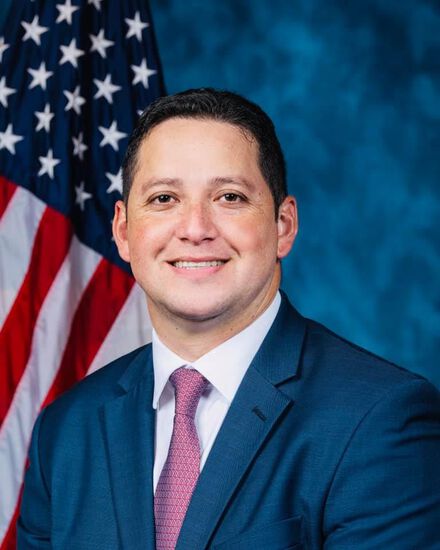
Photo of Tony Gonzales
R United States House · District 23 · Texas

Rep. Tony Gonzales

Compare
Total votes
2,633
all sessions
Attendance
95%
128 missed
Lower than 90% of chamber peers
With party
93%
of cast votes
Higher than 95% of chamber peers
Bipartisan score
3%
crosses aisle rarely
Lower than 99% of chamber peers
Sponsored
614
bills & resolutions
Lower than 89% of chamber peers
Committees
0
assignments
614 bills and resolutions

Sponsored bills

Total
614
Primary
85
Co-sponsor
529
This page
614
matching current filters
Co-sponsor HCONRES 9
Passed · United States House · Co-sponsor
Denouncing the horrors of socialism.

Maddy summaryHCONRES 9 is a symbolic resolution passed by the U.S. House of Representatives that formally denounces socialism as incompatible with American values, citing historical examples of socialist regimes causing widespread suffering and authoritarian rule. It states Congress opposes the implementation of socialist policies in the United States. This resolution has no legal effect, does not change any laws, and serves solely as a non-binding statement of congressional opinion. It directly affects no individuals or policies, as it is purely a declarative position.

Passed Feb 7, 2023 1 co-sponsor
Co-sponsor HRES 100
In committee · United States House · Co-sponsor
Expressing support for the Iranian people's desire for a democratic, secular, and nonnuclear Republic of Iran, and condemning violations of human rights and state-sponsored terrorism by the Iranian Government.

This resolution condemns Iranian state-sponsored terrorist attacks against U.S. citizens and officials and Iranian dissidents. The resolution also expresses support for the people of Iran who are legitimately defending their rights for freedom against repression and condemns the killing of Iranian protesters by the Iranian regime.

In committee Feb 7, 2023 1 co-sponsor
Co-sponsor HCONRES 13
In committee · United States House · Co-sponsor
Supporting the Local Radio Freedom Act.

Maddy summaryHCONRES 13 is a concurrent resolution expressing Congress's support for maintaining the current policy that prohibits imposing new fees on local radio stations for playing music. It states that Congress should not impose any performance fee, tax, royalty, or charge on local radio stations for broadcasting sound recordings over the air, or on businesses like bars and restaurants that play music publicly. The resolution argues that such fees would harm local radio stations - critical sources for emergency information and community programming - and jeopardize the economic model that has supported both radio and the music industry for decades. This resolution does not create new law but formally opposes potential legislative changes to the existing fee structure.

In committee Feb 6, 2023 1 co-sponsor
Co-sponsor HR 838
In committee · United States House · Co-sponsor
Freight RAILCAR Act of 2023

Freight Rail Assistance and Investment to Launch Coronavirus-Era Activity and Recovery Act of 2023 or the Freight RAILCAR Act of 2023 This bill provides a new tax credit through 2025 for 10% of freight railcar fleet modernization expenses (i.e., railcar replacement and modernization expenses for meeting fuel efficiency and performance standards). The bill provides that no more than 2,000 freight railcars per taxpayer may be taken into account for purposes of determining the credit in a taxable year. The Department of the Treasury must report to Congress on the credit to provide information on the number of times the credit was claimed and the number of railcars scrapped or built as a result of the credit.

In committee Feb 6, 2023 1 co-sponsor
Co-sponsor HR 568
In committee · United States House · Co-sponsor
SAFE Act

Save Americans from the Fentanyl Emergency Act or the SAFE Act This bill permanently places fentanyl-related substances as a class into schedule I of the Controlled Substances Act. A schedule I controlled substance is a drug, substance, or chemical that has a high potential for abuse; has no currently accepted medical value; and is subject to regulatory controls and administrative, civil, and criminal penalties under the Controlled Substances Act. The temporary scheduling order issued by the Drug Enforcement Administration to place fentanyl-related substances into schedule I of the Controlled Substances Act expires on December 31, 2024. It limits the application of mandatory minimum penalties for certain offenses involving fentanyl-related substances, establishes a process to deschedule or remove certain fentanyl-related substances that have a low potential for abuse, and allows a federal court to vacate or reduce the sentence for convictions of offenses involving a fentanyl-related substance that is descheduled or moved to a schedule other than schedule I or II. The bill establishes a new, alternative registration process for schedule I research. It also makes other changes to registration requirements for conducting research with controlled substances, including permitting a single registration for related research sites in certain circumstances, waiving the requirement for a new inspection in certain situations, and allowing a registered researcher to perform certain manufacturing activities with small quantities of a substance without obtaining a manufacturing registration. Finally, the bill requires the Government Accountability Office to analyze the implementation and impact of permanently placing fentanyl-related substances into schedule I of the Controlled Substances Act.

In committee Feb 3, 2023 1 co-sponsor
Co-sponsor HR 733
In committee · United States House · Co-sponsor
Vet CENTERS for Mental Health Act of 2023

Veterans Census-Enabled National Treatment Equitable Resource Supplement for Mental Health Act of 2023 or the Vet CENTERS for Mental Health Act of 2023 This bill requires the Department of Veterans Affairs (VA) to ensure that there is a minimum number of Vet Centers located in each state. Vet Centers are community-based counseling centers that provide social and psychological services to eligible veterans, service members, and their families. The minimum number of Vet Centers required in each state is generally based on the state's geographic size or the number of veterans located in the state. The VA must establish additional Vet Centers as necessary to meet the minimum required number for each state. The VA may establish the additional Vet Centers at facilities made available by a state, local government, or recognized Indian tribe. If a state needs more than one additional Vet Center to meet its minimum requirement, the VA must establish at least one additional Vet Center and may establish Vet Center outstations to cover the difference.

In committee Feb 1, 2023 1 co-sponsor
Co-sponsor HR 603
In committee · United States House · Co-sponsor
HEAL Act

Maddy summaryThe HEAL Act (HR 603) requires the U.S. Holocaust Memorial Museum Director to study how public elementary and secondary schools teach about the Holocaust and related antisemitism. The study will examine curriculum requirements, teaching methods (like project-based learning), instructional materials, and assessment approaches across states and school districts. It specifically analyzes whether Holocaust education is mandatory, optional, or integrated across subjects, and how schools address antisemitism and genocide prevention. The resulting report, due within 180 days of the study or three years after enactment, will inform Congress but does not change current school policies. This is a data-gathering measure, not a policy mandate.

In committee Jan 27, 2023 1 co-sponsor
Co-sponsor HR 427
In committee · United States House · Co-sponsor
SAVE Moms and Babies Act of 2023

Maddy summaryThis bill would prohibit the FDA from approving new abortion medications or investigational uses of existing ones. It would restrict currently approved abortion drugs to in-person administration only in clinics, hospitals, or medical offices by certified providers who can handle complications like ectopic pregnancy or severe bleeding. The law requires detailed adverse event reporting (excluding patient identifiers) to the FDA by both manufacturers and prescribers, and mandates provider certification covering pregnancy assessment, surgical intervention capabilities, and patient safety documentation. These provisions apply directly to healthcare providers, patients seeking medication abortions, and manufacturers of abortion drugs.

In committee Jan 27, 2023 1 co-sponsor
Co-sponsor HR 383
In committee · United States House · Co-sponsor
To nullify the modifications made by the Food and Drug Administration in January 2023 to the risk evaluation and mitigation strategy for the abortion pill mifepristone, and for other purposes.

This bill nullifies certain changes made by the Food and Drug Administration (FDA) to dispensing requirements for mifepristone. (Mifepristone is a drug that is approved to end pregnancies through 10 weeks gestation when used in conjunction with the drug misoprostol. The procedure is often referred to as medication abortion or the abortion pill.) The FDA regulates the use of mifepristone through the Mifepristone Risk Evaluation and Mitigation Strategy (REMS) program. The program requires health care providers to comply with certain requirements in order to prescribe or dispense mifepristone to end a pregnancy; the program previously included an in-person dispensing requirement that required mifepristone to be directly dispensed to patients in clinics, medical offices, or hospitals. During the COVID-19 public health emergency, the FDA temporarily stopped enforcing the in-person dispensing requirement, which allowed mail-order pharmacies to fill and dispense mifepristone prescriptions. In January 2023, the FDA modified program requirements so as to (1) remove the in-person dispensing requirement, and (2) require pharmacies to be certified in the program in order to dispense mifepristone. The modifications allow retail pharmacies, after receiving certification, to dispense mifepristone pursuant to prescriptions that are written by program-certified prescribers. The bill nullifies the January 2023 changes and prohibits any similar changes in the future.

In committee Jan 27, 2023 1 co-sponsor
Co-sponsor HR 531
In committee · United States House · Co-sponsor
Educational Choice for Children Act

Maddy summaryThe Educational Choice for Children Act creates tax credits for individuals and corporations that contribute to scholarship granting organizations providing education scholarships. Individuals can claim a credit up to $5,000 or 10% of their income, while corporations can claim up to 5% of taxable income. The scholarships are available to students from households with income up to 300% of the area median income, and can be used for private school tuition, tutoring, and other educational expenses at elementary and secondary schools. The bill includes strict requirements for scholarship organizations to verify income, conduct audits, and prevent misuse of funds, while also prohibiting government control over these organizations and protecting private and religious schools from discrimination in the program. It establishes a $10 billion annual cap on the total tax credits available.

In committee Jan 26, 2023 1 co-sponsor
Showing 411 to 420 of 614 bills
Previous 1 … 41 42 43 … 62 Next