

Maddy summaryHR 3773, the Stop Anti-Semitism on College Campuses Act, requires colleges and universities receiving federal funding to prohibit any event promoting antisemitism on campus. This includes not hosting, facilitating, funding, or supporting such events. The bill adopts the International Holocaust Remembrance Alliance's 2016 definition of antisemitism - including contemporary examples - as the standard for determining prohibited conduct. The law directly affects all institutions covered by the Higher Education Act of 1965.
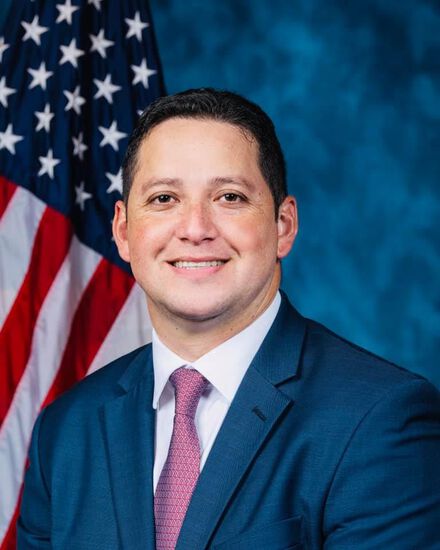
Rep. Tony Gonzales
Sponsored bills
Maddy summaryThe Essential Workers for Economic Advancement Act creates a new H-2C visa program for non-agricultural workers in jobs that remain unfilled after employers recruit U.S. workers. Employers must advertise positions for 30 days, pay prevailing wages, and register positions with the government before hiring H-2C workers, with a numerical cap of 65,000 positions in the first year. The bill includes worker protections against wage theft, prohibits treating workers as independent contractors, and requires employers to pay fees directly rather than deducting them from wages.
Stop Our Scourge Act of 2023 or the SOS Act of 2023 This bill directs the Department of Homeland Security to designate illicit fentanyl as a weapon of mass destruction and requires the Office of National Drug Control Policy to conduct an assessment regarding that substance. Specifically, the office must assess foreign manufacturing of illicit fentanyl, the tools and capabilities across federal agencies to address trafficking of that substance, the capabilities of the Mexican military to conduct counterdrug missions with respect to that substance, the capacities and willingness of China to take specified actions with respect to that substance, and illicit fentanyl being trafficked into the United States from Mexico.
Maddy summaryThe Dark Web Interdiction Act establishes a new FBI-led Joint Criminal Opioid and Darknet Enforcement Task Force to combat drug trafficking on the dark web. It amends the Controlled Substances Act to make it a federal crime to distribute controlled substances through the dark web, with a 2-level sentencing increase for violations. The task force will develop training, evidence-sharing protocols, and build partnerships with law enforcement agencies to detect and dismantle illicit marketplaces. The bill also requires a report on virtual currency use in dark web drug transactions and includes a 5-year sunset provision for the law.
Tribal Gaming Regulatory Compliance Act This bill allows the Ysleta del Sur Pueblo and Alabama-Coushatta tribes to conduct gaming activities on their land in Texas if certain conditions are met. Currently, the Ysleta del Sur Pueblo and Alabama-Coushatta Indian Tribes of Texas Restoration Act prohibits the tribes from conducting gaming activities on their land if those activities are prohibited by Texas law. The bill repeals those provisions and instead applies the Indian Gaming Regulatory Act (IGRA) to gaming activities on Indian lands of the tribes.
Maddy summaryThis bill requires that AM radio receivers be included as standard equipment in all new motor vehicles (such as cars and trucks) sold in the United States, with a rule to be issued by the Department of Transportation within one year. The rule must ensure AM radio is easily accessible on the dashboard and allows manufacturers to use digital AM radio technology instead of traditional AM. During the one-year period between the bill's enactment and the rule's effective date, manufacturers must clearly label vehicles without AM radio. The bill also directs a study to evaluate whether an alternative system could deliver emergency alerts as reliably as AM radio across the country, especially during crises.
Maddy summaryHR 3337, the Fuels Parity Act, removes a prohibition that previously excluded corn starch ethanol from being counted as "advanced biofuel" under the Clean Air Act. This change directly affects corn-based ethanol producers by allowing corn starch ethanol to qualify under renewable fuel standards. The bill also requires the EPA to update its methodology for calculating greenhouse gas emissions from corn-based ethanol and biomass-based diesel every five years, starting 90 days after enactment, with the first update mandating the use of the Argonne National Laboratory's GREET model. These provisions aim to standardize how emissions are assessed for these fuels under federal renewable fuel programs.
Maddy summaryHRES 424 is a non-binding resolution recognizing the 100th anniversary of the birth of His Holiness Pramukh Swami Maharaj, the spiritual leader of the BAPS Swaminarayan Sanstha. It formally honors his life and legacy as the founder of a global Hindu organization with thousands of places of worship. The resolution has no policy impact or effect on any individuals or groups; it serves solely as a commemorative gesture by the U.S. House of Representatives.
Maddy summaryHR 3508, the Comprehensive Southern Border Strategy Act, requires the Department of Homeland Security (DHS) to submit a detailed strategy report to Congress within 12 months of the bill’s enactment. The strategy must outline current border security risks, assess existing technology and tools for combating drug and human trafficking (especially fentanyl), and provide cost estimates for physical barriers and technologies per mile of the southern border. It mandates DHS to justify chosen solutions based on stakeholder input from governors, local officials, and property owners, along with methodology for selecting barriers. The bill does not fund new projects but establishes a framework for evaluating border security measures.
Maddy summaryHR 3392, the Fighter Force Preservation and Recapitalization Act of 2023, requires the Air National Guard to maintain at least 25 fighter squadrons (each with a minimum of 18 aircraft) by mandating one-for-one replacement of existing squadrons by 2034. The bill directs the Air Force Secretary to develop and submit a recapitalization plan to Congress within 120 days of enactment, including modernizing squadrons and fielding new "Next Generation Air Dominance" systems. This directly affects the Air National Guard's fighter force structure, setting specific numerical requirements for aircraft and squadrons. The law allows limited waivers for extraordinary circumstances but maintains the core 2034 deadline for full recapitalization.