

Maddy summaryThis bill would expand Medicare to cover dental, vision, and hearing services for beneficiaries 65 and older (and some younger people with disabilities), effective January 1, 2026. It would provide 100% coverage for preventative dental services in 2026, with basic and major dental services gradually increasing to 80% coverage by 2029. Vision benefits would include 80% coverage for annual eye exams and specific limits on eyeglasses, frames, and contact lenses ($100 per year for lenses, $100 every two years for frames, $200 every two years for contacts). Hearing services would include 80% coverage for hearing exams and hearing aids, with a limit of one hearing aid per ear every 48 months. The bill also adds oral health professionals to the United States Preventive Services Task Force to help guide coverage decisions.
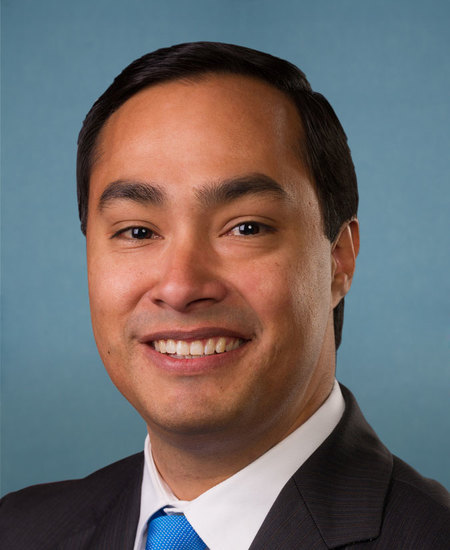
Rep. Joaquin Castro
Sponsored bills
Maddy summaryHR 2033, the Military Spouse Hiring Act, expands the Work Opportunity Tax Credit to include spouses of active-duty military personnel. It adds "qualified military spouse" as an eligible category for the tax credit, meaning employers who hire such spouses can claim the credit. A "qualified military spouse" is defined as someone certified by a local agency as married to an active-duty service member at the time of hire. The credit applies to hires occurring after the bill's enactment date. This directly affects military spouses seeking employment and employers hiring them, providing a tax incentive to encourage their hiring.
This bill designates the facility of the United States Postal Service located at 620 East Pecan Boulevard in McAllen, Texas, as the "Agent Raul H. Gonzalez Jr. Memorial Post Office Building".
Maddy summaryHR 2009, the Global Criminal Justice Act, establishes a new Office of Global Criminal Justice within the U.S. Department of State. This office advises the Secretary of State on war crimes, crimes against humanity, and genocide; coordinates U.S. policy and resources (diplomatic, legal, economic) to prevent atrocities, support prosecutions, and assist victims; and works with international courts and partners to investigate and address global atrocities. The office will be led by an Ambassador-at-Large appointed by the President with Senate approval. It directly affects U.S. foreign policy implementation and coordination with international justice mechanisms.
Maddy summaryHR 2000, the Arctic Watchers Act, establishes a new State Department program to monitor security, economic, and political activities in the Arctic region. The program assigns "Arctic Watchers" to at least three European diplomatic posts and one North American post to track foreign influence (particularly from China and Russia), protect U.S. interests, and strengthen engagement with Arctic stakeholders. It requires annual reports to Congress detailing assigned staff, responsibilities, and strategies, with $10 million authorized annually for fiscal years 2025 and beyond. The bill directly affects U.S. diplomatic operations in Arctic-focused countries and aims to counter perceived threats to U.S. security and economic interests in the region.
Maddy summaryThis bill terminates a national emergency declared by the President on February 1, 2025, under Executive Order 14194. It directly ends the legal status of that emergency by invoking Section 202 of the National Emergencies Act (50 U.S.C. 1622). The key mechanism is a formal congressional resolution to revoke the emergency designation, which would end any special authorities granted under that emergency. This is a procedural action affecting only the emergency status itself, not new policies or affected groups.
Maddy summaryThis bill strengthens the Voting Rights Act of 1965 by clarifying how to prove voting discrimination and expanding requirements for preclearance of voting changes. It establishes new standards for determining when voting practices dilute minority voting strength or deny/abridge voting rights, requiring plaintiffs to show specific conditions for vote dilution claims and including factors like historical discrimination and racial polarization in court analyses. The bill modifies the criteria for determining which states and political subdivisions must seek preclearance for voting changes, and adds new transparency requirements for jurisdictions to publicly disclose changes to voting qualifications, polling locations, and election districts. It directly affects states and local governments that implement voting policies, particularly those with a history of voting rights violations or that make changes to voting qualifications, procedures, or district boundaries. The bill aims to prevent discriminatory voting practices by providing clearer standards for courts and requiring greater transparency in voting rule changes.
Maddy summaryThe Richard L. Trumka Protecting the Right to Organize Act of 2025 strengthens workers' organizing rights by making it an unfair labor practice for employers to threaten permanent replacement of striking workers, discriminate against workers who support unions, or require employees to attend employer campaigns unrelated to their job duties. It expands the definition of "employee" to make it harder for companies to classify workers as independent contractors and requires employers to post notices about workers' rights in conspicuous locations. The bill establishes a new electronic voting system for union elections, creates a 90-day bargaining period before mediation can be requested, and increases penalties for violations of labor laws. These changes are intended to make it easier for workers to form unions and negotiate better wages and working conditions.
Maddy summaryHR 1787 authorizes the U.S. Mint to produce commemorative coins honoring baseball legend Roberto Clemente, including $5 gold, $1 silver, and half-dollar coins, with specific specifications for weight, size, and metal content. The bill requires the coins to feature Clemente's image and commemorative inscriptions, and mandates a surcharge ($35 for gold, $10 for silver, $5 for half-dollar) paid to the Roberto Clemente Foundation for its educational, youth sports, and disaster relief programs. All coins must be minted in 2027, sold at face value plus surcharge and production costs, and will be legal tender. The bill focuses solely on the coin program, not broader policy changes.
Safe Schools Improvement Act This bill requires states to direct their local educational agencies (LEAs) to establish policies that prevent and prohibit bullying and harassment of elementary and secondary school students. In particular, these policies must prohibit bullying and harassment based on race, color, national origin, disability, religion, or sex. Sex includes sexual orientation, gender identity, and sex characteristics (including intersex traits). Further, LEAs must provide (1) students, parents, and educational professionals with annual notice of the conduct prohibited in their disciplinary policies; (2) students and parents with grievance procedures that target such conduct; and (3) the public with annual data on the incidence and frequency of that conduct at the school and LEA level. The Department of Education must conduct and report on an independent biennial evaluation of programs and policies to combat bullying and harassment in elementary and secondary schools. The National Center for Education Statistics must collect state data to determine the incidence and frequency of the conduct prohibited by LEA disciplinary policies.