

Build the Wall and Fight Fentanyl Act of 2023 This bill establishes accounts to fund the construction of physical barriers along the U.S. southern border and to provide grants to address fentanyl abuse. These accounts shall be funded from the sale of assets belonging to cartels that have been seized by the Drug Enforcement Administration, U.S. Immigration and Customs Enforcement, or U.S. Customs and Border Protection. The bill defines cartel as (1) an organization with operations in Mexico and the United States designated as a significant transnational criminal organization; (2) certain named organizations, such as the Sinaloa Cartel and the Juarez Cartel; and (3) other organizations as designated by the President.
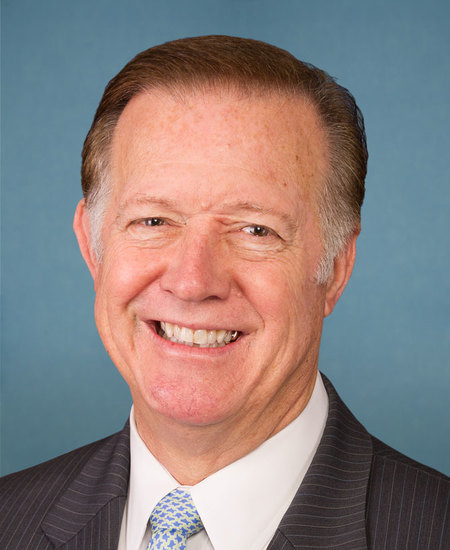
Rep. Randy K. Weber, Sr.
Sponsored bills
Maddy summaryThis bill directs the U.S. Treasury to mint commemorative coins marking the Marine Corps' 250th anniversary in 2025. It authorizes three coin types: $5 gold coins (max 50,000), $1 silver coins (max 400,000), and half-dollar coins (max 750,000), with surcharges of $35, $10, and $5 respectively. The surcharge proceeds will fund the Marine Corps Heritage Center's educational programs, with no net cost to taxpayers as the Treasury must recover all minting costs through the surcharges. The coins can only be issued during 2025, and the Treasury must ensure all costs are covered before distributing funds to the Heritage Foundation.
Maddy summaryHR 4860, the PROTECT the Second Amendment Act, prevents landlords in specific federally assisted housing from banning or restricting residents' lawful possession of firearms in their private units or during travel between units and common areas. It directly affects tenants in housing funded by HUD or USDA programs, including public housing, Section 8 vouchers, and housing for veterans or people with disabilities. The bill prohibits landlords from imposing firearm bans or additional conditions on residents who lawfully carry firearms within their dwelling units or while moving through common areas to reach their units. This changes current policies in these housing programs by explicitly allowing firearm possession where state law permits.
Maddy summaryHR 4701 designates all fentanyl-related substances - including their isomers, salts, and structurally similar compounds - as Schedule I controlled substances under the Controlled Substances Act. This means any substance meeting the bill's broad chemical definition (like modifications to fentanyl's molecular structure) is automatically illegal without approval, directly affecting drug manufacturers, pharmacies, and law enforcement. The key mechanism is expanding the legal definition to cover a wide range of chemical variations that could otherwise evade current drug scheduling. This policy change aims to close loopholes used to traffic fentanyl analogs by making their legal status clear without requiring individual case-by-case scheduling.
Maddy summaryHR 4663, the Federal Mechanical Insulation Act, defines "mechanical insulation" (insulation around pipes and equipment in federal buildings) as an eligible energy efficiency measure. It requires federal agencies to include mechanical insulation in their required energy and water evaluations, specifically mandating that evaluations identify this insulation as a potential efficiency measure. The bill specifies that such insulation must meet minimum standards under Reference Standard 90.1 to qualify. This change directly affects federal building managers and contractors by formally recognizing mechanical insulation as a standard efficiency option in compliance with existing energy conservation laws.
Maddy summaryHRES 606 is a resolution passed by the U.S. House of Representatives to formally censure Representative Pramila Jayapal (D-WA) for her July 15, 2023, remarks describing Israel as a "racist state" and advocating for Palestinian self-determination, which the resolution characterizes as antisemitic. The resolution also references her 2021 co-sponsorship of legislation opposing U.S. arms sales to Israel during a Hamas rocket attack on Israel. It requires Jayapal to appear in the House chamber for the Speaker to publicly read the censure resolution. This symbolic action, without legal penalties, serves as the House's formal expression of disapproval.
Maddy summaryThis bill cancels a 2016 rule requiring new truck drivers to complete specific training programs. It removes the Federal Motor Carrier Safety Administration's mandate for minimum training standards for entry-level commercial drivers. The repeal directly affects trucking companies and new drivers who would no longer need to follow these training requirements. The change eliminates a specific regulatory obligation without creating new policies or funding.
Maddy summaryThis bill creates two tax credits to support local media and small businesses. It provides a credit for small businesses (under 50 full-time employees) that advertise in qualifying local newspapers or broadcast stations, covering 80% of first-year ad costs up to $5,000 and 50% of subsequent-year costs up to $2,500. It also establishes a payroll tax credit for employers hiring local news journalists, covering 50% of wages for the first four quarters (capped at $12,500 per journalist) and 30% thereafter, with a maximum of 1,500 journalists per employer. Both credits expire after five years and require strict definitions of "local media" (e.g., publishers with local journalists and community focus) to prevent misuse.
No Taxpayer Funding For Climate Zealots Advancing Radical Schemes Act or the No Taxpayer Funding For CZARS Act This bill prohibits the use of federal funds for any activity of the Special Presidential Envoy for Climate.
Maddy summaryHR 4721, the Main Street Tax Certainty Act, makes a permanent the 20% tax deduction for eligible small business owners under Section 199A of the tax code. This provision directly affects pass-through business owners (like S-corps, partnerships, and sole proprietorships) who qualify for the deduction. The bill achieves this by removing the temporary expiration language (subsection (i)) from the existing tax code provision. The key change is ending the need for annual congressional extensions of this deduction, providing long-term tax certainty for small businesses.