

Maddy summaryThis bill prohibits federal funding for housing undocumented immigrants on public lands managed by specific federal agencies. It blocks the use of federal money to provide temporary or permanent shelter (including encampments) for "specified aliens" - defined as individuals not legally admitted to the U.S. - on lands under the National Park Service, Bureau of Land Management, Fish and Wildlife Service, or Forest Service. The restriction applies to all housing arrangements, including leases or contracts, and directly affects how these agencies manage public lands. The policy change prevents federal agencies from using taxpayer funds to support shelter for non-admitted immigrants on federally managed properties.
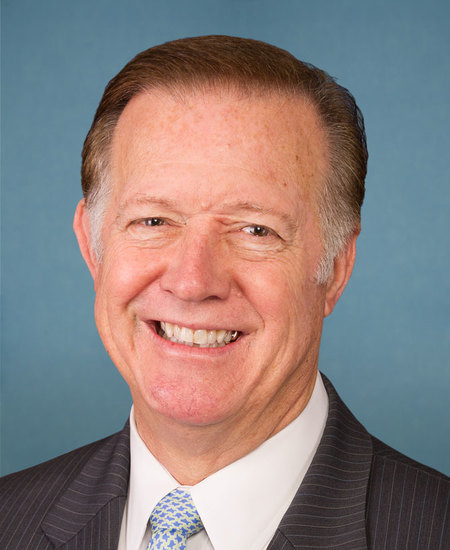
Rep. Randy K. Weber, Sr.
Sponsored bills
Maddy summaryHRES 905 is a House resolution commemorating the 200th anniversary of the Monroe Doctrine, first articulated by President James Monroe in 1823. The resolution formally recognizes the doctrine's historical significance in establishing U.S. policy against foreign colonization in the Western Hemisphere and its enduring influence on U.S. foreign policy. It resolves that the House will "commemorate" the anniversary, "reassert" the U.S. position against foreign malign influence threatening Western Hemisphere democracies, and "recognize" the doctrine's principles as a foundational element of U.S. foreign policy. This is a purely ceremonial resolution with no new policy or funding implications.
Maddy summaryThis bill requires U.S. Customs and Border Protection (CBP) to obtain fingerprints from noncitizen children under 14 years old if officers suspect they are trafficking victims upon entering the U.S. It also creates a new federal crime for adults (18+) who knowingly use a minor for entry without being a relative or guardian, punishable by fines or up to 10 years in prison. The bill mandates sharing fingerprints collected under this provision with the Department of Health and Human Services for unaccompanied minors and requires CBP to report monthly data on trafficking-related apprehensions and annual data on fingerprinting to Congress. These provisions directly affect CBP officers, unaccompanied children, and individuals suspected of exploiting minors for entry.
Maddy summaryThe Southern Border Transparency Act of 2023 (HR 6523) requires U.S. Customs and Border Protection (CBP), the Department of Homeland Security (DHS), and U.S. Citizenship and Immigration Services (USCIS) to publish specific immigration data online. It mandates monthly reports on parole grants at ports of entry (including numbers by nationality and family status), quarterly reports on processing outcomes for aliens encountered at the southern border (disaggregated by nationality, demographics, and processing paths), and annual reports on parolees (including employment status and status changes). These reports must be posted on agency websites and submitted to relevant congressional committees. The bill directly affects federal agencies responsible for border processing and aims to increase public and congressional transparency about immigration enforcement practices at the southern border.
Maddy summaryThis bill would amend the census law to exclude non-citizen residents from the population count used to determine congressional representation. It directly affects states with significant non-citizen populations, as their number of House seats could decrease in future apportionments. The key provision changes the statutory language to explicitly exclude "individuals who are not citizens of the United States" from the population figure. This change would apply starting with the 2030 census and all subsequent decennial counts.
Maddy summaryThis bill requires Congress to authorize any U.S. vote to allocate IMF funds (Special Drawing Rights) or support quota increases for eight specific countries: China, Russia, Iran, North Korea, Cuba, Venezuela, Nicaragua, and Afghanistan under Taliban control. It directs the U.S. Treasury to oppose IMF proposals that would benefit these nations through funding or policy changes. The law applies directly to U.S. representation at the International Monetary Fund, preventing automatic U.S. support without legislative approval. It targets countries designated as adversaries or subject to U.S. sanctions.
Maddy summaryHR 6504, the Protect American Gun Exporters Act, blocks the Department of Commerce from implementing a pause on new export licenses for specific firearm exports (items under Commerce Control List numbers 0A501, 0A502, 0A504, and 0A505). The bill directly affects U.S. gun exporters by preventing the Commerce Secretary from enforcing the October 2023 pause or similar restrictions on these exports. Key provisions prohibit the Secretary from taking any action to carry out the pause unless it follows standard regulatory processes, including a required impact analysis and compliance with the Administrative Procedure Act and Congressional Review Act. This bill does not create new export rules but stops the existing pause on certain firearm exports.
Maddy summaryHRES 683 is a non-binding resolution expressing the House's support for diplomatic efforts to encourage Mexico to fulfill annual water delivery commitments under the 1944 U.S.-Mexico treaty. The treaty requires Mexico to deliver an average of 350,000 acre-feet of water annually (over a 5-year cycle) to the U.S., but Mexico has historically delayed deliveries until the cycle ends. The resolution specifically acknowledges water shortages faced by South Texas farmers and urges Mexico to meet its annual obligations, while supporting negotiations for more reliable water agreements. It does not create new legal requirements but formally encourages diplomatic action to address the delivery delays.
Maddy summaryHR 6459, the "No Abortion Coverage for Medicaid Act," permanently prohibits Medicaid and CHIP funds from covering abortions, except in specific medical circumstances. It directly affects Medicaid recipients and state Medicaid programs by blocking federal funding for abortion services, including travel or lodging to obtain one, and prevents states from using Medicaid demonstration waivers to expand abortion coverage. The bill codifies the existing Hyde Amendment restrictions, ensuring taxpayer dollars cannot pay for abortions except when a pregnancy results from rape or incest, poses a life-endangering physical condition, or involves miscarriage or ectopic pregnancy. This policy change would restrict abortion coverage under Medicaid nationwide, with exceptions limited to the three medical scenarios outlined in the bill.
Maddy summaryThis bill prohibits the use of federal funds to cover abortions or related expenses (like travel or lodging) for unaccompanied immigrant minors. It directly affects unaccompanied alien children, as defined by immigration law, by blocking federal rules or guidance that would facilitate access to abortion services for them. The key provision bans the Health and Human Services Secretary from issuing, implementing, or enforcing any rule that enables such access using taxpayer money. This is a policy change limiting federal funding for abortion-related costs for this specific group, not a general abortion ban.