

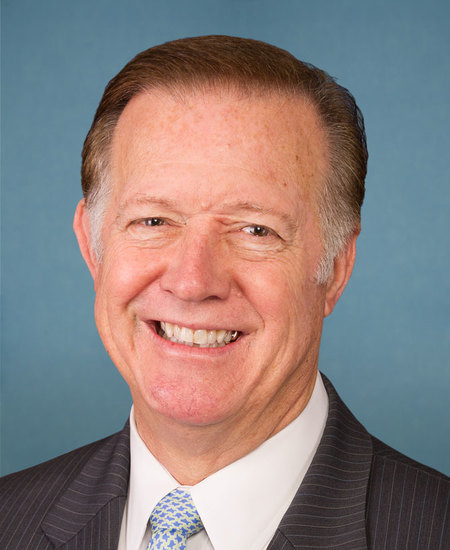
Photo of Randy K. Weber, Sr.
R United States House · District 14 · Texas On the 2026 ballot

Rep. Randy K. Weber, Sr.

Compare
Total votes
2,837
all sessions
Attendance
98%
68 missed
Near the chamber average
With party
92%
of cast votes
Near the chamber average
Bipartisan score
4%
crosses aisle rarely
Near the chamber average
Sponsored
1,848
bills & resolutions
Higher than 84% of chamber peers
Committees
6
assignments
1,848 bills and resolutions

Sponsored bills

Total
1,848
Primary
60
Co-sponsor
1,788
This page
1,848
matching current filters
Co-sponsor HR 6818
In committee · United States House · Co-sponsor
BEST Act

Bettering Employee Skills and Talents Act or the BEST Act This bill allows a new tax credit against employment taxes for 30% of qualified workforce training expenses paid by an employer. The bill defines qualified workforce training expenses as amounts paid by an employer to provide entry-level employees without a bachelor's degree with skills training recognized by governmental and private organizations.

In committee Dec 14, 2023 1 co-sponsor
Co-sponsor HR 6782
In committee · United States House · Co-sponsor
SAFER Voter Act

Maddy summaryThis bill, titled "SAFER Voter Act" but focused on firearms, amends federal law to require federal firearms licensees to verify that buyers of handguns (not shotguns or rifles) are at least 21 years old. It directly affects gun dealers and individuals under 21 seeking to purchase handguns. The key provision removes existing exceptions allowing sales of handguns to those under 21, requiring licensees to confirm age before transferring handguns. The bill does not address voting rights or voter registration, despite its misleading title. (Note: The bill's title conflicts with its actual provisions, which relate to firearm age restrictions.)

In committee Dec 14, 2023 1 co-sponsor
Co-sponsor HR 6795
In committee · United States House · Co-sponsor
ACE Act

Maddy summaryThe ACE Act expands tax-advantaged education savings by allowing 529 plan funds to cover homeschooling costs and additional K-12 expenses like tutoring, therapies, and curriculum materials. It doubles the annual distribution limit from $10,000 to $20,000 for these expenses and adds a $20,000 annual gift tax exclusion for contributions to 529 plans. The bill also restricts tax-exempt bonds for school construction to states meeting specific school choice program metrics, requiring at least 40% of students to be eligible for programs like vouchers or education savings accounts. These changes directly affect families using homeschooling or private education, states with school choice programs, and contributors to 529 plans.

In committee Dec 14, 2023 1 co-sponsor
Co-sponsor HR 6758
In committee · United States House · Co-sponsor
Defense of Property Rights Act

Maddy summaryThe Defense of Property Rights Act (HR 6758) would allow property owners to seek compensation in either U.S. District Court or the U.S. Court of Federal Claims when government actions - such as regulations or physical takings - deprive them of property rights without "just compensation." It repeals a law that previously forced owners to choose between courts, clarifies that "just compensation" includes full market value and business losses (with interest), and shifts the burden of proof to the government to justify regulatory actions. The bill directly affects individuals and businesses owning real estate, water rights, mineral rights, or other property protected under the Fifth Amendment, particularly when government rules significantly restrict property use or value. It sets a 6-year statute of limitations for claims and requires courts to award attorney fees to successful plaintiffs.

In committee Dec 13, 2023 1 co-sponsor
Co-sponsor HR 6753
In committee · United States House · Co-sponsor
PLCAA Federal Jurisdiction Act

Maddy summaryHR 6753, the PLCAA Federal Jurisdiction Act, amends the Protection of Lawful Commerce in Arms Act to allow gun manufacturers, sellers, and trade associations to move certain lawsuits from state courts to federal courts. Specifically, if these defendants claim a case falls under the PLCAA's protections against liability for gun-related injuries, they can request the case be removed to federal district court. The federal court would then determine if the case qualifies under PLCAA and dismiss it if it does. This change directly affects gun industry defendants by shifting jurisdiction for these specific lawsuits to federal courts.

In committee Dec 13, 2023 1 co-sponsor
Co-sponsor HR 6734
In committee · United States House · Co-sponsor
Stopping Unconstitutional Background Checks Act

Maddy summaryHR 6734 prohibits the use of federal funds to finalize, implement, or enforce the Bureau of Alcohol, Tobacco, Firearms, and Explosives' (ATF) proposed rule (2022R-17) defining "engaged in the business as a dealer in firearms." This bill directly affects the ATF by blocking funding for this specific regulatory rule, which was proposed in August 2023. The legislation does not create new requirements but prevents federal resources from being used to advance this particular ATF regulation.

In committee Dec 13, 2023 1 co-sponsor
Co-sponsor HR 4531
Passed · United States House · Co-sponsor
Support for Patients and Communities Reauthorization Act

Maddy summaryThis bill reauthorizes and extends funding for programs addressing substance use disorders and opioid addiction, including residential treatment for pregnant and postpartum women, first responder training, and community recovery initiatives. It increases funding levels for these programs, adds xylazine to Schedule III of controlled substances, and requires a study on remote monitoring for patients prescribed opioids. The bill also expands Medicaid coverage requirements for medication-assisted treatment and mandates reporting on mental health condition data alongside substance use disorder data, directly affecting individuals with substance use disorders, healthcare providers, and state and tribal governments.

Passed Dec 13, 2023 1 co-sponsor
Co-sponsor HJRES 88
Passed · United States House · Co-sponsor
Providing for congressional disapproval under chapter 8 of title 5, United States Code, of the rule submitted by the Department of Education relating to "Improving Income Driven Repayment for the William D. Ford Federal Direct Loan Program and the Federal Family Education Loan (FFEL) Program".

Maddy summaryHJRES 88 is a resolution seeking to block a Department of Education rule that would have improved income-driven repayment options for federal student loan borrowers. The rule, published in the Federal Register on July 10, 2023, targeted the William D. Ford Direct Loan Program and the Federal Family Education Loan (FFEL) Program. This resolution uses the Congressional Review Act process to disapprove the rule, preventing it from taking effect and preserving the current repayment structure. If enacted, it would stop the proposed changes to repayment terms without altering existing loan policies.

Passed Dec 11, 2023 1 co-sponsor
Co-sponsor HR 6711
In committee · United States House · Co-sponsor
Prison Staffing Reform Act of 2023

Maddy summaryHR 6711, the Prison Staffing Reform Act of 2023, requires the Bureau of Prisons to conduct a comprehensive external review of staffing levels within 180 days of enactment. This review, to be led by an independent organization and involving prison unions, civil rights groups, and recidivism programs, must identify how understaffing affects inmate access to medical care, programming, safety, and staff well-being. The bill mandates a detailed staffing plan with specific ratios (e.g., correctional officers per inmate, medical staff per unit) and a 3-year strategy to fill vacancies, reduce overtime, and improve security. The Bureau must submit the plan to Congress and prison unions, with annual progress reports over three years, all subject to funding.

In committee Dec 11, 2023 1 co-sponsor
Co-sponsor HR 6619
In committee · United States House · Co-sponsor
Preventing Aliens Through Rivers Or Land Act

Maddy summaryHR 6619, the PATROL Act, prevents the federal government from suing states for building border barriers. It specifically blocks the Attorney General from filing civil lawsuits under the 1899 Act against states that construct physical barriers (like walls, fences, or buoys) along the border to stop illegal entry or protect state territory. The law directly affects states building such barriers and the federal government’s legal authority to challenge those actions. This is a procedural change that removes a legal obstacle for states pursuing border security measures.

In committee Dec 11, 2023 1 co-sponsor
Showing 841 to 850 of 1,848 bills
Previous 1 … 84 85 86 … 185 Next