

Maddy summaryHR 7552, the "RECOGNIZING Judea and Samaria Act," is a procedural bill requiring the U.S. government to replace the term "West Bank" with "Judea and Samaria" in all official documents, communications, and policy materials after enactment. It prohibits federal funds from being used to prepare or distribute any materials using "West Bank," with limited exceptions for international treaty obligations and a Secretary of State waiver process. The bill amends multiple laws (including the Foreign Assistance Act and Taylor Force Act) to update terminology throughout U.S. legal texts. This is a terminology change affecting government communications, not a policy altering territorial status or impacting individuals.
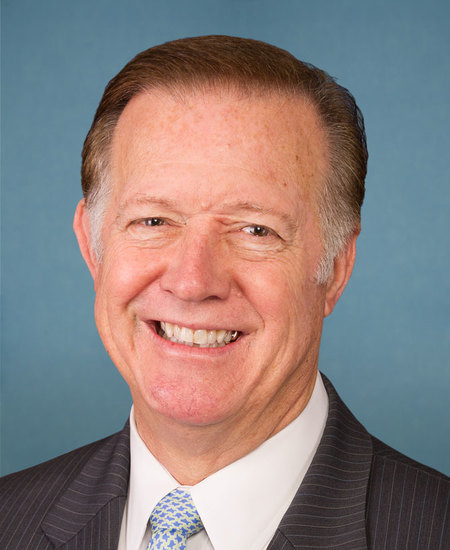
Rep. Randy K. Weber, Sr.
Sponsored bills
Let Injured Americans Be Legally Empowered Act or the LIABLE Act This bill prohibits COVID-19 vaccine manufacturers from being immune under federal law from lawsuits relating to their vaccines. Specifically, the bill prohibits any federal law from providing immunity for COVID-19 vaccine manufacturers from civil suits or liability, or limiting liability, with respect to the administration or use of their vaccines. Additionally, individuals may not be precluded from bringing a civil suit against a COVID-19 vaccine manufacturer because the individual sought or received compensation through specified federal vaccine injury compensation programs, nor does the bill preclude individuals from seeking compensation through these programs. The bill applies to vaccine administrations that occur before, on, or after the bill's date of enactment.
Maddy summaryHRES 1046 is a ceremonial resolution honoring 13 U.S. military veterans and civilians who led the 2021 Afghanistan evacuation. It recognizes their efforts in safely evacuating over 17,000 Afghan allies and citizens from Taliban-controlled areas during the U.S. withdrawal. The resolution formally thanks these individuals for their "extraordinary efforts" and "exceptional service," as detailed in the Congressional Record. This is purely symbolic recognition with no policy or legal impact.
Maddy summaryHRES 1041 is a non-binding resolution introduced in the U.S. House of Representatives on February 29, 2024, that condemns the International Court of Justice's (ICJ) January 26, 2024, order requiring Israel to report on measures taken to comply with provisional measures related to South Africa's genocide case against Israel. The resolution specifically condemns the ICJ's order and South Africa's case, asserts Israel's right to self-defense against Hamas, and calls on the U.S. President to direct the Secretary of State to intervene in support of Israel. It does not impose legal requirements or alter policy, as resolutions like this express congressional opinion only.
Maddy summaryHR 7505, the American Worker Protection Act of 2024, would change how H-1B visas are issued by requiring the Department of Homeland Security to prioritize applications based on the highest salary offered to foreign workers. This amendment to the Immigration and Nationality Act would reorder visa issuance from the current first-come-first-served system to rank applicants by the compensation rate stated in their visa applications. The bill directly affects employers seeking H-1B workers and foreign workers applying for these visas, as it would influence which applications are approved first. The key mechanism is the new requirement to process applications in descending order of salary rates, with implementation rules to be issued by the Secretary of Homeland Security after enactment.
Maddy summaryThe Save our Allies Congressional Gold Medal Act authorizes Congress to award a single gold medal to seven individuals - Chad Robichaux, Sarah Verardo, Tim Kennedy, Kevin Roarke, Sean Gabler, Dave Johnson, and Dennis Price - for their role in rescuing over 17,000 people during the 2021 Afghanistan evacuation. The medal, to be struck by the U.S. Treasury, will be presented by Congress and then displayed at the Smithsonian Institution. The bill also permits the sale of bronze duplicates to cover production costs, with proceeds deposited into the U.S. Mint fund. This legislation is a commemorative honor recognizing specific individuals' actions during the evacuation.
Maddy summaryThis bill directs the Secretary of State to actively use U.S. diplomatic resources, including the voice and influence of U.S. diplomats and officials at the International Boundary and Water Commission, to advance efforts ensuring Mexico complies with the 1944 water treaty. It requires U.S. officials to work toward establishing reliable water delivery agreements under the treaty for the Colorado, Tijuana, and Rio Grande rivers. The key mechanism is mandating diplomatic engagement to address Mexico's compliance with treaty obligations, aiming to secure predictable water flows for U.S. users. The bill affects U.S. diplomatic operations and water management coordination with Mexico, focusing on treaty implementation rather than new water infrastructure.
Maddy summaryHRES 1031 is a non-binding House resolution declaring the U.S. southern border situation an "invasion," citing three specific claims: over 8 million migrant crossings since 2021, a 1,000% rise in watchlist entries, and drug-related deaths. It does not create new laws or affect individuals, as resolutions like this only express legislative sentiment. The bill formally states the House's viewpoint through these cited statistics without proposing policy changes. As a symbolic gesture, it has no legal force or impact on border policy.
Maddy summaryHR 7455, the Sunset Act of 2024, requires federal agencies to automatically expire significant rules after 10 years unless Congress passes a new law extending them. Agencies must submit reports 180 days before expiration, and Congress can extend rules via joint resolution within 3 legislative days of receiving the report. The bill also mandates annual reviews of 10% of active agency rules for 9 years, with rules not extended by Congress after the 10-year period expiring. It applies to all major agency rules (e.g., environmental or safety regulations) and includes limited presidential exemptions for emergencies, but does not affect existing rules already in effect.
Maddy summaryThis bill amends the 2018 Anti-Boycott Act to include boycotts by international governmental organizations (IGOs), such as UN agencies, alongside boycotts by foreign countries. It expands existing requirements for U.S. entities to report boycotts they comply with, now covering IGO-initiated boycotts as well. The change directly affects U.S. businesses and organizations operating internationally who might face pressure from IGOs to participate in boycotts. Key provisions update legal definitions in the law by inserting "or international governmental organization" in relevant sections without creating new penalties.