No Taxpayer Funding for the Central American Minors Program Act This bill prohibits using federal funds to carry out the Central American Minors program, a Department of Homeland Security and Department of State program that reunites qualified children from El Salvador, Guatemala, and Honduras with their parent who is lawfully present in the United States.
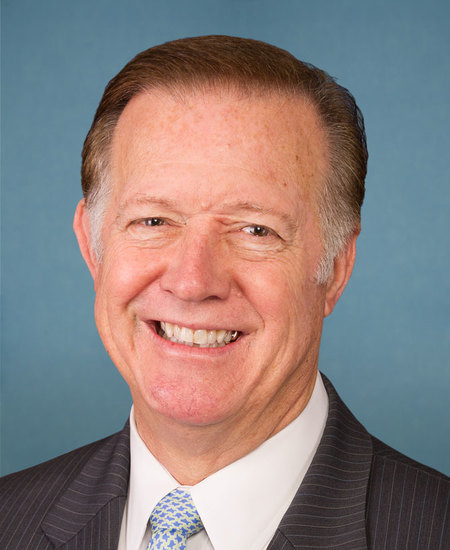
Rep. Randy K. Weber, Sr.
Sponsored bills
Transparency of Migration Act This bill requires the Department of Homeland Security and the Department of Health and Human Services (HHS) to make publicly available online certain information about individuals unlawfully present in the United States who are (1) apprehended by U.S. Customs and Border Protection and sent to a federal detention center or released into the United States, or (2) processed through an HHS facility. This information must be updated weekly and must include daily numbers, the country of origin of such individuals, and other details.
Study To Observe and Prevent (STOP) Human Trafficking Act of 2021 This bill directs the Department of Justice, in coordination with the President's Interagency Task Force to Monitor and Combat Trafficking in Persons, to study and report on the prevalence and instances of human trafficking at adult entertainment clubs in the United States.
Second Amendment is Essential Act of 2021 This bill directs the Department of Homeland Security to designate the business of importing, manufacturing, or dealing firearms, or importing or manufacturing ammunition, as a critical infrastructure sector. Additionally, the bill states that individuals who are employed by those entities are critical infrastructure workers. The term critical infrastructure means systems and assets, physical or virtual, so vital to the United States that the incapacity or destruction of such systems and assets would have a debilitating impact on security, national economic security, national public health and safety, or any combination of those matters.
Fairness in Firearm Testing Act This bill establishes additional requirements for the Bureau of Alcohol, Tobacco, Firearms and Explosives (ATF). Specifically, the bill requires the ATF to make a video recording of its process for evaluating and testing an item to determine if it is a firearm or ammunition.
Responsible Practical Training Act of 2021 This bill imposes limits on the Optional Practical Training program and addresses related issues. (The program provides an F-1 student visa holder temporary employment authorization before or after completion of the student's studies, or both. Currently, an eligible alien may receive up to 12 months of employment authorization under the program, with a 24-month extension available to certain individuals with degrees in certain fields related to science, technology, engineering, or math.) Specifically, the bill requires the Department of Homeland Security to issue regulations to (1) limit the program to six months and eliminate any extensions; and (2) exclude from the program any alien with a degree or working in a sensitive field, such as military-related fields. The Department of Labor must conduct a wage analysis of the Optional Practical Training program and Curricular Practical Training program. The analysis must include a determination as to whether the aliens in the programs received wages appropriate for the type and location of employment.
Firearm Due Process Protection Act This bill expands the grounds for pursuing judicial remedies related to certain firearm transfers. Additionally, the bill establishes procedural rules applicable to actions for judicial remedies. Current law authorizes judicial remedies for an individual who is erroneously denied a firearm (e.g., an individual is denied a firearm but the individual is eligible to receive or possess a firearm). This bill authorizes remedies for an individual who experiences an extended delay (i.e., a delay of more than 60 days) on a firearm transfer. Additionally, the bill requires an expedited hearing on an action for judicial remedies and places the burden of proof on the respondent to show by clear and convincing evidence that the individual was ineligible to receive or possess a firearm.
Protecting Individual Sovereignty Through Our Laws Act or the PISTOL Act This bill modifies the definition of rifle for purposes of the National Firearms Act to exclude from such definition a pistol equipped with a rear brace or rear attachment designed to assist the shooter in controlling the pistol. The bill also directs the Department of Justice to amend applicable regulations governing pistols to provide that the presence or absence of rear mounted braces or attachments that can assist a user in controlling the pistol shall not cause a firearm to be considered a pistol.
Stars and Stripes Act of 2021 This bill prohibits the Department of State from displaying any flag or banner at a diplomatic or consular post other than specified flags. Such flags are (1) the U.S. flag; (2) the flag of the country wherein the post is located; (3) the flag of a state, territory, or possession of the United States; (4) a departmental or secretarial flag; (5) the flag of an Armed Force; or (6) a flag to honor prisoners of war or those missing in action.
Safeguarding United States Research Act This bill imposes certain reporting requirements on the sponsor of an F, M, or J (student or exchange visitor) visa and authorizes the Department of Homeland Security (DHS) to revoke such a visa in certain instances. It also expands disclosure requirements for applicants of federal research and development awards. The Department of State must require a sponsor of a J visa to report any change to the visa holder's primary field of study. The State Department and DHS shall require a sponsor of an F, M, or J visa to report when the visa holder is participating in a federally funded research program. DHS may review and revoke an F, M, or J visa in certain instances, such as finding that (1) the visa holder misrepresented an intention to pursue a field of study, or (2) the visa holder's participation in a federally funded research program poses a national security risk. The bill also imposes certain limits on the ability to appeal such a revocation decision. The bill also requires applications for federal research and development awards to disclose any in-kind contributions received by the applicant. Furthermore, if an applicant works for an institution that is required to file disclosures relating to the receipt of foreign gifts, the application for the federal award must include a certification that the applicant has provided the employing institution all the information necessary to comply with that disclosure requirement.