

Maddy summaryHR 1286, the Lone Star Reimbursement Act, directs the Department of Defense and Department of Homeland Security to reimburse the State of Texas $2.2 billion for costs incurred during Operation Lone Star in fiscal years 2022 and 2023. The bill specifically allocates funds from existing appropriations to cover Texas' expenses related to border security operations, including apprehensions and fentanyl seizures documented in the bill's findings. This reimbursement applies to costs already incurred by Texas, with no new policy changes or requirements for the state.
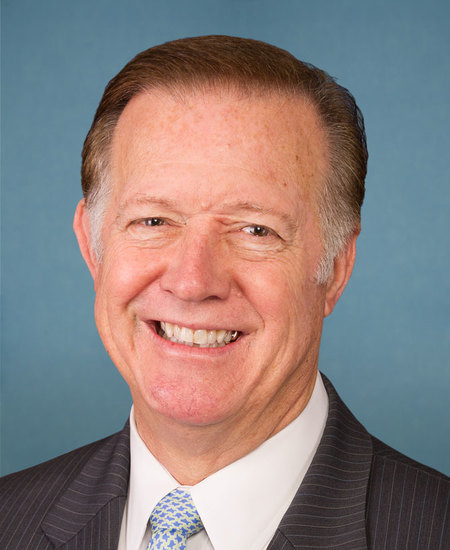
Rep. Randy K. Weber, Sr.
Sponsored bills
No Retaining Every Gun In a System That Restricts Your Rights Act This bill modifies the retention requirements for firearm transaction records of federal firearms licensees (FFLs) that go out of business. Current law generally requires FFLs that go out of business to deliver their firearm transaction records to the Bureau of Alcohol, Tobacco, Firearms and Explosives (ATF). This bill removes the requirement for FFLs that go out of business to deliver their firearm transaction records to the ATF. Further, the bill requires the ATF to destroy all out-of-business records it has collected from FFLs.
Maddy summaryThis bill prohibits the Department of Defense from using funds to pay for or reimburse abortion services, except when the pregnancy endangers the mother's life, results from rape, or results from incest. It directly affects military personnel, civilian DOD employees, and contractors receiving medical care at military facilities by restricting funding for abortion-related expenses. Key provisions include amending federal law to ban reimbursement for travel or licensing costs related to abortion services and repealing a 2022 DOD memo that expanded access to such care. The bill explicitly blocks all funding for abortion services beyond the existing exceptions, with no new exceptions added. It does not change abortion access for civilians outside the military healthcare system.
Maddy summaryHRES 165 is a non-binding resolution commemorating the 200th anniversary of the Texas Ranger Division, established in 1823 and recognized as North America's oldest state law enforcement agency. It honors all past and present Texas Rangers, including the 149 who died in service, and acknowledges their historical roles from frontier protection to modern law enforcement. The resolution highlights the Rangers' cultural impact, noting their presence in over 225 movies and 7 TV series, and their partnerships with federal agencies like the FBI. As a ceremonial resolution, it does not create new laws or policies but formally recognizes the Rangers' legacy.
Maddy summaryThe Federal Agency Sunset Commission Act of 2023 would establish a 13-member commission to review all federal agencies every 12 years (or less) to determine if they should be abolished, reorganized, or continued. The commission would evaluate agencies based on specific criteria including efficiency, cost-effectiveness, duplication with other agencies, and whether the agency has achieved its original purpose. Agencies would be scheduled for review and potentially abolished unless Congress reauthorizes them, with a supermajority vote allowing up to a 2-year extension. This bill directly affects all federal agencies and would require Congress to periodically assess the necessity of government programs. The commission would also monitor new legislation to prevent unnecessary creation of new agencies or programs.
Maddy summaryHR 1200, the National Right-to-Work Act, prohibits requiring workers to join a union or pay dues as a condition of employment in both private-sector workplaces (covered by the National Labor Relations Act) and railroad industries (covered by the Railway Labor Act). The bill amends key sections of these laws to eliminate provisions that allowed union security agreements, meaning workers in unionized settings would no longer be forced to pay dues to retain their jobs. This directly affects employees in unionized workplaces across the U.S., particularly those in industries with existing union contracts that included mandatory dues. The law changes the legal framework to ensure union membership and dues payment remain voluntary for all workers.
Maddy summaryHRES 124 is a non-binding House resolution expressing congressional support for expanding domestic nuclear energy and advanced nuclear technology. It states the House believes the U.S. should promote nuclear energy as a reliable, low-carbon power source to enhance energy leadership and independence, citing its high reliability (92% operation rate), carbon reduction benefits (482 million metric tons avoided in 2021), and economic contributions (475,000 jobs supported). The resolution urges actions like streamlining regulations for advanced reactors, securing domestic uranium supply chains, and addressing misinformation about nuclear safety - though it does not create new laws or funding. It serves solely as a statement of policy preference, not a legislative mandate.
Maddy summaryThe Nuclear Fuel Security Act establishes programs to increase domestic production of nuclear fuel, specifically low-enriched uranium (LEU) and high-assay, low-enriched uranium (HALEU), which are critical for advanced nuclear reactors. It requires the Department of Energy to acquire 100 metric tons of LEU annually by 2026 and 20 metric tons of HALEU annually by 2027 through contracts with U.S. nuclear companies. The bill sets specific deadlines for making HALEU available (3 metric tons by 2024, 8 more by 2025, 10 more by 2026) to support advanced reactor developers. It prioritizes using domestically produced uranium but allows partnerships with U.S. allies for HALEU when domestic production isn't available at scale.
Maddy summaryHR 1007, the Nuclear Assistance for America’s Small Businesses Act, delays collection of nuclear regulatory fees for small businesses applying for permits to build or operate advanced nuclear reactors. It allows eligible small businesses (defined as those with NAICS code 221113 that responded to NRC's RIS-20-02) to delay up to 50% of pre-application fees and 35% of post-application fees. The delayed fees must be repaid over 10 years at 10% annually, or accelerated to 25% if the business fails to submit a covered application within 5 years, withdraws it, or faces denial. This applies specifically to applications for construction permits, operating licenses, or combined licenses for advanced nuclear reactors under NRC oversight.
Maddy summaryHR 1008 adds harmful algal blooms to the list of qualifying events for federal disaster assistance under the Stafford Act, enabling affected communities to access emergency aid. It also requires the CDC to conduct a study on health effects from airborne toxins during blooms within one year of enactment, to be shared with relevant congressional committees. The bill establishes a framework for federal response but does not provide new funding or directly regulate pollution sources. It primarily affects coastal and lake communities where blooms threaten public health, tourism, and local economies through potential beach closures, fishing restrictions, and property value declines.