

Maddy summary# Summary of the TAPP American Resources Act This comprehensive legislation, titled the "TAPP American Resources Act" (or "Transparency, Accountability, and Permitting Process for American Resources Act"), is a major overhaul of federal energy and natural resource permitting processes. The key provisions include: 1. **Streamlined Permitting Processes**: - Creates a 50-year term limit for pipeline rights-of-way - Allows oil and gas exploration on non-Federal surface estate without Federal permits - Reduces royalty rates for oil and gas leases from 16.67% to 12.5% - Limits judicial review of permits to cases involving "imminent and substantial environmental harm" 2. **NEPA Reforms**: - Expands categorical exclusions for certain energy projects - Allows use of previously completed environmental assessments for similar projects - Limits environmental reviews to areas directly affected by the proposed action - Reduces consideration of downstream effects of oil and gas consumption 3. **Mining and Mineral Development**: - Designates mining as a "covered sector" for permitting improvement - Creates a memorandum of agreement process for mining projects - Requires mineral resource assessments before land withdrawals - Ensures uranium is considered a critical mineral 4. **Revenue Sharing**: - Changes distribution of Gulf of Mexico revenue to states (37.5% to Gulf states, 62.5% to general fund) - Creates parity in offshore wind revenue sharing with offshore oil and gas - Eliminates administrative fees under the Mineral Leasing Act 5. **Water Quality Certification**: - Limits certification requirements to specific provisions of Clean Water Act sections - Requires states to publish certification requirements within 30 days - Sets 90-day timeline for states to identify additional materials needed The legislation represents a significant shift toward expediting domestic energy production while reducing regulatory burdens, with a focus on oil, gas, and mineral development on federal lands. It includes numerous amendments to existing laws including the National Environmental Policy Act, Mineral Leasing Act, Outer Continental Shelf Lands Act, and Clean Water Act.
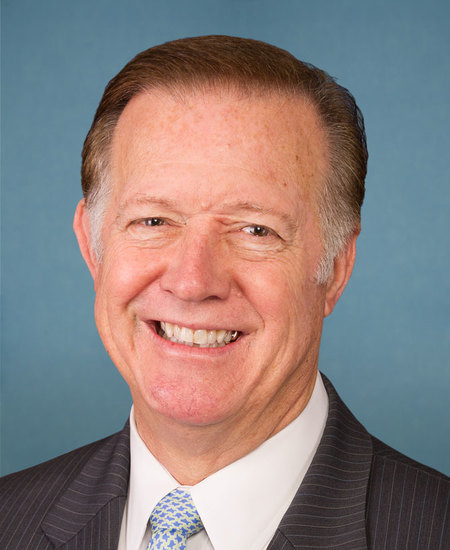
Rep. Randy K. Weber, Sr.
Sponsored bills
Maddy summaryHR 314, the FORCE Act, prohibits the President or Secretary of State from removing Cuba from the U.S. list of state sponsors of terrorism. It requires the President to first make a specific determination under the 1996 LIBERTAD Act before Cuba can be removed. The bill directly affects Cuba (by maintaining its current designation) and the executive branch (by restricting their authority to remove the designation). This is a procedural bill focused on preserving Cuba's current status on the terrorism list until the specified conditions are met.
Maddy summaryThis bill prohibits public colleges receiving federal funds under the Higher Education Act from denying religious student groups equal access to campus facilities and official recognition that is available to other student organizations. It directly affects public institutions of higher education that receive federal funding, requiring them to treat religious groups the same as secular groups regarding access to spaces and official status. The key provision states that schools cannot withhold these rights based on a group's religious beliefs, practices, speech, leadership standards, or conduct. The law aims to ensure religious student organizations have the same opportunities as non-religious groups on campus.
Maddy summaryHR 1782, the International Port Security Enforcement Act, requires the Secretary of Homeland Security to certify that foreign governments conducting port security assessments meet specific standards before those assessments can be accepted. The bill mandates that the foreign government must have followed proper assessment procedures, provided sufficient information, and not be a state sponsor of terrorism (as defined in law). If a foreign government is a state sponsor of terrorism, the Secretary must automatically treat its ports as lacking effective security measures and apply sanctions under existing law. This directly affects foreign governments operating ports, particularly those designated as state sponsors of terrorism, by imposing new certification requirements and automatic sanctions. The bill clarifies that these rules do not limit the Secretary's discretion to conduct independent assessments or request security measures.
Maddy summaryHRES 253 is a symbolic resolution introduced by House members expressing the House's opinion that Vice President Kamala Harris should be removed as the lead for the Biden administration's strategy on migration root causes. It does not create new law or policy but urges the administration to replace her with another leader and take specific border security actions like reinstating migrant protocols. The resolution cites border statistics and claims the current approach has worsened security, though it remains non-binding. It directly addresses the Vice President's role in immigration policy, not broader legislative changes. This is a procedural statement of opinion, not a bill with enforceable provisions.
Maddy summaryHR 1777 establishes a $50 million annual fund (2024-2028) for collaborative defense research between the U.S. and Israel in emerging technologies like artificial intelligence, cybersecurity, directed energy, and automation. The bill directly supports U.S. and Israeli military forces by enabling joint development of new warfare capabilities to address current and future defense challenges. Key provisions include authorizing $50 million per year for collaborative projects, building on existing U.S.-Israel defense partnerships like counter-tunnel and counter-drone systems. This funding aims to strengthen bilateral defense innovation without altering existing military aid structures.
Ensuring Lawful Collection of Hidden Assets to Provide Order Act or the EL CHAPO Act This bill requires the forfeited profits of Joaquin Archivaldo Guzman Loera (El Chapo) from his illicit drug trafficking enterprise to be reserved for border security measures between the United States and Mexico, including the completion of a wall. Additionally, it requires the forfeited funds from the felony conviction of a member of a drug cartel to be reserved for border security measures between the United States and Mexico, including the completion of a wall.
Let Experienced Pilots Fly Act of 2023 This bill raises the mandatory retirement age for pilots engaged in commercial aviation operations from 65 to 67 years of age, unless the operation takes place in (1) the territorial airspace of a foreign county where such operations are prohibited by the foreign country, or (2) international airspace where such operations are not in compliance with the Annexes to the Convention on International Civil Aviation. The Federal Aviation Administration must also submit a report to Congress on further increasing the age limitation for pilots engaged in commercial aviation operations.
Maddy summaryThe Spectrum Coordination Act (HR 1341) requires the National Telecommunications and Information Administration (NTIA) and Federal Communications Commission (FCC) to improve coordination when managing radio spectrum, directly affecting federal agencies that rely on spectrum for operations (like military, emergency services, and scientific uses). It mandates that NTIA publicly share details about spectrum actions - including impacted federal entities and any technical or policy concerns raised - before FCC decisions. The FCC must also publish an interagency summary with final rules, explaining how concerns were addressed. The bill updates the existing FCC-NTIA coordination agreement every three to four years to reflect technological changes, ensuring federal input is systematically considered in spectrum management.
Maddy summaryHR 1354, the Information and Communication Technology Strategy Act, requires the Commerce Secretary to produce a report within one year of enactment assessing the U.S. information and communication technology (ICT) supply chain. The report must identify critical technologies for economic competitiveness, evaluate U.S. and trusted vendor capacity, and analyze dependence on "untrusted" vendors (defined as companies posing national security risks under existing law). Based on this report, the Secretary must develop a government-wide strategy within 180 days to strengthen trusted ICT vendors and reduce reliance on untrusted sources. The strategy will outline specific agency roles, needed resources, and potential changes to federal programs or laws to support this goal.