

Military Spouse Licensing Relief Act of 2021 This bill provides for the portability of professional licenses of service members and their spouses who are relocated, because of military orders, outside of the jurisdiction that issued the license. Specifically, a professional license in good standing of a service member or spouse shall be considered valid at a similar scope of practice and in the discipline applied for in the new jurisdiction for the duration of such military orders. To establish and maintain eligibility, a service member or spouse must (1) provide a copy of the military orders to the licensing authority in the new jurisdiction; (2) remain in good standing with the licensing authority that issued the license; and (3) submit to the authority of the licensing authority in the new jurisdiction for the purposes of standards of practice, discipline, and fulfillment of any continuing education requirements. The bill also provides that if a service member or spouse is licensed to operate in multiple jurisdictions through an interstate licensure compact, the service member or spouse is subject to the requirements of the compact or the applicable provisions of the state law rather than the provisions of this bill.
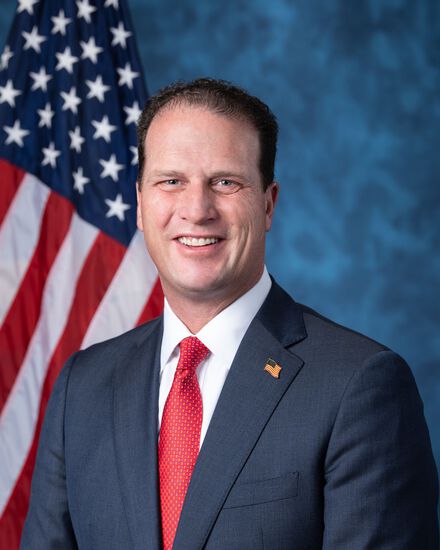
Rep. August Pfluger
Sponsored bills
This resolution condemns the unauthorized leak of a draft Supreme Court opinion concerning abortion and the related violence, property damage, and attempted intimidation of Supreme Court Justices by activists. It also encourages the enforcement of federal criminal laws that prohibit protests and picketing outside of the homes of federal judges, jurors, witnesses, and others involved in the U.S. court system.
Designates the facility of the United States Postal Service located at 5302 Galveston Road in Houston, Texas, as the "Vanessa Guillen Post Office Building."
This resolution expresses the sense of the House of Representatives that the United States should support the development of hydrocarbons via drilling, including by repealing administrative precedent that limits the exploration, drilling, and production of domestic natural resources on federal lands.
This bill prohibits the use of Department of Homeland Security (DHS) funds to carry out the activities of a Disinformation Governance Board or to establish or carry out the activities of any other DHS entity that is substantially similar to the board.
Transatlantic Telecommunications Security Act This bill directs the Department of State and other federal agencies to help certain countries improve the security of their telecommunications networks and addresses related issues. Assistance provided under this bill shall be available to projects in a country that falls below certain gross domestic product per capita thresholds and is (1) a NATO member state that shares a border with Russia, or (2) a European country that has not participated in or aided Russia's invasion of Ukraine. A project located in such a country shall be eligible for assistance if the project (1) improves telecommunications networks; (2) is inclusive, transparent, economically viable, sustainable, supplied only with secure equipment and services, and compliant with international standards and laws; and (3) does not use equipment or services from China or Russia or replaces such equipment or services. To support eligible projects, the State Department shall provide diplomatic and political support and shall also encourage international financial institutions to provide investment support. The U.S. Trade and Development Agency, the U.S. International Development Finance Corporation, and other specified federal agencies shall also provide project support, such as feasibility studies and finance-related support, as necessary. The State Department must also appoint, from among its existing personnel, an International Telecommunication Union Security Campaign Director. The director must, among other duties, lead efforts to promote candidates for elections at the International Telecommunication Union who will support and defend democratic values, internet freedom, and telecommunication security.
Aviator Cancer Examination Study Act or the ACES Act This bill requires the Department of Veterans Affairs to seek to enter into an agreement with the National Academies of Sciences, Engineering, and Medicine to study the incidence and mortality of cancer among individuals who served in the regular or reserve components of the Navy, Air Force, or Marine Corps as air crew members of a fixed-wing aircraft or personnel supporting generation of such an aircraft.
Maddy summaryThis bill prohibits using federal funds to establish a Disinformation Governance Board under the Department of Homeland Security. It directly affects the DHS by blocking any allocation of taxpayer money for creating this board. The key provision is a funding restriction that prevents the board's formation, requiring Congress to specifically authorize such spending if desired. The bill does not address disinformation policies or content, only the funding mechanism for the proposed board.
Protecting Free Speech Act This bill terminates the Disinformation Governance Board of the Department of Homeland Security (DHS) and prohibits using DHS funding for the activities of any other entity that is substantially similar to the board.
This joint resolution nullifies the rule issued by the Centers for Disease Control and Prevention on February 3, 2021, that requires the use of face masks on planes, trains, buses, and other public conveyances and at transportation hubs to prevent the transmission of COVID-19.