

Reducing Farm Input Costs and Barriers to Domestic Production Act This bill addresses various provisions related to the regulation of domestic agricultural products, including by requiring the Department of Agriculture to publish criteria for considering requests from meat and poultry establishments to operate at line speeds in excess of the current regulatory limitations. The bill also nullifies the final rule issued by the Council on Environmental Quality on April 20, 2022, that reinstated various National Environmental Policy Act regulatory provisions.
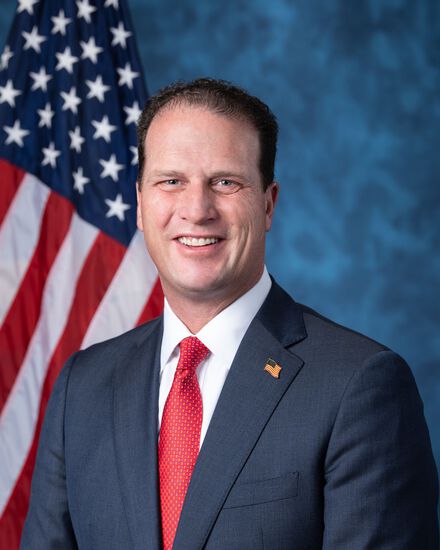
Rep. August Pfluger
Sponsored bills
Critical Minerals Classification Improvement Act of 2022 This bill permits the inclusion of fuel minerals (e.g., uranium) on a list of mineral commodities that are critical to the U.S. economy and national security. (Fuel minerals are currently excluded from the list.) Additionally, the U.S. Geological Survey must revise the list to add critical fuel minerals if it determines the revisions are necessary.
Stop Communist Construction of Public Infrastructure Act of 2022 or the Stop CCP Infrastructure Act of 2022 This bill prohibits certain entities related to China or the Chinese government from receiving federal funds for public works projects in the United States. Specifically, this prohibition applies to entities that are (1) headquartered in China; or (2) owned, financed, influenced by, or affiliated with the Chinese government, the Chinese Communist Party (CCP), or the Chinese military. Further, state and local governments must verify that a recipient for federal funds for a public works project is free from any obligations, influences, or connections to any of these entities.
Maddy summaryHRES 1166 is a symbolic House resolution condemning the May 24, 2022, mass shooting at Robb Elementary School in Uvalde, Texas, which killed 19 students and 2 teachers. It honors the victims, expresses support for the injured and affected families, and thanks first responders, without enacting new policies or requiring government action. The resolution was introduced by Texas representatives and passed unanimously by the House on June 9, 2022, as a formal expression of solidarity with the Uvalde community. As a procedural resolution, it has no legal effect but serves to publicly acknowledge the tragedy.
Stop Iranian Drones Act This bill expands existing provisions requiring sanctions against individuals or entities that provide certain types of weapons to Iran. Specifically, the bill modifies the provisions by adding unmanned combat aerial vehicles to the list of weapons covered by the sanctions. The bill also requires the Department of State to periodically report to Congress on the identities of any Iranian entity that has attacked a U.S. citizen using an unmanned combat aerial vehicle. The President must designate any such entity as a foreign terrorist organization.
Protecting American Sovereignty Act This bill prohibits the federal government from implementing any obligations upon the United States that may be contained in a draft report by a World Health Organization (WHO) working group on strengthening the WHO's preparedness and response to health emergencies. This prohibition shall also apply to any related or successor reports and recommendations regarding pandemics.
This bill requires institutions of higher education (IHEs) to disclose information regarding gifts from and contracts with China-affiliated organizations. China-affiliated organization refers to any entity that receives support directly or indirectly from the Chinese government, including certain educational institutes or programs, think tanks, and business entities. Under current law, an IHE must disclose to the Department of Education (ED) a gift or contract from a foreign source that is valued at $250,000 or more, considered alone or in combination with all other gifts from or contracts with that foreign source in a calendar year. This bill establishes a special disclosure rule relating to China-affiliated organizations. Specifically, the bill requires an IHE to disclose a gift from or contract with a China-affiliated organization that is valued at $5,000 or more, considered alone or in combination with all other gifts from or contracts with that organization in a calendar year. Additionally, the bill requires an IHE that receives federal grants to annually file a report with ED that identifies any activities conducted pursuant to a contract or other agreement between the IHE and a China-affiliated organization, including any joint research or academic exchanges. Such a contract or other agreement must be made available on a publicly accessible website of the IHE.
Halting Academic Liaisons To Our Adversaries Act or the HALT Our Adversaries Act This bill requires the Department of Defense (DOD) to identify academic institutions of China, Russia, and other countries that are known to provide support to China's People's Liberation Army or Russia's armed forces. Further, the bill prohibits an institution of higher education from receiving federal funds if it maintains a contract or other agreement with such an academic institution identified by DOD.
Preventing Racism in Medicare Act of 2022 This bill prohibits the Centers for Medicare & Medicaid Services from including the development of anti-racism plans (i.e., plans to address systemic racism in health care) as a qualifying clinical practice improvement activity under the Merit-based Incentive Payment System (MIPS), as described in a November 2021 rule. (MIPS is an incentive program under Medicare that allows health care professionals to receive payment adjustments based on certain performance measures.)
Babies Need More Formula Now Act of 2022 This bill addresses the regulation of infant formula, including by authorizing the Food and Drug Administration (FDA) to waive certain requirements related to importation. The FDA may waive labeling requirements related to the importation (or distribution or sale) of infant formula from a country with requirements that provide a similar assurance of safety as U.S. requirements. The FDA must, when appropriate, enter into arrangements to harmonize U.S. regulatory requirements pertaining to infant formula with the requirements of other nations. The bill imposes time lines for the FDA to respond to submissions for market approval for new infant formula. The FDA must also issue guidance as to what types of changes in the ingredients of infant formula, if any, may not require a new growth study to meet FDA requirements. The bill also authorizes a person to import, without prior notice to the FDA, up to a three-month supply of infant formula for personal use from a country with formula safety standards similar to U.S. standards, such as Canada. Before recommending or requiring a recall of infant formula due exclusively to a labeling deficiency, the FDA must ensure that the recall will not negatively affect the supply of formula in the United States. The bill also requires the FDA to (1) notify Congress no later than 24 hours after initiating a formula recall, and (2) provide certain information to formula manufacturers about restarting production after an inspection of a manufacturing facility impacted by a recall.