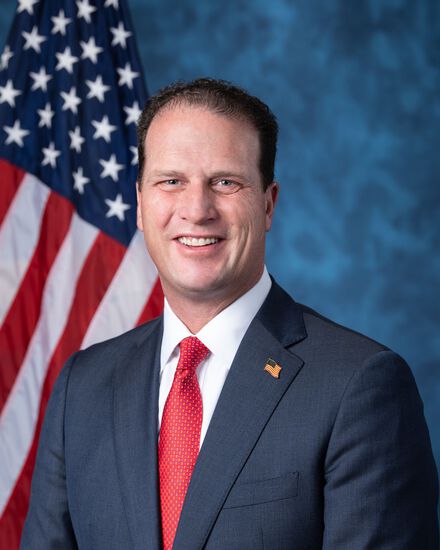
Photo of August Pfluger
R United States House · District 11 · Texas On the 2026 ballot

Rep. August Pfluger

Compare
Total votes
2,837
all sessions
Attendance
99%
37 missed
Near the chamber average
With party
96%
of cast votes
Higher than 93% of chamber peers
Bipartisan score
2%
crosses aisle rarely
Lower than 94% of chamber peers
Sponsored
1,080
bills & resolutions
Near the chamber average
Committees
6
assignments
1,080 bills and resolutions

Sponsored bills

Total
1,080
Primary
157
Co-sponsor
923
This page
1,080
matching current filters
Co-sponsor HR 3044
In committee · United States House · Co-sponsor
No Vaccine Mandates in Higher Education Act

Maddy summaryHR 3044, the "No Vaccine Mandates in Higher Education Act," prohibits federal funding from being provided to colleges and universities that require students or staff to receive a COVID-19 vaccine for enrollment, employment, or access to services. This directly affects institutions of higher education receiving federal funds, such as those participating in student aid programs. The bill's key mechanism is withholding federal funds from any institution enforcing such vaccine mandates, as defined under the Higher Education Act of 1965. The law focuses solely on vaccine requirements, not other health or safety policies.

In committee Apr 28, 2025 1 co-sponsor
Co-sponsor HR 633
In committee · United States House · Co-sponsor
TAKE IT DOWN Act

Maddy summaryThe TAKE IT DOWN Act makes it a crime to intentionally share intimate images or digital forgeries of people without their consent, with penalties of up to 2 years in prison for adults and 3 years for minors. It requires major online platforms to establish a 48-hour process for victims to request removal of such content, with platforms protected from liability when acting in good faith. The bill defines "digital forgery" as AI-generated content that appears authentic and applies to websites and apps primarily hosting user-generated content, excluding email services and broadband providers. The Federal Trade Commission will enforce these notice and takedown requirements. This legislation directly affects victims of nonconsensual intimate content, the platforms hosting such material, and individuals who distribute it.

In committee Apr 28, 2025 1 co-sponsor
Co-sponsor HRES 339
In committee · United States House · Co-sponsor
Supporting the Second Amendment's guarantee that the right of the people to keep and bear arms shall not be infringed, and commending President Trump and his administration as they work to protect Second Amendment freedoms by reviewing and eliminating any of the Biden administration's infringements on American's constitutional freedoms.

Maddy summaryHRES 339 is a non-binding House resolution supporting the Second Amendment and criticizing the Biden administration's firearm-related policies. It does not create new laws or directly affect anyone; instead, it formally disapproves of specific Biden-era actions by the Bureau of Alcohol, Tobacco, Firearms, and Explosives (ATF) and Bureau of Industry and Security (BIS) that the resolution claims restricted constitutional rights. Key provisions include condemning ATF rules limiting firearm access, BIS policies restricting firearm exports, and the Biden administration's "gun control agenda," while commending former President Trump for seeking to reverse these policies. The resolution reaffirms the constitutional right to bear arms but has no legal effect, as it is a symbolic statement of legislative opinion.

In committee Apr 17, 2025 1 co-sponsor
Co-sponsor HR 2950
In committee · United States House · Co-sponsor
Disaster Relief Transparency Act

Maddy summaryHR 2950, the Disaster Relief Transparency Act, requires the Department of Housing and Urban Development (HUD) to explain how it distributes disaster relief funds to states, tribes, territories, and local governments. Specifically, HUD must submit annual reports detailing the process for allocating funds from the Community Development Block Grant Disaster Recovery and Mitigation Programs, including why allocations may vary between funding years. The first report must be submitted within 90 days of the bill’s enactment, examining funds from fiscal years 2024 and 2025, with subsequent reports due annually. These reports aim to improve the clarity and consistency of how disaster relief funds are distributed.

In committee Apr 17, 2025 1 co-sponsor
Co-sponsor HR 2923
In committee · United States House · Co-sponsor
To nullify certain interagency guidance related to climate-related financial risk management for large financial institutions.

Maddy summaryHR 2923 would eliminate a 2023 rule requiring large financial institutions to assess climate-related financial risks. It specifically targets guidance issued by the Federal Reserve, OCC, and FDIC titled "Principles for Climate-Related Financial Risk Management." The bill states this guidance "shall have no force or effect" and prohibits those agencies from issuing similar requirements. This directly affects major banks and financial firms that would have been required to implement climate risk management practices under the repealed rule.

In committee Apr 17, 2025 1 co-sponsor
Co-sponsor HR 1288
In committee · United States House · Co-sponsor
DRIVE Act of 2025

Maddy summaryThe DRIVE Act of 2025 requires the Department of Veterans Affairs (VA) to set mileage reimbursement rates for veterans at the federal government's current standard rate for employees using personal vehicles on official business, replacing the previous fixed rate of 41.5 cents per mile. It also mandates that the VA process and pay these reimbursements within 90 days of a veteran's valid request. This directly affects veterans who travel for VA medical appointments or services using their personal vehicles. The bill aligns veteran travel reimbursements with federal employee standards and ensures timely payments.

In committee Apr 11, 2025 1 co-sponsor
Co-sponsor HR 2838
In committee · United States House · Co-sponsor
Ending Intermittent Energy Subsidies Act of 2025

Maddy summaryThis bill phases out federal tax credits for electricity generated from wind and solar power over a four-year period. It reduces the clean electricity production credit to 80% in the first year after enactment, 60% in the second, 40% in the third, and 20% in the fourth, ending at 0% after that. Similarly, it phases out the clean electricity investment credit for qualifying solar and wind facilities based on when they begin operation. These changes directly affect renewable energy producers and developers who currently claim these tax credits under the Internal Revenue Code. The bill takes effect for electricity produced or facilities placed in service after enactment.

In committee Apr 10, 2025 1 co-sponsor
Co-sponsor HR 22
Passed · United States House · Co-sponsor
SAVE Act

Safeguard American Voter Eligibility Act or the SAVE Act This bill requires individuals to provide documentary proof of U.S. citizenship when registering to vote in federal elections. Specifically, the bill prohibits states from accepting and processing an application to register to vote in a federal election unless the applicant presents documentary proof of U.S. citizenship. The bill specifies what documents are considered acceptable proof of U.S. citizenship, such as identification that complies with the REAL ID Act of 2005 that indicates U.S. citizenship. Further, the bill (1) prohibits states from registering an individual to vote in a federal election unless, at the time the individual applies to register to vote, the individual provides documentary proof of U.S. citizenship; and (2) requires states to establish an alternative process under which an applicant may submit other evidence to demonstrate U.S. citizenship. Each state must take affirmative steps on an ongoing basis to ensure that only U.S. citizens are registered to vote, which shall include establishing a program to identify individuals who are not U.S. citizens using information supplied by certain sources. Additionally, states must remove noncitizens from their official lists of eligible voters. The bill allows for a private right of action against an election official who registers an applicant to vote in a federal election who fails to present documentary proof of U.S. citizenship. The bill establishes criminal penalties for certain offenses, including registering an applicant to vote in a federal election who fails to present documentary proof of U.S. citizenship.


Passed Apr 10, 2025 1 co-sponsor
Co-sponsor HR 2784
In committee · United States House · Co-sponsor
Stopping the Theft and Destruction of Broadband Act of 2025

Maddy summaryThis bill amends federal law (18 U.S.C. § 1362) to explicitly include broadband internet access service infrastructure under protections against destruction. It directly affects entities that operate or damage broadband facilities, such as internet service providers, infrastructure owners, and individuals who might intentionally destroy such infrastructure. Key changes expand the definition of protected "means of communication" to specifically cover broadband facilities and broaden liability to include "any other person or entity" beyond government-controlled systems. The amendment removes the prior exemption for infrastructure used in "military or civil defense functions," ensuring all broadband infrastructure receives equal legal protection. This strengthens existing penalties for damaging broadband networks but does not create new regulatory requirements for service providers.

In committee Apr 9, 2025 1 co-sponsor
Primary HR 2158
In committee · United States House · Lead sponsor
Countering Transnational Repression Act of 2025

Maddy summaryThe Countering Transnational Repression Act of 2025 establishes a new Transnational Repression Working Group within the Department of Homeland Security to monitor and address threats where foreign governments or their agents target individuals in the U.S. through coercion, harassment, surveillance, or threats. The bill requires the Working Group to produce annual assessments of such incidents - including data on perpetrators, countries involved, and government responses - and share information with law enforcement partners. It mandates privacy and civil liberties safeguards, prohibits infringing on free speech, and includes a 7-year sunset provision. The law directly affects DHS operations, federal-state-local law enforcement coordination, and individuals targeted by foreign government repression tactics.

In committee Apr 9, 2025 0 co-sponsors
Showing 271 to 280 of 1,080 bills
Previous 1 … 27 28 29 … 108 Next