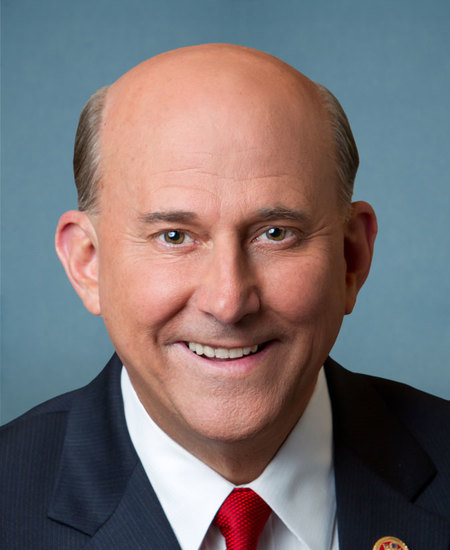
This resolution requires the Joint Committee on the Library to approve or deny the statue of Rev. Billy Graham for placement in the National Statuary Hall within 30 days after North Carolina submits (1) photographs of the statue, (2) dimensions of the statue and pedestal, (3) the final weight of the statue and pedestal, and (4) any inscriptions on the statue.
Sponsored bills
Supply Chain Emergency Response Act This bill directs the Maritime Administration to establish a program to provide grants to certain owners of cargo vessels to cover toll costs associated with rerouting cargo vessels from ports along the western seaboard of the United States through the Panama Canal to ports along the Gulf of Mexico and the eastern seaboard of the United States. To receive a grant, an owner of a cargo vessel shall submit documentation that such owner intends to reroute a cargo vessel and has the corresponding docking agreements. The bill allows states and localities to use COVID-19 relief funds for costs related to rerouting cargo vessels. Any marine terminal operator who is operating a port located along the western seaboard of the United States may not collect port fees from a recipient of a grant who has rerouted a cargo vessel from such port due to the inability of such port to receive such vessel. Any individual who is a member of the Chinese Communist Party or any company owned, in whole or in part, by the Chinese Communist Party may not receive a grant under this bill.
Maddy summaryHRES 785 is a symbolic resolution designating November 8, 2021, as "National First-Generation College Celebration Day." It urges all Americans to celebrate this day, recognize the contributions of first-generation college students (those whose parents did not earn bachelor's degrees), and honor the Higher Education Act of 1965. The resolution highlights existing federal programs like TRIO and Pell Grants that support underrepresented students but does not create new laws or funding. As a non-binding resolution, it has no direct policy impact but aims to raise awareness about first-generation students' challenges and achievements.
Veterans' Preference Parity Act This bill modifies the eligibility criteria for certain veterans to qualify for a preference in the federal hiring process. Specifically, an individual who is honorably discharged from active duty service is eligible for a veterans' preference, if the active duty service was performed for more than 180 total days (currently, consecutive days). Additionally, a retired member of the Armed Forces is eligible for a veterans' preference, even if the retiree (1) is not a disabled veteran and (2) retired at or above the rank of major or its equivalent.
This bill prohibits military departments from taking any adverse action against a member of the Armed Forces based solely on the member's refusal to receive a COVID-19 vaccination or to disclose whether they have received such vaccination.
Honoring Our Promises through Expedition for Afghan SIVs Act of 2021 or the HOPE for Afghan SIVs Act of 2021 This bill authorizes the Department of State and the Department of Homeland Security (DHS) to postpone the medical exam requirement for qualifying citizens or nationals of Afghanistan seeking entry into the United States as special immigrants. Specifically, this bill applies to an existing program that provides special immigrant status to an individual (or the spouse or child of such an individual) who (1) faithfully performed sensitive and trusted duties for the U.S. government or the International Security Assistance Force in Afghanistan on or after October 7, 2001, and (2) has experienced or is experiencing an ongoing serious threat due to the performance of those duties. Under this bill, the State Department and DHS may jointly issue a blanket waiver of any requirement for such individuals to undergo a medical exam before admission into the United States. DHS shall ensure, to the greatest extent practicable, that individuals admitted under such a waiver undergo medical exams no later than 30 days after admission into the United States. Such an individual shall be admitted as a conditional permanent resident. DHS shall remove the conditions once the individual receives and passes a medical examination.

Protecting America From Spies Act This bill expands the grounds for barring aliens who have engaged in acts relating to espionage or sabotage from entering the United States. Specifically, any alien shall be inadmissible if the alien has engaged in or will engage in an act that (1) violates a U.S. law relating to espionage or sabotage; (2) would violate any U.S. law relating to espionage or sabotage if it occurred in the United States; or (3) violates any U.S. law prohibiting the export of goods, technology, or sensitive information. Currently, an alien shall be inadmissible if the alien seeks to enter the United States to engage in such an action. Furthermore, the bill expands these grounds of inadmissibility and other security-related grounds to cover the spouse or child of the barred alien if the act occurred in the last five years. The bill also modifies the authority of the Department of Justice to waive certain security-related grounds of inadmissibility for an alien applying for a nonimmigrant visa.
Protecting Our Kids from Harmful Research Act This bill prohibits the use of federal funds for research or publications concerning gender transitions in individuals under the age of 18.
Employment Freedom for All Act This bill prohibits an employer from enforcing a noncompete agreement with an employee, or former employee, who has been fired for not receiving a COVID-19 vaccine. The Federal Trade Commission and state attorneys general are authorized to enforce this bill.
Truckers Responding At National Shipping Ports Overcoming Retail Turmoil Act or the TRANSPORT Act This bill requires the Department of Transportation (DOT) to award grants to motor carriers and motor private carriers for transporting goods from ports during declared national emergencies or when DOT determines a port is at least 50% congested. DOT may use unobligated funds available under specified COVID-19 relief laws for the grants.